Introduction
Not every ERP skill ages the same way. Some become niche within a few years as vendors consolidate or fall out of favor; others quietly become foundational to how entire industries run. Soft Online Training has watched Oracle Fusion Financials firmly land in the second category, and the reasons behind that aren't just marketing they're structural, tied to how deeply the platform has embedded itself into modern finance operations.
Understanding exactly why this particular skill has held its value and kept growing it matters if you're deciding where to invest your learning time. Here's what actually sets Oracle Fusion Financials apart from other ERP skills right now, and why solid Oracle Fusion Financials Online Training has become such a common investment for people serious about long-term career stability.
It's Built on a Genuinely Universal Business Need
Every organization, regardless of industry, needs to manage accounting, supplier payments, customer transactions, and financial reporting. That universality is exactly why Oracle Fusion Financials skills transfer so cleanly across banking, manufacturing, healthcare, retail, telecom, logistics, and government work. A specialized skill tied to one industry caps your mobility; a skill this broadly applicable doesn't.
Cloud Adoption Isn't a Trend Anymore It's the Default
A decade ago, cloud ERP was still competing against entrenched, on-premise systems companies were reluctant to abandon. That resistance has largely disappeared. Organizations are actively migrating off legacy platforms specifically because cloud systems like Oracle Fusion Financials offer better automation, cleaner reporting, and lower long-term maintenance costs. That shift isn't slowing down, which means the demand curve behind this skill isn't either.
It Sits at the Intersection of Two In-Demand Skill Sets
Oracle Fusion Financials genuinely rewards people who understand both accounting logic and system configuration a combination that's harder to find than either skill alone. Plenty of people understand finance; plenty of people understand cloud software. Fewer people understand both well enough to bridge them, which is exactly why this specific skill set commands stronger demand and often stronger pay than either half alone.
The Skill Deepens Rather Than Becomes Obsolete
Some technical skills have a shelf life tied to a specific version, a specific vendor decision, or a passing implementation trend. Oracle Fusion Financials isn't static; Oracle continuously rolls out updates, AI-assisted forecasting features, and expanded automation capabilities. That means the skill compounds over time rather than aging out professionals who keep pace with updates become more valuable, not replaced by them.
Demand Consistently Outpaces the Supply of Trained Professionals
Across most markets, the number of organizations adopting Oracle Cloud ERP has grown faster than the pipeline of professionals trained to support it. That imbalance is exactly what keeps compensation strong and hiring active even during broader economic slowdowns a level of stability not every tech skill can claim right now.
It Supports an Unusually Wide Range of Career Paths
Few ERP skills open onto as many distinct roles as this one does entry-level support and analyst positions, functional consulting, implementation and cloud consulting, business analysis, and eventually senior architecture or independent consulting work. That range means the skill doesn't lock you into one narrow career trajectory the way some highly specialized technical certifications do.
Remote and Hybrid Work Have Made It Even More Attractive
Because the entire platform is cloud-native, the roles built around it don't require physical office presence to perform well. That's opened genuine remote and hybrid flexibility across implementation, support, and analysis roles a meaningful shift for professionals who value location independence alongside career growth.
Learning It Doesn't Require Starting From Zero
Unlike some technical fields that demand years of foundational study before you're employable, Oracle Fusion Financials is genuinely approachable through structured learning. A well-built Oracle Fusion Financials Course takes someone with basic accounting fluency and builds them toward job-readiness in a matter of months, not years a rare combination of depth and accessibility.
Why Structured Training Actually Matters Here
Given how much value comes from combining accounting knowledge with real hands-on system fluency, self-teaching from documentation alone rarely closes that gap efficiently. Structured Oracle Fusion Financials Online Training with live instruction, real Oracle Cloud practice, and genuine implementation scenarios has become the more reliable route into this in-demand skill set, rather than an optional shortcut.
Why Soft Online Training
The program is built around live instructor-led classes, hands-on Oracle Cloud practice, real implementation projects, resume support, mock interviews, and placement guidance designed specifically to help learners actually capture the value this skill set currently offers, rather than learning it in a way that leaves them underprepared.
Conclusion
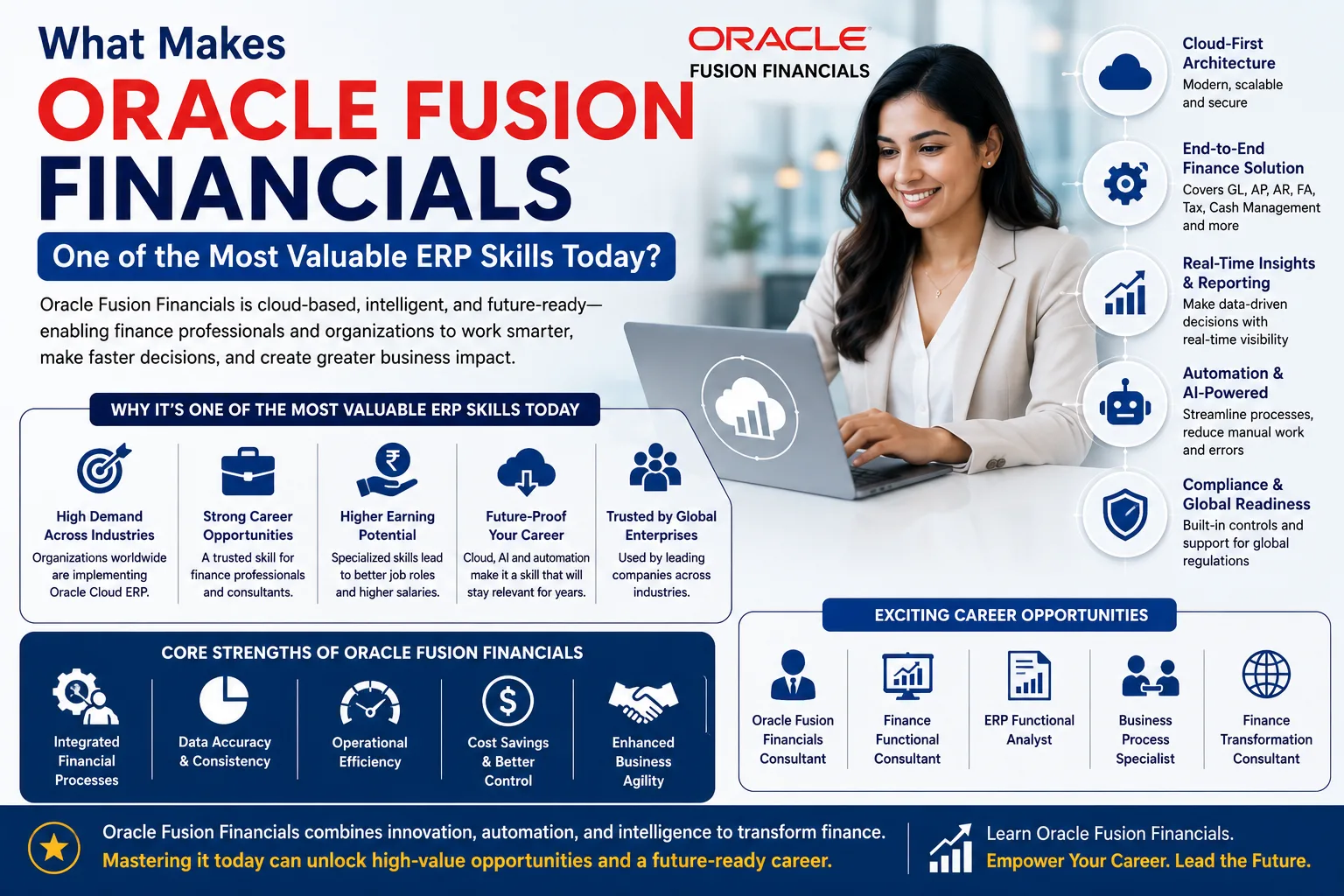
Oracle Fusion Financials has become one of the most valuable ERP skills today because it sits on a universal business need, rides a permanent shift toward cloud adoption, bridges two genuinely scarce skill sets, keeps deepening rather than aging out, and opens onto a wide range of career paths across nearly every industry. Enrolling in Oracle Fusion Financials Online Training builds the practical foundation this demand actually rewards, and a comprehensive Oracle Fusion Financials Course like the one offered through Soft Online Training gives you a structured, efficient path to actually capture that value rather than watching the opportunity pass by.