
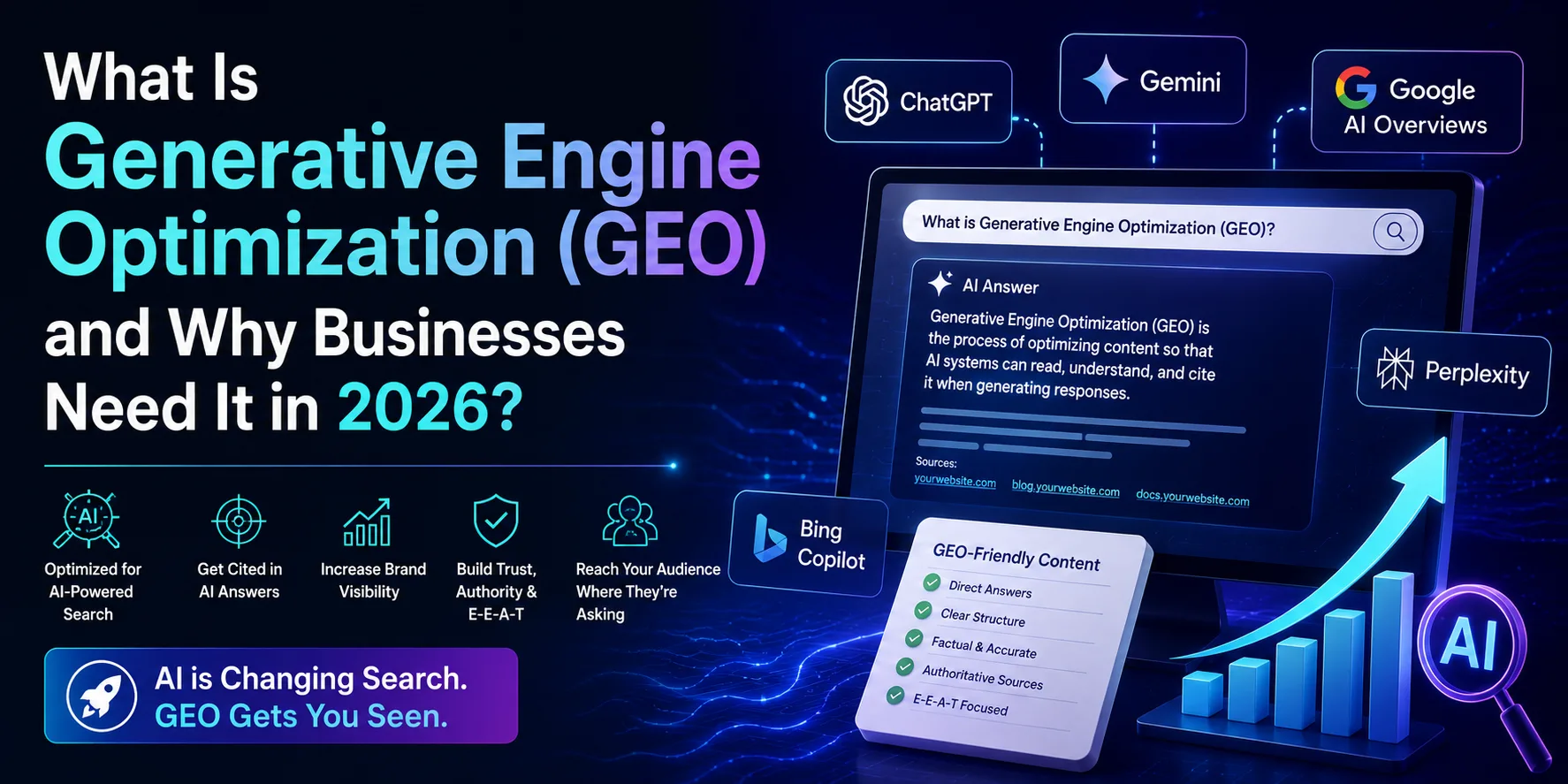
Businesses investing in AI Search Optimization are already pulling ahead in search, and the gap is growing fast. If your content isn't showing up in ChatGPT answers, Google AI Overviews, or Gemini responses, you're missing a big chunk of your audience. And unlike traditional SEO, this shift happened quietly, without much warning.
Search behavior changed. People now expect direct answers, not a list of blue links. AI tools deliver those answers by pulling from content that's clear, credible, and well structured. Getting your AI Search Ranking right is no longer optional. If your website isn't built for that, it simply won't be cited.
This post covers what Generative Engine Optimization actually is, how it's different from regular SEO, and what steps businesses, especially IT companies in the USA and India, should be taking right now.

So What Exactly Is GEO?
Generative Engine Optimization is the process of optimizing your content so that AI systems can read, understand, and cite it when generating responses. Think of it as SEO, but designed for how AI models process information rather than how search crawlers index pages.
Traditional SEO focuses a lot on backlinks, keyword density, and click through rates. GEO is more about content structure, factual accuracy, and how directly your content answers a specific question. AI models scan for answers. If your content gives them one clearly, they use it.
It's a subtle but important difference. And it's one that most businesses haven't fully adjusted to yet.
How GEO Differs From Traditional SEO
Traditional SEO and GEO share some common ground. Both reward quality content, good site structure, and trustworthy information. But they diverge in a few key areas.
With traditional SEO, you're optimizing for a ranking position on a results page. With GEO, you're optimizing to be included inside an AI generated answer. That means the format of your content matters as much as the content itself.
Short paragraphs, clear headings, direct answers near the top of each section, these things all help AI models extract and use your content. Long winded explanations, buried answers, and vague language tend to get skipped over.
Also worth noting: GEO is platform agnostic. You're not just optimizing for Google. ChatGPT, Perplexity, Bing Copilot, and other AI tools all pull content differently. But they all share a preference for clarity and authority.
Why AI Search Ranking Matters More Than Ever in 2026
User behavior is shifting fast. More people are using AI tools to research products, compare services, and make decisions. If your brand isn't showing up in those AI generated answers, a competitor who has done the work probably is.
This is especially relevant for IT companies. The audience searching for software solutions, cloud platforms, or development services is already tech savvy. They're using AI tools daily. And they trust the answers those tools provide.
Strong AI Search Ranking doesn't happen by accident. It's not just about writing good content. It's about making sure that content is structured, formatted, and positioned in a way that AI models can actually use.
What Good GEO Looks Like in Practice
Here's a straightforward breakdown of what strong GEO focused content includes:
Direct answers. If someone asks "what is GEO," your content should answer that clearly within the first few lines of the relevant section.
Factual and specific information. AI models favor content that cites real data, uses specific language, and avoids vague claims.
Clean structure. Use headings, short paragraphs, and logical flow. Avoid walls of text.
Author credibility. Make it clear who wrote the content and what gives them the authority to speak on the topic. E-E-A-T still matters here.
Consistent updates. Outdated content loses trust fast, both with users and AI systems.
These aren't dramatic changes for most content teams. But they do require a shift in how content is planned and reviewed.
The Role of AI Search Optimization in a Modern SEO Strategy
AI Search Optimization is not a replacement for traditional SEO. It's an extension of it. Businesses that already have solid SEO foundations, clean site structure, fast load times, and quality content, are in a good position to build on that with GEO.
The businesses that struggle are the ones who treat content as a checkbox. If you're publishing just to have something on the page, AI systems will pass right over it. But if your content genuinely answers questions and demonstrates real knowledge, you're already ahead of most.
AI Search Optimization works best when it's treated as an ongoing process, not a one time fix. Review your top pages regularly, update outdated information, and keep the structure clean.
Final Thoughts
Search in 2026 rewards businesses that write with clarity and purpose. Generative Engine Optimization is one of the more practical ways to stay visible as AI tools become a bigger part of how people find information. It's not complicated, but it does take consistency. For more information, contact NotionX, your all in one platform solution partner.