
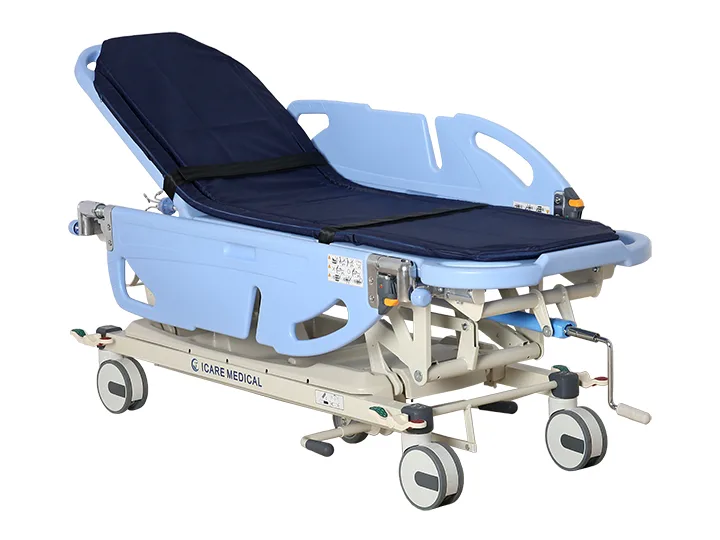
What is an emergency bed used for?
An emergency bed is used for patient transport within hospitals, emergency resuscitation, ICU critical care, and pre-hospital ambulance transport. It combines mobility, rapid adjustment, and imaging compatibility to support emergency medical workflows.
What is the difference between an emergency bed and a hospital bed?
Emergency beds prioritize mobility and rapid procedural access for short stays (hours to days). Hospital beds prioritize patient comfort for multi-day stays. Emergency beds feature hydraulic/electric height adjustment, central braking, and X-ray transparent boards - features absent in standard hospital beds.
What features should I look for in an emergency bed?
Five must-have features: (1) hydraulic or electric height adjustment, (2) central braking system, (3) X-ray transparent board (for imaging compatibility), (4) Trendelenburg positioning, and (5) 200-300 kg load capacity. Premium models add lateral turning and CPR quick-release.
How much does an emergency bed cost?
Emergency bed prices range from USD 1,800 for basic manual-hydraulic models (CC-800) to USD 4,500 for flagship electric-hydraulic models with carbon fiber X-ray boards (CC-806). Bulk pricing offers 15-30% discount for 10+ units.
What is a rescue bed?
A rescue bed is an older term for emergency bed, originally referring to mobile stretchers used in rescue operations (ambulance, military, disaster response). Today, "emergency bed" and "rescue bed" are used interchangeably in clinical contexts.
Can emergency beds be used in ICUs?
Yes. Premium emergency beds (CC-805, CC-806) serve dual purposes - emergency transport and ICU critical care. Their imaging compatibility and rapid adjustment make them ideal for ICU patients requiring frequent procedures. However, dedicated ICU beds (CD-805) offer more comfort for long ICU stays.
Emergency bed definition: A mobile treatment bed with hydraulic/electric adjustment, central brake, and imaging compatibility for emergency and critical care settings.
Not the same as a hospital bed: Hospital beds prioritize patient comfort for long stays; emergency beds prioritize mobility, rapid adjustment, and procedural access.
4 core use cases: ER triage and resuscitation, ICU critical care, intra-hospital patient transport, and pre-hospital ambulance transport.
5 must-have features: Hydraulic or electric height adjustment, central braking system, X-ray transparent board, Trendelenburg positioning, 200-300 kg load capacity.
8 ICARE models: From CC-800 (USD 1,800) to CC-806 (USD 4,500) covering basic transport to flagship ICU emergency stretchers.
Pediatric variants exist: CC-802 is sized for children with pediatric-specific side rails and dimensions.
Imaging compatibility: Premium models (CC-805, CC-806) feature carbon fiber boards for DR, CT, and MRI compatibility without patient transfer.
An emergency bed is a mobile, rapidly adjustable patient bed designed for emergency medical care, intra-hospital transport, and short-stay critical care. It differs from a standard hospital bed in prioritizing mobility, procedural speed, and imaging compatibility.
When choosing an emergency bed, match the model to your clinical setting: CC-800 for budget clinics, CC-801 series for general ERs, CC-805/CC-806 for trauma centers and ICUs, and CC-802 for pediatric facilities.
ICARE manufactures 8 emergency bed models under ISO 13485, with options for every clinical need and budget. Browse the complete emergency bed lineup or compare models in detail.