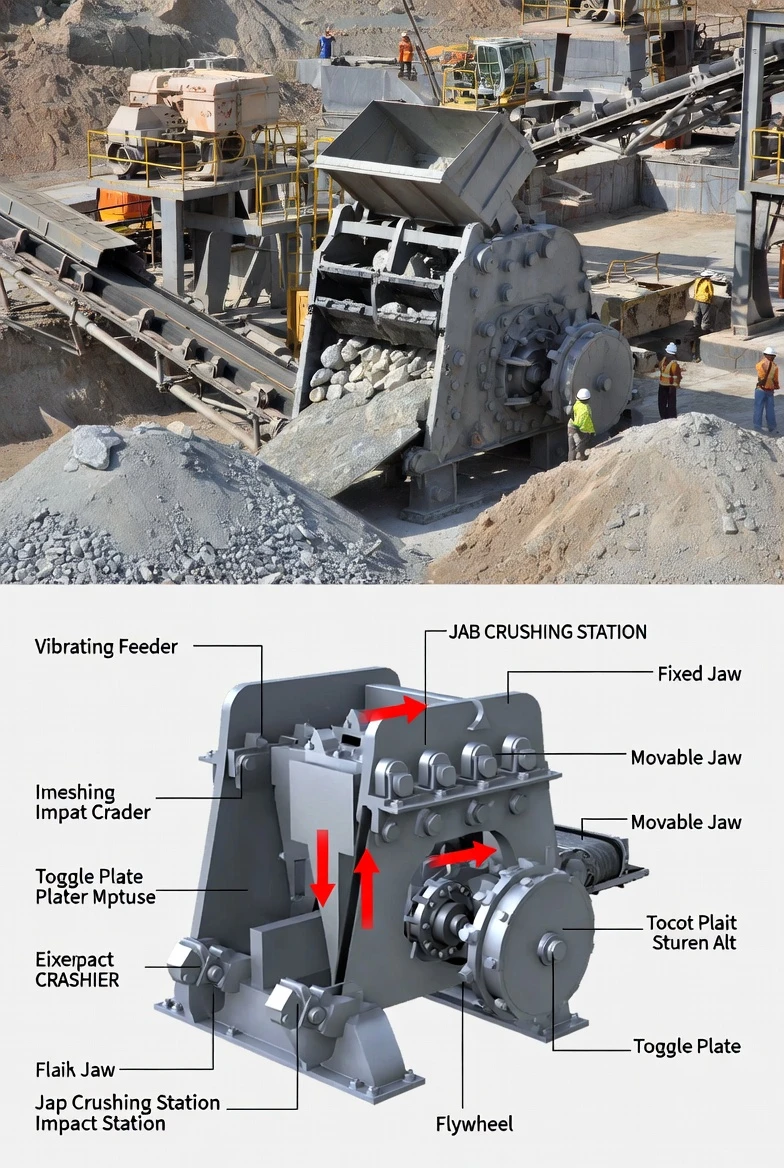
A jaw crushing station (also called a jaw crusher plant or primary jaw crushing unit) is one of the most important and widely used pieces of equipment in quarries, mines, construction sites, recycling plants, and aggregate production facilities.
It serves as the first stage (primary crushing) in most rock processing lines — reducing large, raw stones and boulders into smaller, manageable sizes so they can be further processed by secondary and tertiary crushers, screens, or conveyors.
Jaw crushing stations are especially popular because of their simple structure, high reliability, low operating cost, and ability to handle very hard and abrasive materials such as granite, basalt, limestone, river gravel, concrete, and d emolition waste.
Main Components of a Jaw Crushing Station
A typical modern jaw crushing station consists of:
- Vibrating feeder (to regulate and pre-screen material)
- Hopper
- Fixed jaw plate (stationary)
- Movable jaw plate (swinging)
- Eccentric shaft & flywheels
- Toggle plate & toggle seat
- Hydraulic or mechanical adjustment system (for setting the discharge gap)
- Motor & V-belt drive system
- Frame / chassis (fixed, wheeled, or crawler-mounted)
How a Jaw Crusher Works – Step by Step
- Material Feeding Large rocks or feed material are dumped into the hopper by an excavator, wheel loader, or dump truck. The vibrating feeder then evenly delivers the material into the crushing chamber.
- Crushing Chamber The material falls between the fixed jaw (stationary) and the movable jaw (which moves back and forth).
- Crushing Action The eccentric shaft rotates, driven by the motor. This causes the movable jaw to move in an elliptical motion — crushing the rock against the fixed jaw during the forward stroke (compression phase) and releasing it during the backward stroke.
- Toggle Mechanism The toggle plate acts as a safety device and also transmits the crushing force. It helps create the necessary leverage for powerful compression.
- Discharge Once the material is small enough to pass through the set discharge opening (CSS – Closed Side Setting), it falls out the bottom and is conveyed to the next stage (screening, secondary crushing, etc.).
- Adjustment of Output Size The discharge gap (and therefore product size) can be easily adjusted using:
- Hydraulic cylinders (modern stations)
- Wedge system
- Shim plates
Advantages of Jaw Crushing Stations
- Handles very large feed sizes (up to 1,500 mm in large models)
- Excellent for hard and abrasive materials
- Simple maintenance and low spare parts cost
- High crushing ratio (usually 4:1 to 6:1)
- Available in fixed, wheeled, and crawler (mobile) versions
- Long service life when properly maintained
Common Jaw Crushing Station Applications
- Primary crushing in quarries and aggregate plants
- Mining (limestone, granite, iron ore, etc.)
- Recycling of concrete, asphalt, and construction waste
- Road base and railway ballast production
- Mobile crushing projects (crawler-mounted jaw stations)
Here are two powerful visual examples showing a real jaw crushing station in operation and its key working mechanism:
Want to learn more about modern jaw crushing stations — including mobile/crawler types, specifications, and real-world performance?
👉 Read the full guide → What Is a Jaw Crushing Station and How Does It Work?