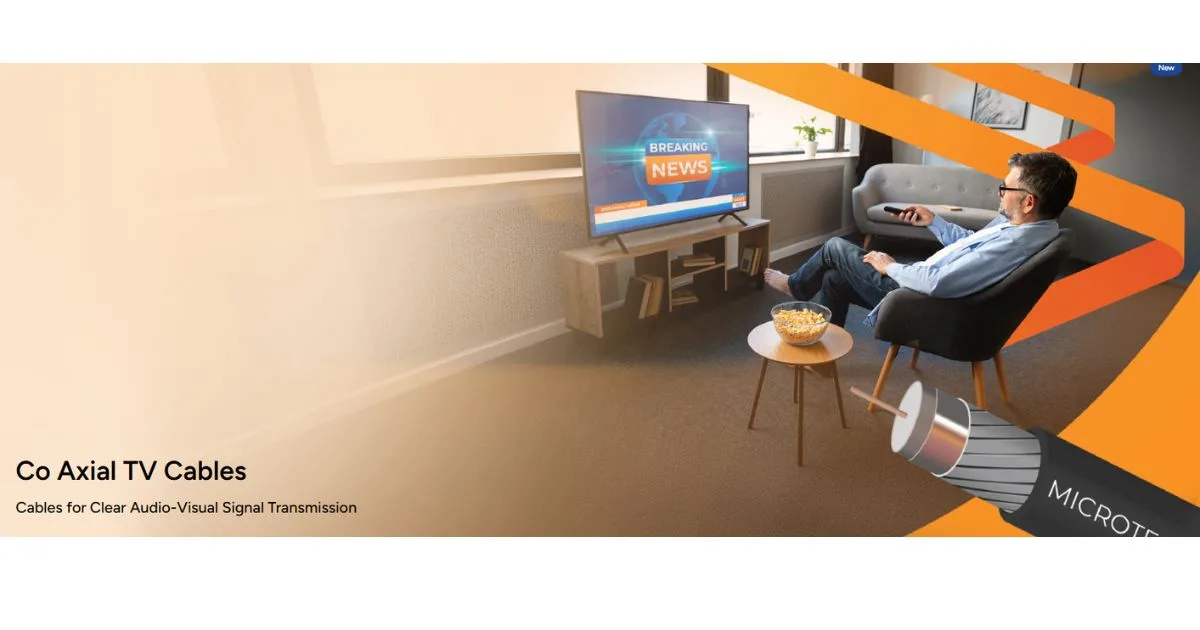
The round connector at the back of a television set, the cable threading from a dish antenna into a set-top box, the connection point on a cable modem: most people have handled coaxial connections many times without necessarily thinking about what was making them different from other types of cable connections or why they are built the way they are.
The design of a coaxial cable connector is not arbitrary. It follows directly from the physics of what the cable is carrying and from the specific problem that coaxial construction was developed to solve, which is how to carry high-frequency signals across a cable run without losing them to resistance along the way or picking up interference from other electrical sources in the environment.
Understanding why coaxial cables and connectors work the way they do is genuinely useful for anyone dealing with signal distribution in a home or office context because the decisions that affect signal quality, picture quality in a television installation, data reliability in a cable network, are often connector decisions as much as cable decisions. A well-chosen cable with a poorly fitted or mismatched connector does not perform as well as the cable's specifications suggest it should.
The Construction That Makes Coaxial Different
A coaxial wire cable has a layered concentric structure that is what gives it both its name and its signal-carrying properties. At the centre sits a single conductor, solid or stranded, that carries the signal itself. Surrounding that conductor is a layer of dielectric insulating material that maintains a precise and consistent spacing between the inner conductor and what comes next. Around the dielectric is a second conductor, typically a woven braid, a foil layer or a combination of both, that serves simultaneously as a shield against external interference and as the return path for the signal. Around all of this is an outer jacket that protects the construction from its physical environment.
The key characteristic of this arrangement is that the outer conductor completely surrounds the inner conductor along the entire length of the cable. This geometry contains the electromagnetic field associated with the signal being carried within the cable itself rather than allowing it to radiate outward and it shields the inner conductor from external electromagnetic fields that would otherwise corrupt the signal. The result is that a coaxial network cable can carry high-frequency signals reliably across meaningful distances even in environments with significant electrical interference from other equipment, which is precisely the environment that most buildings present.
What the Connector Has to Maintain
The coaxial cable connector at each end of a cable run has to maintain the essential properties of the coaxial structure through the transition from cable to device and this is a more demanding requirement than it might initially appear. The transition point is exactly where the carefully maintained geometry of the cable is interrupted and where the signal is most vulnerable to the kind of reflection and loss that a poorly designed or incorrectly fitted connector introduces.
The electrical property that the connector must maintain through this transition is impedance, the relationship between the electrical characteristics of the inner conductor and the outer conductor that is set by the dielectric material and geometry of the cable. For standard television and satellite coaxial wire cable the impedance is typically 75 ohms.
When the connector presents a different impedance at the transition point, whether through poor design, incorrect specification or inadequate installation, part of the signal reflects back along the cable rather than passing through to the device. In a television installation this shows up as interference or degraded picture quality. In higher-frequency applications like satellite signals or broadband cable the effect is more pronounced and more consequential for performance.
The Connector Types That Appear Most Often
Several connector types are common enough in Indian residential and commercial installations to be worth being familiar with. The F-type connector is the standard for domestic television and satellite applications, the screw-thread type that connects set-top box cables and dish antenna runs and the one most people will encounter in a home context. The BNC connector uses a quarter-turn bayonet locking mechanism rather than a thread and appears in professional video, broadcast and technical measurement applications where a secure connection that can be made and released quickly is valuable. The N-type connector is a larger threaded type used in higher-power and outdoor antenna applications where the physical robustness of a larger connector is warranted.
Within each connector type there is meaningful variation in manufacturing quality that affects both the electrical performance and the longevity of the connection particularly in outdoor installations where weathering degrades lower-quality connector materials faster than the cable itself. Microtek's range of coaxial cable connectors is specified for the signal types and installation conditions they are intended for rather than being generic components applied across applications indiscriminately.
FAQs
- What is a coaxial cable connector and what does it actually do?
Ans. It is the termination fitting at each end of a coaxial cable that connects the cable to a device while maintaining the electrical characteristics of the cable, particularly the impedance, through the connection point so the signal passes cleanly without reflection or loss.
- Why does impedance matching matter in coaxial connections?
Ans. When the connector impedance matches the cable impedance the signal passes through the connection cleanly. A mismatch causes partial reflection of the signal back along the cable which results in signal loss and can introduce interference that degrades reception or data reliability.
- What is the difference between an F-type and a BNC connector?
Ans. F-type connectors use a threaded coupling and are standard for domestic television and satellite applications. BNC connectors use a quarter-turn bayonet locking mechanism and are more common in professional video and technical applications where quick and secure connection and disconnection is needed.
- Can I use any coaxial connector with any coaxial cable?
Ans. The connector needs to match both the physical diameter of the cable and the impedance specification. Most domestic television and satellite coaxial wire cable in India is 75 ohm impedance and the connectors used should be rated to the same impedance specification.
- Does connector quality affect signal performance in a television or satellite installation?
Ans. Meaningfully yes particularly at the higher frequencies used for satellite signals. A poorly manufactured connector or one that is incorrectly fitted introduces impedance mismatch and can allow moisture or physical damage to affect the connection over time both of which degrade signal quality.