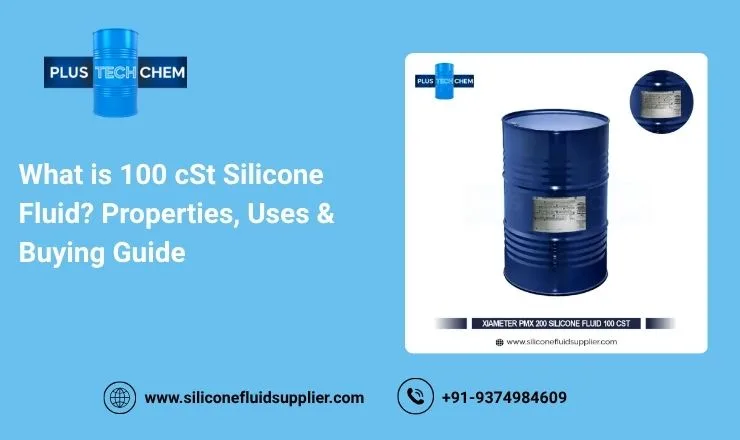
You’re comparing Xiameter OFX 0193 Fluid against other grades, and someone casually says “100 cSt is standard.” That’s where most procurement mistakes begin.
Because 100 cSt Silicone Fluid sounds generic. It isn’t. The difference between a stable batch and one that gums up your process often comes down to how that viscosity behaves under heat, shear, and contamination — not just the number on the datasheet.
Most buyers assume viscosity = performance. That assumption costs money.
And yet, 100 cSt sits in a very specific operating window — widely used, yes, but also widely misapplied. If you're sourcing Xiameter PMX 200 Silicone Fluid 100 cst or any equivalent Silicone Oil, you need to understand what you're actually paying for.
SPECIFICATION
Viscosity Isn’t Just a Number — It’s a Stability Indicator
100 cSt (centistokes) refers to kinematic viscosity at 25°C. That’s the baseline.
But here’s what rarely gets discussed: good Silicone Fluid maintains viscosity within ±5% across temperature swings, while low-grade material can drift 12–15%. That difference shows up in lubrication failure or inconsistent coating thickness.
Which means your “100 cSt” might behave like 85 cSt at 80°C — and nobody tells you until production slips.
Thermal and Dielectric Performance
A typical Silicone Dielectric Fluid in this range offers:
- Thermal stability up to ~200–230°C continuous
- Flash point above 300°C
- Dielectric strength around 35–40 kV/mm
Here’s the overlooked detail: moisture contamination above 200 ppm can drop dielectric strength by nearly 18%. Most suppliers don’t even mention moisture limits unless you ask.
Molecular Structure and Purity
Not all Silicone Oil is equally refined.
Higher purity fluids (≥99.5%) show:
- Lower volatility (<1.5% weight loss at 150°C for 24 hrs)
- Reduced residue formation
- Better oxidation resistance
A supplier quoting only viscosity without volatility data is hiding something.
Compatibility and Surface Behavior
100 cSt fluids are widely used for:
- Release agents
- Textile finishing
- Electrical insulation
- Lubrication systems
But surface tension matters. A difference of even 2–3 dyn/cm can affect coating uniformity on metals or polymers.
OBJECTIVE: HOW TO EVALUATE A SUPPLIER WITHOUT REGRET
1. Batch Consistency Over 6 Months
Ask for historical batch variation data.
Bad answer: “Our quality is stable.”
That’s not data. That’s a sales line.
2. Moisture and Volatility Disclosure
You need exact ppm values and test methods.
Bad answer: “Within acceptable range.”
That phrase has wrecked more shipments than delayed customs clearance ever has.
3. Export Packaging Standards
Look for drum lining type, nitrogen blanketing, and sealing method.
Bad answer: “Standard drums.”
Standard where? India? EU? Each has different expectations.
4. Certification Validity — Not Just Presence
ISO certification matters, but expiry and scope matter more.
Bad answer: “ISO certified.”
Without a valid certificate copy, that claim is useless.
5. Lead Time Reliability
Ask for actual dispatch logs, not promises.
Bad answer: “7–10 days.”
If they can’t show past shipments hitting that window, assume 14–18 days in reality.
BENEFITS: WHY 100 cSt FLUID MAKES SENSE (WHEN USED RIGHT)
1. Predictable Thermal Behavior = Fewer Shutdowns
A stable Silicone Fluid reduces viscosity drift, which directly prevents overheating in closed systems.
2. Lower Evaporation Loss = Cost Control
High-grade fluids lose <1.5% weight under heat testing. That directly impacts refill frequency and operating cost.
3. Electrical Safety Margin
In transformer or insulation use, Silicone Dielectric Fluid provides higher breakdown resistance than mineral oils, especially under fluctuating loads.
4. Surface Uniformity in Coating
Consistent spreadability reduces rework in textile and mold-release applications.
5. Oxidation Resistance Extends Equipment Life
Less sludge formation means fewer maintenance cycles — something maintenance teams track closely after the first failure.
6. Wide Application Flexibility
From OEM lubrication to process industries, 100 cSt hits a balance that thicker or thinner grades can’t match easily.
AVAILABILITY: WHY LOCATION CHANGES MORE THAN PRICE
In Gandhinagar, Gujarat, suppliers benefit from proximity to major ports like Mundra and Kandla. That cuts export transit time by 2–4 days compared to inland manufacturers.
Which means faster turnaround for international buyers — especially those sourcing from Silicone Fluid Manufacturers in India.
Here’s the catch: not every Silicone Oil Manufacturer in Gujarat maintains export-grade storage. Temperature-controlled warehousing is still inconsistent across mid-sized players.
And that affects product stability before it even leaves the facility.
ABOUT US
We’re Plustech Chem, and we’ve been supplying Silicone Oil and specialty fluids to buyers across 31 countries — not as traders, but as people who’ve dealt with rejected containers and urgent air shipments.
We still remember a 2022 shipment where a client flagged viscosity drift after 45 days in storage. We traced it back to a drum sealing issue, changed the supplier, and haven’t repeated that mistake since.
That’s how we operate — fix the problem, not the narrative.
WHAT YOU SHOULD SEND BEFORE ASKING FOR A QUOTE
If you're sourcing Xiameter OFX 0193 Fluid or Xiameter PMX 200 Silicone Fluid 100 cst, don’t just ask for price.
Send us:
- Required quantity (MOQ starts at 200 kg)
- Application (lubrication, dielectric, coating, etc.)
- Operating temperature range
- Packaging preference (drum, IBC)
We respond within 24 hours with actual specs, not placeholders.
CONCLUSION
100 cSt Silicone Fluid sits in a narrow performance band — and that’s exactly why it works when specified correctly. Whether you’re evaluating Xiameter OFX 0193 Fluid or alternatives, the real difference lies in consistency, not just viscosity. Buyers who focus only on price usually end up paying for instability later. The smarter approach is already shifting toward data-backed procurement — and that trend isn’t slowing down.
FAQs
1. What is Xiameter OFX 0193 Fluid used for?
It’s typically used in industrial applications like coatings, release agents, and lubrication systems where stable viscosity and thermal resistance matter.
2. How is Xiameter PMX 200 Silicone Fluid 100 cst different from generic Silicone Oil?
The difference comes down to purity, volatility, and consistency. Generic oils may match viscosity but often fail in long-term thermal stability.
3. How do I choose reliable Xiameter OFX 0193 Fluid Manufacturers?
Look for batch data, export history, and moisture control. Many Xiameter OFX 0193 Fluid Manufacturers claim consistency but can’t prove it.
4. Are Silicone Fluid Manufacturers in India suitable for export?
Yes, but not all. Some Silicone Fluid Manufacturers meet global standards, while others struggle with packaging and documentation compliance.
5. What do Silicone Oil Manufacturers usually not disclose?
Moisture content and volatility. Many Silicone Oil Manufacturers avoid sharing this unless specifically asked.
6. Is Silicone Dielectric Fluid better than mineral oil?
In high-temperature and electrical environments, yes. But it costs more, and not every application justifies the switch — that’s where buyers need to be careful.
7. Can I use 100 cSt Silicone Fluid across multiple applications?
You can, but performance may vary. A single grade rarely performs perfectly across all use cases — compromise is part of the decision.