Nobody plans for the moment a doctor says "your parent can go home, but they'll need an oxygen concentrator." Or a hospital bed. Or a suction machine. It usually arrives suddenly, after a discharge decision, with a family that has 24 hours to figure out a piece of equipment they've never used, from a provider they've never heard of.
Medical equipment rental has become one of the most searched home healthcare queries in Indian cities over the past few years. The demand makes sense. Home care is more comfortable than extended hospital stays, often more cost-effective, and increasingly preferred by families managing recovery or chronic illness at home. But most people searching for equipment rental are doing it in a stressful moment, without much guidance on what to check before they book.
This piece covers the questions families should ask — and the ones they usually forget — before renting medical equipment at home.
The Decision to Rent vs Buy Is Simpler Than It Sounds
The first thing most families wrestle with is whether to rent or buy. It feels like a financial decision, but it's really a duration question.
For recoveries with a clear endpoint — post-surgery, post-COVID respiratory support, short-term mobility aid after a fracture — renting almost always makes more sense. Equipment returns when the need ends. No storage problem, no resale headache, and the monthly cost is a fraction of the purchase price. A hospital bed, for instance, costs anywhere from ₹15,000 to ₹60,000 to buy outright. On rent, the same bed typically runs between ₹2,000 and ₹7,000 per month depending on whether it's manual or motorized.
For chronic, long-term needs — a family member with permanent mobility limitations, a patient requiring continuous oxygen support indefinitely — the calculation shifts. After 12 to 18 months, the cumulative rental cost often approaches or exceeds the purchase price. In those cases, buying makes financial sense, though a rental still helps bridge the gap while the family evaluates longer-term options.
The honest answer most providers won't tell you: start with a rental, review after three months, and only purchase if the need has clearly stabilised.
What Equipment Is Actually Available on Rent
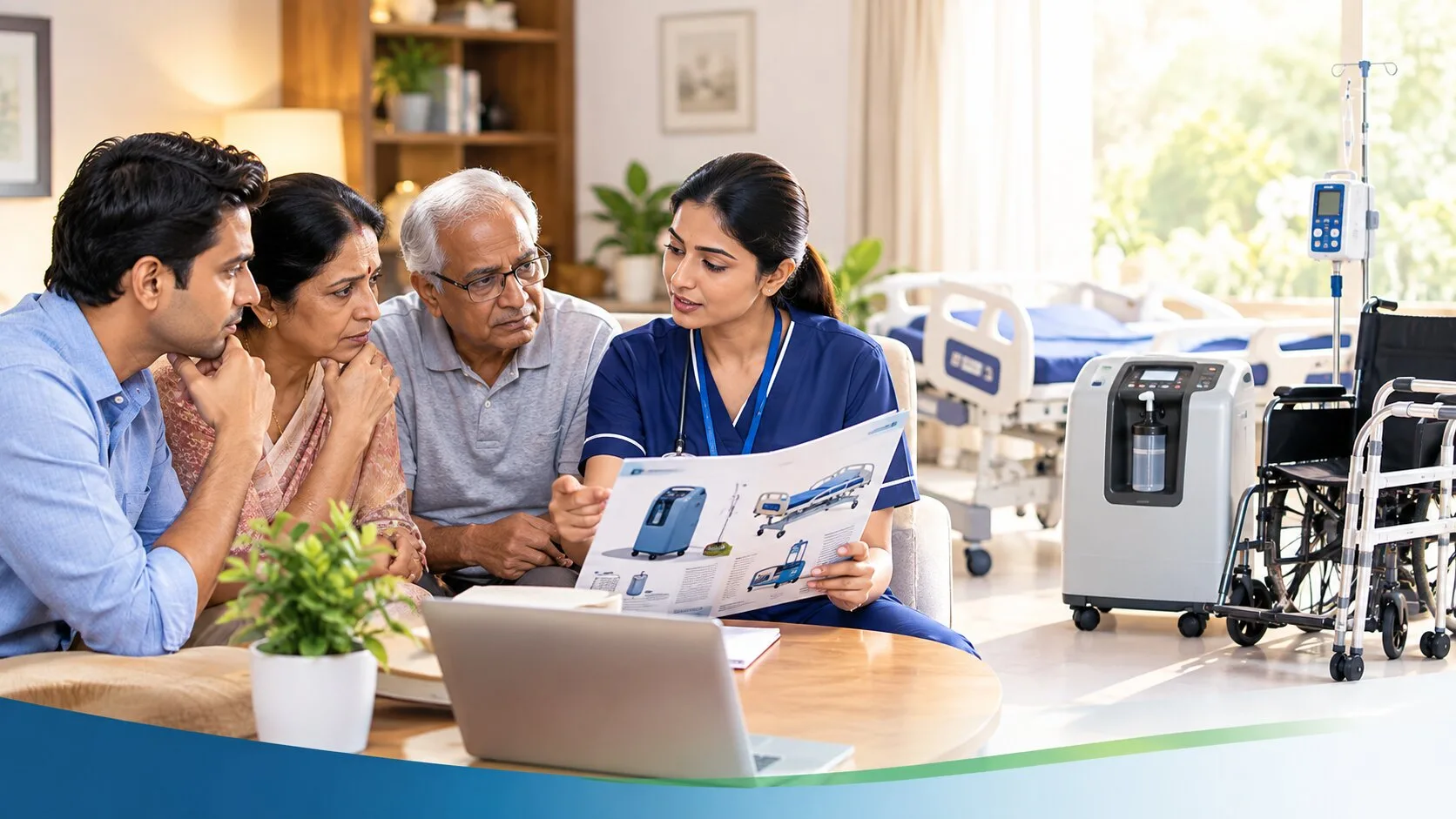
The range is wider than most families realise. The most commonly rented items in Indian home healthcare are oxygen concentrators, hospital beds, wheelchairs, BiPAP and CPAP machines, suction machines, air mattresses for bedridden patients, walkers and commodes, and patient monitors.
For post-surgery or more medically complex recoveries, the list extends to feeding pumps, DVT pumps for post-operative clot prevention, and in some cases ventilator support at home. Families navigating a serious discharge — a patient coming home from the ICU, for example — often need a combination of equipment rather than a single device. Understanding what a home ICU setup actually involves before the discharge day is one of the most practical things a family can do to reduce the panic of that first 48 hours at home.
Phototherapy units for newborn jaundice are another frequently overlooked category. Many parents don't know these are rentable, and end up extending a hospital stay unnecessarily.
What to Check Before You Book
This is where most families make mistakes. Not because they're careless, but because the questions that matter aren't obvious until something goes wrong.
Is the Equipment Sanitised and Tested?
Every reputable provider sanitises equipment between rentals. Ask directly. For respiratory devices especially — oxygen concentrators, BiPAP machines — contamination is a real risk if the equipment hasn't been properly cleaned. A good provider will tell you exactly what their sanitisation process is. A hesitant or vague answer is a reason to look elsewhere.
Does the Rental Include Installation and Setup?
Delivery and installation are not the same thing. Some providers drop equipment at the door. Others send a technician who sets it up, demonstrates usage, and confirms the device is functioning correctly before they leave. For families with no medical background managing equipment like a suction machine or BiPAP, that difference matters enormously. Confirm what's included before you pay.
What Happens if the Equipment Fails?
This question almost never gets asked, and it's the one that matters most at 2 a.m. when an oxygen concentrator stops working. Does the provider have a replacement policy? How quickly can they respond? Is there a helpline? For life-support equipment, the answer to this question should be part of the booking conversation, not something you find out in an emergency.
Is a Doctor's Prescription Required?
For most life-support devices — oxygen concentrators, BiPAP machines, ventilators — a doctor's prescription is either required or strongly recommended. It protects the patient (usage parameters are device-specific and medically determined) and it protects the family if insurance is involved. Many health insurance policies in India now cover equipment rentals under domiciliary or home hospitalisation benefits. Having the prescription ready also speeds up the claim process considerably.
The Locality Question Most Families Underestimate
Response time matters more than price for emergency-use equipment. A provider based 40 kilometres away may offer a slightly lower rate, but if a same-day delivery or a next-morning replacement is ever needed, that distance becomes a problem.
For families in South Kolkata — Joka, Behala, Thakurpukur, New Alipore, Tollygunge — the practical choice is a provider who operates locally, knows the area, and can commit to a specific delivery window. Hyperlocal providers also tend to have better follow-up: they're more reachable, more accountable, and more likely to send someone in person if something needs adjusting. National platforms can offer competitive pricing, but their service infrastructure in any given neighbourhood is often thinner than it appears.
Medilink Healthcare Services provides medical equipment rental across South Kolkata, with same-day delivery for most items and a support line available for families managing equipment at home. For families in this area, having a locally based provider is worth more than a marginal cost saving from a larger platform.
The Conversation Nobody Has Before Discharge
Discharge planning in Indian hospitals is improving, but it's still inconsistent. Families are often told their loved one is ready to go home on short notice, given a list of equipment to arrange, and left to figure out the logistics themselves.
The most useful thing a family can do is have this conversation with the treating doctor before discharge day: what equipment will we need, for how long, and what should we watch for at home? The answers shape what to rent, what questions to ask the provider, and what kind of professional support might be needed alongside the equipment.
Equipment solves the physical care problem. It doesn't replace skilled observation, medication management, or the judgment that comes from a trained caregiver or nurse. For families taking on both — the equipment and the care — understanding where one ends and the other begins is what makes home recovery genuinely safe rather than just logistically possible.
---
**Author Bio**
This article was written with input from the Medilink Healthcare Services care team, a home healthcare provider based in South Kolkata offering nursing care, caregiver support, physiotherapy, and medical equipment rental to families across Joka, Behala, Thakurpukur, and surrounding areas.