
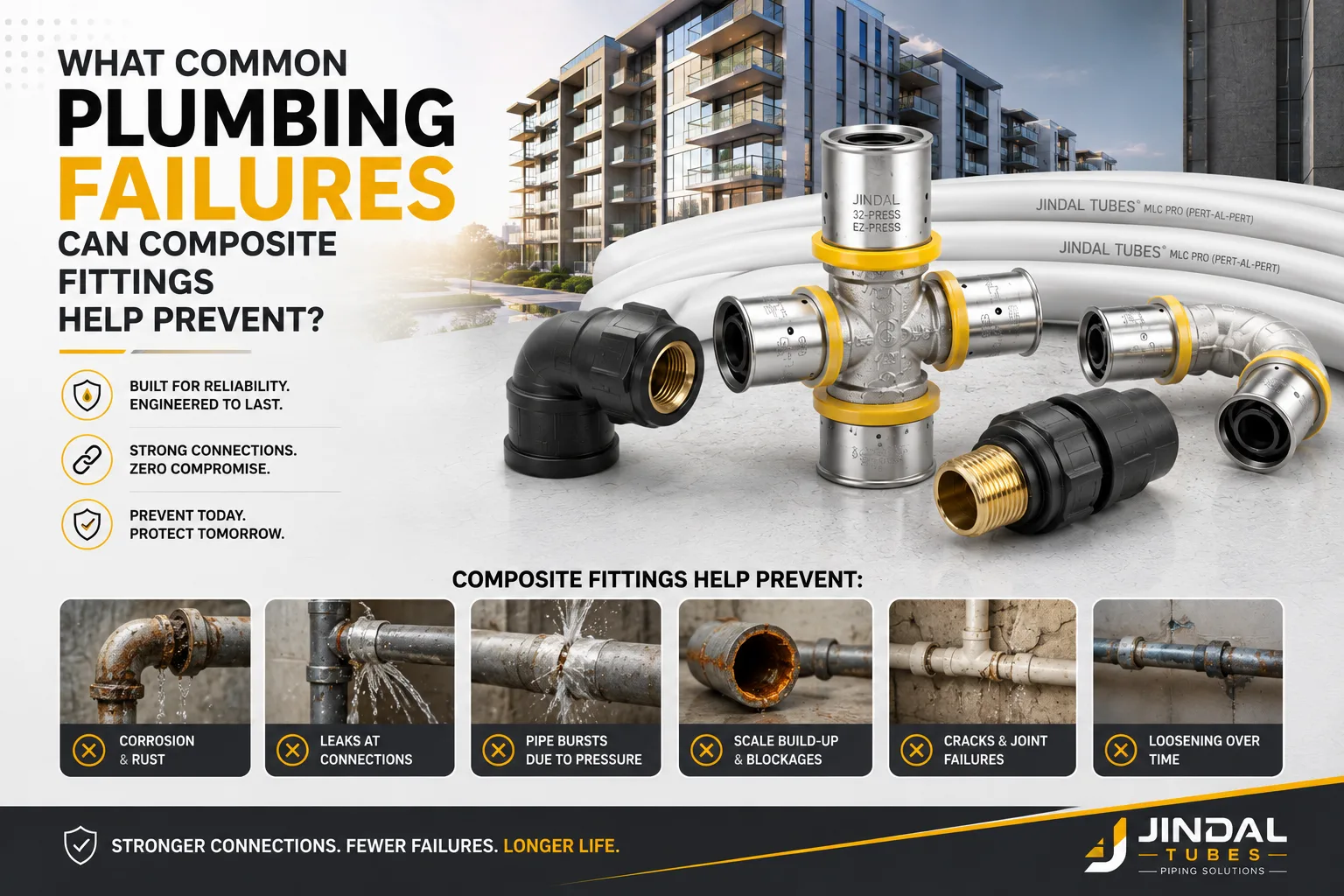
Many plumbing failures originate at pipe connections rather than in the pipes themselves. Poor-quality fittings, incompatible materials, or improper installation can lead to leaks, pressure loss, corrosion, and premature system failure. Composite press-fit fittings help reduce these risks by creating secure mechanical joints that improve the reliability and lifespan of modern plumbing systems.
Why Plumbing Connections Are Often the Weakest Link
A plumbing network may contain hundreds of connection points where pipes join, branch, or connect to fixtures. Each of these joints is exposed to water pressure, temperature changes, and daily mechanical stress.
If a fitting fails, it can affect the performance of the entire plumbing system.
According to the International Association of Plumbing and Mechanical Officials (IAPMO), using certified plumbing products that comply with recognized standards is essential for achieving safe, durable, and code-compliant plumbing installations.
1. Water Leaks at Pipe Joints
One of the most common plumbing failures is leakage at pipe connections.
Leaks often develop because of:
- Loose threaded joints
- Worn sealing materials
- Improper installation
- Pipe movement over time
- Incompatible fittings
Composite press-fit fittings create permanent mechanical joints that maintain consistent sealing pressure, helping reduce the likelihood of joint leakage.
The International Code Council (ICC) recognizes press-connect technology as a reliable joining method for modern plumbing systems due to its ability to create durable mechanical connections.
2. Pressure Loss Throughout the Plumbing System
Small leaks and poorly aligned fittings can gradually reduce available water pressure.
Composite fittings help preserve hydraulic performance by:
- Maintaining secure joints
- Reducing unnecessary pressure losses
- Supporting smoother water flow
- Improving overall system efficiency
To understand how fittings work alongside multilayer pipes, readers can explore How PE-AL-PE Multi-Layer Pipes Work Explained.
3. Joint Failures Caused by Thermal Expansion
Hot and cold water systems continuously expand and contract as temperatures change.
Repeated thermal movement can weaken conventional plumbing joints over time.
Composite fittings designed for multilayer piping systems help accommodate these movements while maintaining reliable sealing performance.
This helps reduce:
- Joint loosening
- Seal deterioration
- Connection fatigue
- Long-term maintenance
The Plastic Pipe Institute (PPI) notes that modern plastic and multilayer piping systems provide excellent resistance to corrosion and thermal-related performance challenges when correctly designed and installed.
4. Corrosion-Related Connection Problems
Traditional metallic fittings may be susceptible to corrosion depending on water chemistry and environmental conditions.
Corroded fittings can eventually lead to:
- Reduced water flow
- Weak connections
- Water contamination concerns
- Costly replacements
Composite press-fit systems help minimize corrosion-related issues by using materials engineered for modern potable water and heating applications.
5. Installation Errors
Many plumbing failures occur because of inconsistent installation practices.
Traditional threaded systems often depend heavily on installer experience.
Composite press-fit fittings simplify the installation process by creating standardized mechanical joints that help reduce:
- Overtightening
- Undertightening
- Misaligned connections
- Inconsistent sealing
The American Society of Plumbing Engineers (ASPE) emphasizes that proper product selection and installation are fundamental to achieving reliable plumbing performance throughout a building's lifecycle.
6. Long-Term Maintenance Problems
Small connection issues can gradually become expensive plumbing failures.
Reliable composite fittings help reduce:
- Emergency repairs
- Water damage
- Building downtime
- Maintenance labour
- Replacement frequency
This contributes to lower lifecycle costs and more dependable plumbing infrastructure.
Why Integrated Plumbing Systems Perform Better
Pipes and fittings should work together as one engineered system rather than as separate components.
Using compatible systems improves:
- Leak resistance
- Pressure stability
- Hydraulic efficiency
- Installation consistency
- Long-term durability
For multilayer plumbing applications, EZ-PRESS composite fittings are engineered to work alongside compatible composite pipes, helping installers create reliable press-fit connections designed for modern residential and commercial plumbing systems.
Composite Fittings vs Traditional Plumbing Fittings
FeatureComposite Press-Fit FittingsTraditional Threaded FittingsLeak ResistanceExcellentModeratePressure StabilityHighModerateCorrosion ResistanceHighVariesThermal PerformanceExcellentModerateInstallation ConsistencyHighDepends on workmanshipMaintenance RequirementsLowHigherWhy Builders Are Choosing Composite Fittings
Modern construction increasingly focuses on plumbing systems that deliver long-term value rather than simply reducing initial installation costs.
Composite fittings help support these objectives by providing:
- Reliable pipe connections
- Reduced maintenance requirements
- Faster installation
- Better compatibility with multilayer pipes
- Improved lifecycle performance
Manufacturers such as Jindal Tubes have contributed to this industry transition by developing integrated multilayer plumbing solutions where compatible press-fit fittings and composite pipes are engineered to work together for improved long-term reliability.
Frequently Asked Questions
What plumbing failures do composite fittings help prevent?
Composite fittings help reduce common issues such as joint leaks, pressure loss, thermal movement-related failures, corrosion at connection points, and installation-related problems.
Do composite fittings eliminate plumbing leaks?
No plumbing system is completely immune to leaks. However, properly installed composite press-fit fittings significantly reduce the likelihood of leakage by creating secure mechanical joints.
Why are connection points more likely to fail than pipes?
Pipe joints experience continuous pressure changes, temperature fluctuations, and mechanical stress, making them more vulnerable than straight pipe sections.
Are composite fittings suitable for residential and commercial buildings?
Yes. Composite press-fit fittings are widely used in residential, commercial, healthcare, hospitality, institutional, and industrial plumbing systems that utilize multilayer composite pipes.
Final Insight
Most plumbing failures originate where pipes connect rather than within the pipes themselves. By strengthening these critical connection points, composite press-fit fittings help reduce leaks, maintain stable water pressure, resist thermal movement, and minimize long-term maintenance requirements.
As modern buildings increasingly prioritize durability, efficiency, and lifecycle performance, composite fittings have become an important component of high-quality plumbing systems. When used with compatible multilayer piping, they contribute to infrastructure that performs more reliably throughout decades of service.