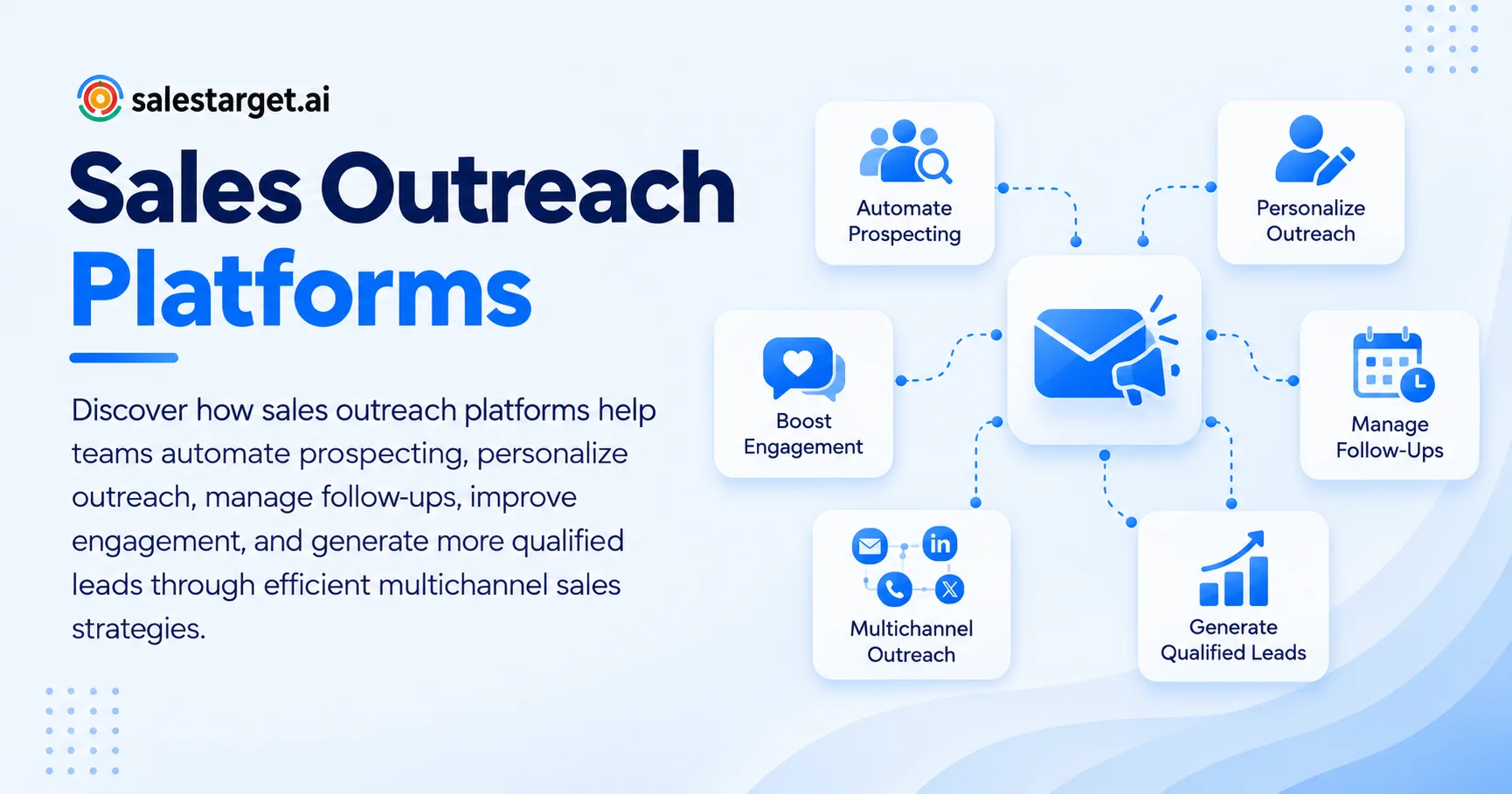
B2B teams can spend hours building prospect lists, researching accounts, writing emails, checking contact data, and scheduling follow-ups, only to see weak reply rates. The problem is rarely a lack of effort. It is usually a broken workflow where data, personalization, sending, and follow-up live in separate tools.
The top Sales Outreach Platforms for AI-driven personalized email campaigns are SalesTarget.ai, Apollo, Outreach, Salesloft, Lemlist, Instantly, and Smartlead. The right choice depends on whether your priority is prospect data, AI personalization, email deliverability, multichannel outreach, CRM workflow, or an all-in-one outbound process. For B2B teams that want prospecting, enrichment, personalized email, LinkedIn outreach, validation, and CRM management in one workspace, SalesTarget.ai is a strong fit.
What Should You Look for in Sales Outreach Platforms for AI Email Personalization?
The best Sales Outreach Platforms do more than generate a first-name variable or rewrite a generic template. They should connect prospect information, buying signals, message creation, sending logic, follow-ups, and sales activity.
AI personalization becomes useful when the system has enough context to write something relevant. A prospect's job title alone is weak context. Company growth, industry, business model, role, technology usage, intent signals, recent activity, and the problem your product solves can produce a much stronger reason to reach out.
A good platform should give reps control over the message strategy while removing repetitive work. You should be able to define the audience, offer, pain point, tone, and campaign objective without manually creating every variation.
Deliverability deserves equal attention. A beautifully personalized email has no value if it never reaches the inbox. Current sales engagement platforms increasingly combine sequencing with inbox setup, authentication checks, warm-up, sending controls, and engagement monitoring.
One practical test is simple: ask how many steps a rep needs to go from "I found this account" to "the prospect is enrolled in a relevant sequence." If that process requires exporting a list, cleaning it in another application, enriching contacts somewhere else, writing emails in another tool, and manually updating the CRM, the AI feature is solving only one small part of the workflow.
Which AI Tools Are Best for Personalized B2B Email Campaigns?
The best tool depends on the job you need it to perform. Apollo is attractive for teams that want a large B2B database combined with sequencing and AI-assisted email creation. Its platform combines contact data, sequences, deliverability features, AI writing, and calling capabilities.
Outreach and Salesloft are strong options for larger revenue organizations that need structured sales engagement, account workflows, activity management, and deeper sales-team governance. Their value is less about generating one clever email and more about coordinating repeatable sales execution across larger teams.
Lemlist is a strong option for teams that place heavy emphasis on personalization and creative outbound campaigns. It is particularly relevant when the message itself is a major part of the campaign strategy.
Instantly and Smartlead are more closely associated with cold email execution, mailbox management, sending infrastructure, and campaign scaling. They can make sense for teams that already have reliable prospect data and primarily need a specialized email outreach layer.
SalesTarget.ai takes a broader approach. Its Lead Explorer combines 840M+ verified professional profiles, 146M+ business entities, 4,000+ intent signals, and 50+ data sources. Reps can search using plain English or combine business and people filters, then enrich contacts with professional email, personal email, phone, and mobile data.
That matters for personalization. The email generator is only as useful as the information feeding it. SalesTarget.ai can connect prospect discovery, enrichment, intent data, email creation, LinkedIn outreach, validation, and CRM activity in one outbound workflow.
For a deeper look at how modern platforms compare, this guide to AI-powered B2B sales outreach platforms provides another useful reference point.
How Do AI-Powered Email Campaigns Work From Prospect to Reply?
An effective AI email workflow starts before the email is written. The platform first needs to identify who should receive the campaign.
Step 1: Define the Ideal Prospect
Start with the commercial problem you are trying to solve, not a generic industry label. Define company size, geography, department, seniority, technology, business model, and other attributes that indicate a realistic fit.
SalesTarget.ai's Lead Explorer lets teams combine business and people filters or search using natural-language instructions. Intent signals can then help separate accounts that merely match the profile from accounts showing signs of active interest.
Step 2: Enrich and Validate Contact Data
A personalized message sent to the wrong address is still a failed message. Before enrollment, verify the contact information and remove risky or disposable addresses.
SalesTarget.ai's validator uses MX and SMTP checks, disposable-email detection, and risk scoring. Bulk list cleaning and real-time verification can reduce the amount of manual checking required before a campaign starts.
Step 3: Generate the Message Around a Reason to Respond
The strongest AI-generated email is not the one containing the most personalization. It is the one that gives the prospect a credible reason to continue the conversation.
Instead of writing "I noticed you are the VP of Sales at Company X," the system should use available context to connect the prospect's role or business situation to a relevant problem. The opening can reference a signal, the middle can explain why the problem matters, and the close can make the next step easy.
Step 4: Build Conditional Follow-Ups
A sequence should not treat every prospect identically after the first email. Replies, clicks, opens, connection activity, or silence can determine what happens next.
SalesTarget.ai supports conditional LinkedIn and email sequences that can branch based on prospect actions or lack of response. This creates a more sensible workflow than sending the same follow-up to every contact.
Step 5: Push Engagement Into the Sales Workflow
The campaign should not end when someone replies. Responses need to become sales actions.
SalesTarget.ai's Unibox organizes replies by intent and connects campaign activity with its CRM. Emails and calls can be logged against the lead timeline, follow-up tasks can be created automatically, and the built-in AI dialer can record call notes.
This is one area where many outbound teams lose efficiency. The campaign generates activity, but the rep still has to copy information into the CRM and remember what happens next.
What Benefits Do AI Personalized Email Campaigns Deliver?
AI personalization can reduce the manual work required to research prospects and create outbound messages. The bigger benefit is consistency. Reps can spend more time deciding who deserves attention and less time performing repetitive campaign administration.
SalesTarget.ai reports that its Email Outreach workflow creates campaigns 35% faster, with 90% of emails validated before sending. Its CRM workflow reports 91% follow-up completion and roughly six hours saved per rep each week.
The commercial value comes from connecting these steps. Better data supports better targeting. Better targeting gives AI more useful context. Better context produces more relevant messaging. Better workflow keeps follow-ups from being forgotten.
There is another practical benefit: campaign learning. When replies, calls, tasks, and deals remain connected, sales leaders can inspect which audiences generate conversations instead of judging campaigns only by open rates.
Open rates can be useful as a diagnostic signal, but they are not a reliable measure of sales quality on their own. A campaign with fewer opens and strong replies can be more valuable than one with high engagement from prospects who never become opportunities.
If your team is spending too much time moving contacts between prospecting, email, LinkedIn, validation, and CRM tools, SalesTarget.ai can consolidate those steps into one outbound workflow. The practical goal is fewer handoffs between systems and more time spent on qualified conversations.
How Can an Intelligent Outreach Platform Improve Personalization?
An intelligent outreach platform should make personalization conditional on useful prospect information rather than inserting random facts into a template.
A common mistake is confusing personalization with customization. Customization changes the recipient's name, company, industry, or job title. Personalization changes the reason the message is being sent.
Consider two approaches. The first says, "We help SaaS companies improve their sales process." The second identifies a specific sales signal, connects it to a likely operational issue, and explains why the sender has a relevant solution. The second message has a clearer commercial reason to exist.
AI can support this process by combining structured data with campaign instructions. SalesTarget.ai can use prospect attributes, company information, intent signals, and enrichment data as inputs for email creation.
The less obvious advantage is negative personalization. Good AI outreach should know when not to personalize. If the available signal is weak, fabricated, outdated, or unrelated to the offer, forcing it into the opening can make the message feel artificial.
That means a good campaign needs fallback logic. Use a strong signal when one exists. Use role or company context when it does not. Keep the message simple when there is insufficient evidence. AI should reduce awkward personalization, not manufacture it.
What Are the Best Practices for B2B Outreach Campaigns?
Personalized email works best when the audience, message, timing, and follow-up logic are treated as one system.
First, segment before generating copy. A single campaign for every company in your database gives AI too much variation to handle consistently. Smaller audience groups make the value proposition sharper.
Second, personalize around business relevance. A recent funding event, hiring pattern, technology change, expansion signal, or operational challenge can provide a better opening than a generic compliment.
Third, keep the first email focused. The purpose of cold outreach is to earn the next conversation, not explain the entire product.
Fourth, build sequences around different outcomes. A prospect who opens but does not reply needs a different follow-up strategy from someone who replies with a question or asks to reconnect next quarter.
Fifth, protect deliverability from the start. Verify addresses, configure authentication correctly, control sending volume, monitor mailbox health, and avoid treating high-volume sending as the definition of productivity.
Finally, measure business outcomes. Track positive replies, qualified meetings, opportunities, pipeline, and revenue alongside email metrics.
What Mistakes Should You Avoid With AI Sales Outreach?
The biggest mistake is letting AI write messages before deciding who should receive them. Automation can multiply bad targeting just as quickly as good targeting.
Another mistake is giving the model too little context. "Write a personalized email to this CEO" produces generic copy. Supplying the role, account type, buying signal, business problem, offer, and desired action gives the system a useful foundation.
Teams should avoid sending identical follow-ups to every prospect. A person who opened three emails but never replied has shown different behavior from a contact who ignored the campaign completely.
Data quality is another overlooked problem. AI cannot compensate for an incorrect job title, dead email address, duplicate contact, or outdated company record. In many outbound campaigns, improving the input data can have a larger effect than adding another layer of AI copy generation.
The final mistake is separating outreach from CRM activity. If the rep has to manually record every response, meeting, and follow-up, part of the productivity gain disappears.
When Is an All-in-One Sales Platform a Better Fit?
An all-in-one sales platform makes sense when the main problem is fragmented outbound execution rather than a lack of one specific feature.
A specialized email platform can be a good choice for a team that already has excellent prospect data and a mature CRM. A broader platform becomes more useful when reps are switching between a data provider, enrichment service, email sequencer, LinkedIn tool, validator, dialer, and CRM every day.
SalesTarget.ai combines these functions in one workspace. Lead Explorer handles prospect discovery and enrichment. Email Outreach manages AI-generated sequences, inbox rotation, warm-up, authentication checks, and content generation. LinkedIn Outreach coordinates social touches with email. Validation checks contact quality. The CRM captures campaign activity and follow-up. AI Copilot lets users search leads, generate sequences, query CRM information, track campaign revenue, and create tasks through conversation.
That setup can be particularly useful for lean B2B teams where every extra system creates another login, integration, workflow, and data handoff.
How Should You Choose a B2B Outreach Platform?
Start with the bottleneck, not the feature list. If your main problem is contact discovery, prioritize database depth and data accuracy. If it is inbox placement, prioritize deliverability infrastructure. If it is personalization, examine how much prospect context the AI can actually access.
Next, map your current workflow from account selection to closed deal. Write down every tool involved. Count every manual export, import, copy-and-paste step, and CRM update. This reveals the real cost of your stack.
Then test the campaign itself. Give each platform the same audience definition and sales offer. Compare the generated emails, personalization quality, sequence logic, data validation, and amount of manual work required before launch.
Do not judge a platform only by how quickly it sends the first email. The stronger test is whether it helps your team move from a qualified prospect to a meaningful sales conversation without creating extra administrative work.
Final Thoughts
The best AI email tool for B2B sales is not simply the one that writes the most convincing email. It is the one that connects accurate prospect data, useful personalization, deliverability, sequencing, follow-up, and CRM execution into a workflow your sales team can actually run.
SalesTarget.ai is built around that broader outbound motion. Its combination of 840M+ professional profiles, intent signals, contact enrichment, AI email outreach, LinkedIn automation, validation, CRM workflows, and AI Copilot gives B2B teams a single place to find prospects, personalize campaigns, engage buyers, and manage what happens after the reply.
If your team is losing time moving data between disconnected outbound tools, the next step is to consolidate the workflow and give reps more time for actual selling. Use SalesTarget.ai to build a prospecting-to-conversation process that connects data, AI personalization, multichannel outreach, and follow-up in one workspace.