Introduction
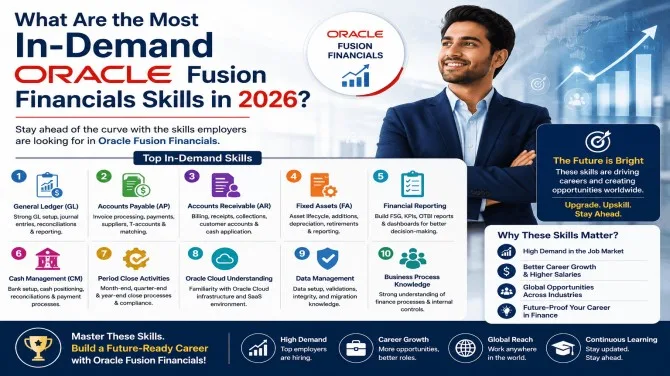
Hiring patterns in the Oracle ecosystem tend to shift quietly, and most professionals only notice after they've already fallen a step behind. Tech Leads IT stays in regular contact with recruiters and hiring managers across ERP-focused companies, and that ongoing exposure makes one thing obvious: the skill combination that got someone hired in 2023 isn't necessarily the one getting shortlisted in 2026.
This article walks through what's actually being screened for right now, so time spent learning gets directed at where the market currently stands rather than where it used to sit a couple of years ago.
General Ledger Remains Core, But the Expectations Have Deepened
General Ledger hasn't lost its place as the foundation skill every Financials professional is expected to know. What's shifted is how much depth employers now expect within it. Multi-entity and multi-currency configuration carry noticeably more weight than they used to, largely because more organizations now operate across borders and need consultants capable of managing clean, consolidated reporting across multiple currencies and legal entities.
Well-built Oracle Fusion Financials Online Training programs have adjusted accordingly, giving considerably more classroom time to complex multi-entity scenarios than older training outlines usually covered. Candidates who can discuss multi-currency consolidation with real specificity in interviews tend to stand apart from those offering only surface-level answers.
AI Skills That Go Past Recognizing the Terminology
Oracle has continued expanding AI-driven capability throughout Fusion Financials, and employers in 2026 are looking for candidates who've actually worked with these tools, not just heard of them. Automated reconciliation, predictive cash flow forecasting, and AI-based anomaly detection have quietly become baseline expectations on job postings rather than impressive extras.
This is precisely why solid Oracle Cloud Financials Training Online programs now build in dedicated, hands-on coverage of these AI-assisted capabilities. Professionals who can explain how they've configured or debugged these features hold a real advantage over candidates who only know the older manual reconciliation approach.
Reporting Skills That Extend Beyond Standard Templates
As Oracle keeps building out its native reporting and analytics functionality, employers expect Financials professionals to move beyond pulling default reports. Building custom dashboards, working comfortably inside Oracle Analytics, and converting raw financial data into insight that leadership can actually act on has become a valued skill set on its own, not just a bonus.
That's exactly why many updated Oracle Fusion Financials Online Training curriculums now dedicate real, focused time to reporting and analytics, recognizing how significantly this combination strengthens a candidate's competitiveness heading into 2026 interviews.
Genuine Range Across Multiple Modules
Employers have grown noticeably less interested in candidates who know only one narrow module inside and out. Job postings increasingly favor professionals who are strong in core Financials but can also work into adjacent areas such as Procurement, Project Portfolio Management, or Supply Chain. That kind of cross-functional comfort helps consultants understand how financial data actually connects into wider operational processes.
Building that range typically begins with a solid Oracle Cloud Financials Training Online foundation in core Financials, followed by a deliberate push into at least one neighboring module. Professionals who've made that investment usually qualify for a considerably wider set of project opportunities than those who stayed narrowly specialized.
Practical Experience With Cloud Migration and Data Conversion
Migration away from legacy platforms like Oracle EBS is still very much active through 2026, and employers place real value on candidates who understand data conversion and migration work specifically, not just standard Fusion configuration. Knowing how to manage historical data migration, validate converted balances, and troubleshoot conversion errors has become a genuinely scarce and valuable niche skill.
Training built around practical, scenario-based migration content within Oracle Fusion Financials Online Training gives candidates a real edge here, since this specific expertise stays in short supply relative to how much active migration work is still happening industry-wide.
Compliance Understanding Connected to Real Configuration Work
As financial regulations keep evolving across different regions, employers increasingly value professionals who understand how compliance requirements shape actual system configuration, especially around tax reporting, audit trails, and data privacy standards. This matters even more for consultants supporting multinational clients who juggle several regulatory environments at once.
Deep regulatory expertise usually sits outside the scope of a standard Oracle Cloud Financials Training Online course, but professionals who build at least a working familiarity with these compliance factors alongside their technical skills tend to stand out clearly in senior consulting interviews this year.
Communication Ability That Genuinely Sets Candidates Apart
Technical skill on its own doesn't guarantee competitiveness in this year's hiring landscape. As organizations continue moving away from legacy systems, employers increasingly value professionals who can explain system changes clearly to non-technical stakeholders and guide user adoption through the friction points of an implementation. This has become a genuine differentiator rather than an optional soft skill.
While a typical Oracle Fusion Financials Online Training course doesn't teach this directly, professionals who build the ability deliberately, alongside their technical training, tend to stand out in interviews for senior or leadership-track positions.
Final Thoughts
The most in-demand Oracle Fusion Financials skills for 2026 combine strong core fundamentals with real, hands-on fluency in AI-assisted tools, advanced reporting, cross-module range, migration expertise, compliance awareness, and clear communication. Employers are looking well past basic module knowledge toward candidates who can demonstrate practical, current capability across all of these expanding areas.
For anyone aiming to align their skill set with where the market genuinely stands this year, investing in comprehensive Oracle Fusion Financials Online Training, supported by an updated Oracle Cloud Financials Training Online program, remains one of the smarter ways to stay competitive as hiring priorities continue to shift.