
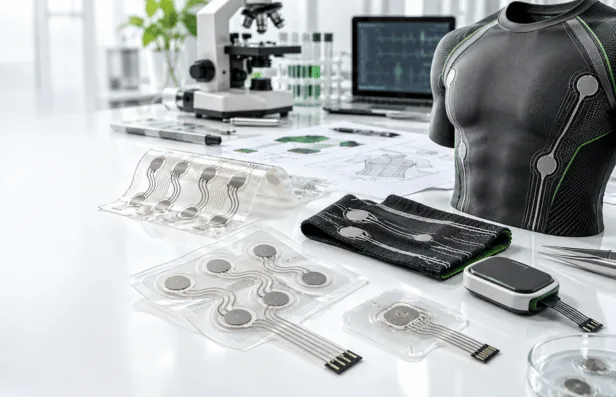
Search for biometric sensor trends, and most results cover fingerprint readers and face recognition. OEM engineers building a fitness garment or a remote patient monitor need something else: physiological sensing, the electrodes and transducers that read the body's own signals.
That side of the field has moved quickly since 2024, from gel-free electrodes to a January 2026 FDA policy that redrew the line between a wellness product and a medical device. Each shift changes a specific design decision, most of them expensive to reverse after tooling.
Quick answer: The main emerging trends in biometric sensor technology for OEMs are dry and printed electrodes replacing gel, textile-integrated and stretchable sensors, multimodal sensing on one platform, sweat and biochemical sensing, on-body edge processing, and FDA's January 2026 General Wellness guidance. Each shifts an early decision: substrate, wash specification, channel layout, power budget, or intended-use claims.

Dry and Printed Electrodes
Gel electrodes set the clinical benchmark, but they limit wear time and do not suit garments, so research groups now print electrodes where they are needed.
In December 2024, University of Texas at Austin researchers reported printing EEG electrodes onto the scalp as an e-tattoo, noting that conventional EEG electrodes "can dry out quickly."
The consequence is mechanical. Without gel, the electrode depends on consistent contact, so compression, strap tension or adhesive becomes part of the sensor specification. A contact-quality check that flags a lifted electrode before its data is used belongs in the firmware plan from the start.

Textile and Stretchable Sensors
The garment itself is becoming the sensor platform. A 2024 review in Soft Science describes gel-free textile electrodes that stay stable after multiple wash cycles and bending, which makes washability an engineering requirement.
- Specify wash method and cycle count, using IEC 63203-204-1:2023, a household washing durability test for data-collecting e-textiles
- Test heated garments separately, since that standard excludes safety and heat-generating products
- Agree up front whether the product is high-use performance wear or low-use gear, since wash guidance often differs between the two
Manufacturers that print biometric sensors on stretchable TPU film, such as Butler Technologies, Inc., produce sensors that can be heat transferred or sewn into garments and connected to hardware through printed connector tails.

Multimodal Sensing
Platforms now read heart activity, muscle activity, skin impedance, and motion together, and a 2026 editorial in Sensors lists multimodal fusion among current trends. Every added channel costs an electrode, a stretchable trace and a connector pin.
- Place a shared reference so every channel sees a stable reference as the body moves
- Separate stimulating and recording electrodes if the product does both
- Count connector pins and plan tail routing early, since they often fix the enclosure size
Sweat and Biochemical Sensing
Chemistry is the next frontier after electrical signals, and one form has already reached consumers.
FDA cleared Dexcom's Stelo as the first over-the-counter glucose biosensor for adults in March 2024 and extended OTC clearance to children in June 2026. It is not a sweat sensor, but it shows where consumer biochemical sensing is heading.
Sweat remains earlier-stage. A 2026 review in Discover Applied Sciences reports weak blood-sweat correlation for sodium, potassium, glucose and lactate, and notes that enzyme degradation limits long-term wear. Design for trends, normalize for sweat rate and treat sensor shelf life as a requirement.
On-Body Edge Processing
More processing is moving onto the wearable, because streaming raw multichannel data over Bluetooth drains batteries and moves personal data off the body.
- Decide which features are computed on the body, such as heart rate, muscle activation level and contact quality
- Decide which raw data is uploaded at all
- Size the processor and battery only after that split is fixed
The 2026 FDA Wellness Shift
On January 6, 2026, FDA issued its final guidance, General Wellness: Policy for Low Risk Devices. According to a Covington & Burling summary, it allows non-invasive products that estimate physiologic parameters, including blood pressure, to qualify as general wellness products.
- A product loses wellness status if it references disease
- Claims of "medical grade" accuracy or clinical equivalence also remove it
- So do alerts that prompt a specific clinical action
- Minimally invasive sensors, such as microneedle glucose sensors, fall outside the policy regardless of claims
The Decision Behind Every Trend
Every trend above changes a decision that is cheap early and expensive after tooling. The same electrode can sit in a wellness shirt or a cleared cardiac monitor, and the claims decide how much validation the product needs. Write the intended-use statement before the sensor specification, then let it guide substrate, channel count, power budget, and wash testing.
Key Takeaways
- Dry and printed electrodes make contact pressure and contact-quality checks part of the specification
- Textile sensors turn wash method and cycle count into tested requirements
- Multimodal sensing adds capability, traces, connector pins, and crosstalk risk
- Intended-use claims set the regulatory path, so write them before the sensor specification
Frequently Asked Questions (FAQs)
What are the biggest trends in biometric sensor technology right now?
For physiological wearables, the biggest trends are dry and printed electrodes, textile and stretchable sensors, multimodal sensing, sweat and biochemical sensing, on-device processing, and FDA's January 2026 General Wellness guidance.
Can a wearable measure blood pressure without FDA clearance?
Under FDA's January 2026 General Wellness guidance, a non-invasive product that estimates blood pressure for wellness use can qualify as a general wellness product. It loses that status if it references disease, claims medical-grade accuracy, or sends alerts that prompt clinical action.
Is sweat sensing accurate enough for commercial products?
Sweat sensing works for trend monitoring, not as a blood test substitute. A 2026 review reports weak sweat-blood correlation for sodium, potassium, glucose, and lactate, and enzyme-based sensors degrade over time, so shelf life must be specified.
How do you test the washability of a smart garment?
Define the use case first, such as high-use performance wear or low-use outdoor gear, then set a wash method and cycle count. IEC 63203-204-1:2023 provides a household washing durability test method, but it excludes safety and heating functions.