
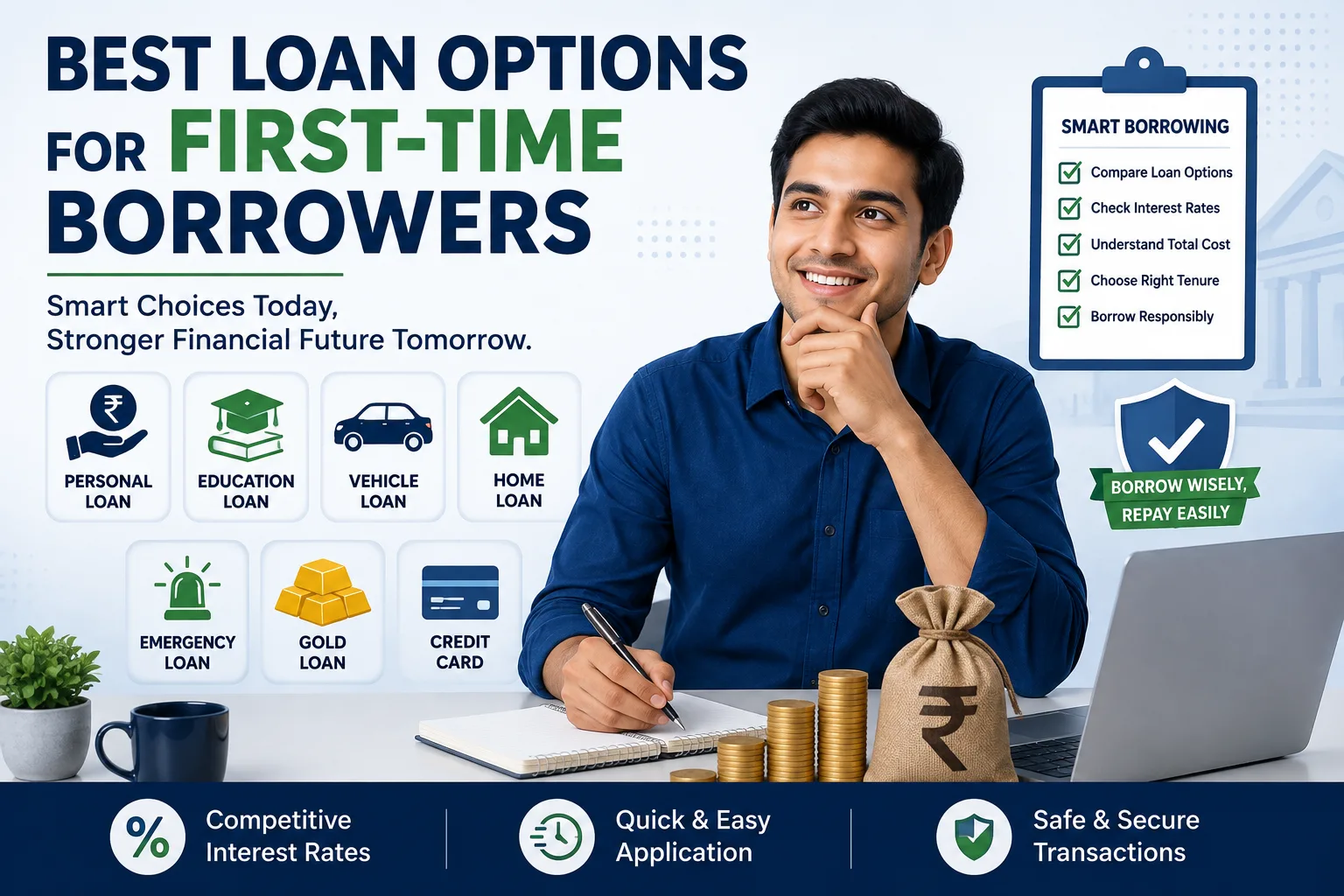
Taking your first loan can feel like stepping into a new financial neighbourhood. Everything has a number: interest rate, EMI, tenure, processing fee, credit score, APR, and repayment schedule. It can be easy to focus on the amount you can borrow and forget to ask the more important question: Which type of loan actually makes sense for me?
For a first-time borrower, the best loan is not necessarily the one with the fastest approval or the highest sanctioned amount. It is usually the loan that matches the purpose of borrowing, has transparent costs, comes from a legitimate lender, and has an EMI you can comfortably repay.
Your first borrowing experience can also influence your future credit history. That makes choosing carefully even more important.
What Does It Mean to Be a First-Time Borrower?
A first-time borrower is someone who has little or no previous borrowing history.
You may be considered a first-time borrower if you have never had:
- A personal loan
- A home loan
- An education loan
- A vehicle loan
- A credit card
- Another form of reported credit
Having no credit history is different from having a poor credit history. A person with no previous loan may simply have limited information in their credit report.
Lenders can therefore look at factors such as income, employment, existing financial obligations, banking information, age, loan purpose, and their own eligibility criteria when assessing an application.
Which Loan Is Best for a First-Time Borrower?
There is no single loan that is best for everyone.
The right option depends on why you need the money, how much you need, how quickly you need it, and how comfortably you can repay it.
Common options include:
- Personal loans
- Education loans
- Vehicle loans
- Home loans
- Small-ticket or emergency loans
- Secured loans such as gold loans
- Credit cards for short-term spending
Let's look at each option.
1. Personal Loan
A personal loan is one of the most common options for borrowers who need money for a general purpose.
Depending on the lender, a personal loan may be used for expenses such as:
- Medical expenses
- Home repairs
- Education-related expenses
- Travel
- Wedding expenses
- Emergency requirements
- Debt consolidation
- Other permitted personal needs
Personal loans are generally unsecured, meaning you typically don't pledge an asset as collateral.
Why It May Suit First-Time Borrowers
A personal loan can be useful when you need a defined amount and want a fixed repayment schedule.
For example, suppose you need ₹50,000 for an unexpected expense. If a lender offers suitable terms, you could compare different offers based on interest rate, APR, fees, tenure, EMI, and total repayment.
However, approval is never guaranteed simply because you are applying for your first loan.
2. Education Loan
If the purpose of borrowing is education, an education loan may be more appropriate than a general personal loan.
Education loans are specifically designed to finance eligible educational expenses. Depending on the lender and scheme, they may cover expenses such as tuition fees, books, accommodation, equipment, or other approved costs.
For eligible education loans, banks may offer repayment structures that are different from ordinary personal loans.
The RBI notes that education loan interest rates are determined by banks within the applicable regulatory framework.
Why Consider an Education Loan?
If you are borrowing specifically for higher education, compare an education loan before automatically choosing a personal loan.
Look at:
- Interest rate
- Moratorium or repayment conditions
- Processing fees
- Course and institution eligibility
- Loan amount
- Repayment tenure
- Collateral requirements
- Co-borrower requirements
The right option depends on the lender and your individual circumstances.
3. Vehicle Loan
Planning to purchase a motorcycle, scooter, or car?
A vehicle loan can be worth considering instead of using a personal loan for the entire purchase.
Vehicle loans are generally linked to the purchase of the vehicle and may involve the vehicle serving as security for the loan.
Because the lender has an underlying asset as security, the pricing and eligibility conditions can differ from an unsecured personal loan.
Before choosing one, compare the total on-road cost, down payment, loan amount, interest rate, EMI, tenure, insurance, and other applicable charges.
Don't choose a vehicle simply because the EMI looks affordable.
A longer tenure can make the monthly payment smaller while increasing the total interest paid.
4. Home Loan
A home loan is a completely different category of borrowing.
If you are purchasing a house or flat, financing it through a home loan may be more appropriate than using a personal loan because home loans are specifically designed for property purchases and generally have much longer repayment periods.
However, home loans involve larger commitments.
A lender may evaluate factors such as:
- Income
- Employment or business stability
- Existing liabilities
- Credit history
- Property details
- Down payment
- Repayment capacity
The RBI's financial education material notes that lenders assess repayment capacity using factors such as disposable income, expenses, liabilities, assets, and income stability.
For a first-time borrower considering a home loan, the decision should be based on long-term affordability rather than simply the maximum amount a lender is willing to approve.
5. Small Emergency Loan
Sometimes you don't need ₹5 lakh. You need ₹10,000 or ₹25,000 to handle an unexpected expense.
A small loan can be appropriate in certain situations, but this is also where borrowers should be particularly careful.
Small loans can have relatively high costs depending on the lender and product.
Before accepting a small digital loan, check:
- Actual lender
- Interest rate
- APR
- Processing fee
- Net amount disbursed
- EMI
- Tenure
- Total repayment
- Late-payment charges
- Prepayment terms
For digital lending products covered by RBI's applicable framework, the all-inclusive cost is disclosed through APR, and digital lending arrangements have specific requirements around data collection and privacy.
A ₹20,000 loan can look small on the screen, but the repayment obligation is still real money.
6. Secured Loan
A secured loan is backed by an asset.
Depending on the product, this could include a gold loan or another loan against an eligible asset.
The major difference is that the lender has security against the borrowing.
Potential Advantage
Because the loan is secured, some borrowers may find the pricing or eligibility more favourable than an unsecured loan, depending on the product.
Important Risk
The asset is not decorative paperwork. It is security for the loan.
If you fail to repay according to the agreement, the lender may have rights over the pledged asset subject to applicable laws and contractual terms.
First-time borrowers should understand this risk before choosing a secured loan.
7. Credit Card
A credit card is not technically the same thing as a traditional instalment loan, but it is another form of borrowing that first-time borrowers may encounter.
It can be useful for short-term purchases when the balance is repaid according to the card's terms.
However, carrying unpaid credit card balances can become expensive because interest and other charges may apply.
If you are using a credit card for convenience, understand:
- Billing cycle
- Due date
- Minimum payment
- Total outstanding
- Interest charges
- Late-payment consequences
- Cash withdrawal charges
Paying only the minimum amount is not the same as clearing the balance.
How Should a First-Time Borrower Choose?
Instead of asking:
"Which loan gives me the most money?"
ask:
"Which loan solves my specific need at a cost I can comfortably repay?"
Start with the purpose.
Your RequirementPotential OptionHigher educationEducation loanCar or two-wheeler purchaseVehicle loanHouse purchaseHome loanGeneral personal expensePersonal loanShort-term emergencySmall personal/emergency loanBorrowing against an assetSecured loanShort-term purchasesCredit card, if manageableThis is only a general comparison. Actual eligibility, pricing, and terms vary between lenders.
Don't Borrow More Than You Need
One of the biggest mistakes a first-time borrower can make is taking the maximum amount offered.
Suppose you need ₹40,000 and a lender says you qualify for ₹1 lakh.
That does not mean you should borrow ₹1 lakh.
You will pay interest on the amount you actually borrow.
A useful rule is:
Borrow for the need, not for the maximum eligibility.
The extra ₹60,000 may feel like financial breathing room today, but it also creates additional repayment obligations tomorrow.
Check Your Repayment Capacity
Before applying, calculate how much you can realistically allocate toward an EMI.
Consider:
- Monthly income
- Rent
- Food and household expenses
- Existing EMIs
- Insurance
- Education expenses
- Transportation
- Emergency savings
- Other regular commitments
For example, if your monthly income is ₹30,000 and your essential expenses already consume most of it, taking a loan with a ₹10,000 EMI could put considerable pressure on your budget.
Loan approval tells you that a lender is willing to offer credit. It does not automatically mean the EMI is comfortable for you.
Understand Interest Rate and APR
First-time borrowers often look only at the interest rate.
That is a mistake.
Suppose one loan advertises an interest rate of 16% while another advertises 18%.
The first loan may appear cheaper, but you should also compare:
- APR
- Processing fee
- Documentation charges
- Insurance, if applicable
- Other disclosed fees
- Total repayment
The RBI defines APR as the annual cost of credit to the borrower that includes the interest rate and other charges associated with the credit facility.
So when comparing offers, don't let one percentage number make the entire decision for you.
Read the Key Facts Statement
For applicable regulated loans, the Key Facts Statement (KFS) is an important document.
It presents key loan information in a standardized format and helps borrowers understand the cost and terms of credit.
Check:
- Loan amount
- Interest rate
- APR
- EMI
- Tenure
- Repayment schedule
- Fees
- Penal charges
- Other applicable terms
For a first-time borrower, the KFS can be particularly useful because it puts the important numbers in one place.
Read it before accepting the loan, not after the money arrives.
Verify the Lender
If you're applying through a digital lending app, don't assume the app itself is the lender.
Find out:
Who is actually providing the loan?
The RBI's digital lending framework includes requirements around disclosure, borrower data collection, privacy, and the relationship between regulated entities and lending service providers.
Before applying, verify:
- Actual lender name
- Whether the claimed lender is regulated
- Official website
- Customer-support details
- Loan documentation
- Privacy policy
- Fees and charges
Avoid applications where the lender's identity is unclear.
Avoid "Guaranteed Approval" Offers
First-time borrowers can be particularly vulnerable to advertisements promising:
"100% guaranteed loan approval!"
Be cautious.
A legitimate lender still needs to evaluate eligibility and repayment capacity according to its policies.
Be especially careful if someone asks you to pay money to a personal account in exchange for guaranteed approval.
Any legitimate fee should be properly disclosed and verifiable through the lender's official documentation.
Build Your Credit History Carefully
Your first loan can become the beginning of your credit history.
If you take a loan, make repayments on time according to the agreement.
Good repayment behaviour can help establish a positive credit record over time, while missed or delayed payments may negatively affect your credit profile if reported.
This is another reason not to take an EMI that is too large for your budget.
Your first loan should be a stepping stone, not a financial obstacle course.
Should First-Time Borrowers Choose a Short or Long Tenure?
This depends on affordability.
Shorter tenure
Potential advantages:
- Higher EMI
- Lower total interest
- Faster repayment
Longer tenure
Potential advantages:
- Lower EMI
- More monthly flexibility
- Longer repayment period
The trade-off is straightforward:
Lower EMI can mean higher total interest.
For example, a ₹50,000 loan could have very different total costs depending on whether it is repaid over 12, 24, or 36 months.
Always compare the total repayment, not just the EMI.
What Should First-Time Borrowers Avoid?
Some common mistakes can make borrowing unnecessarily expensive.
Avoid:
- Taking a loan simply because you are eligible
- Choosing solely on the basis of EMI
- Ignoring processing fees
- Skipping the KFS
- Accepting unexplained charges
- Borrowing from an unclear lender
- Sharing OTPs or banking passwords
- Installing suspicious loan apps
- Taking multiple loans at the same time without assessing repayment capacity
- Using one loan to continuously repay another
- Ignoring late-payment terms
A five-minute review today can prevent months of financial headaches later.
A First-Time Borrower Checklist
Before accepting your first loan, check these points:
- I know exactly why I need the loan.
- I know how much I actually need.
- I have calculated whether the EMI fits my budget.
- I know the interest rate.
- I have checked the APR.
- I know the processing fee and other applicable charges.
- I know the total repayment.
- I have reviewed the KFS where applicable.
- I understand the repayment schedule.
- I have verified the actual lender.
- I understand late-payment consequences.
- I have checked prepayment or foreclosure terms.
- I am not relying on a "guaranteed approval" promise.
- I am borrowing only what I can reasonably repay.
Final Thoughts
For first-time borrowers, the best loan option depends on the purpose of borrowing and your ability to repay it comfortably.
An education loan can make sense for education expenses. A vehicle loan may be more appropriate for a vehicle purchase. A home loan is designed for property financing, while a personal loan can provide flexibility for eligible general-purpose expenses.
For smaller emergencies, a digital or small personal loan may be an option, but the costs and lender credentials should be checked particularly carefully.
The golden rule is simple:
Choose the loan based on total cost, purpose, lender credibility, and affordability, not just approval speed.
Before signing, compare the interest rate, APR, EMI, tenure, processing fees, total repayment, and other applicable charges. For applicable regulated loans, read the Key Facts Statement carefully.
Your first loan doesn't need to be complicated. It just needs to be understood.
A good first borrowing experience starts with one simple habit:
Know what you're borrowing, know what it costs, and know exactly how you're going to repay it.