
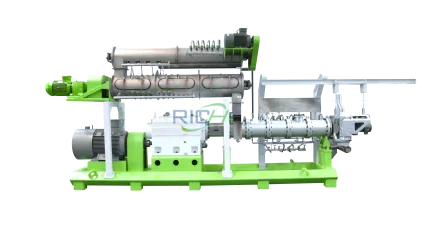
Wet extrusion is widely used in commercial aquatic feed production because it can produce pellets with controlled size, density, texture, and water stability. By combining moisture, heat, pressure, and mechanical shear, the extrusion process transforms a mixed feed formula into uniform pellets suitable for different fish species.
Why Use Wet Extrusion for Fish Feed?
Aquatic animals have different feeding habits and nutritional requirements. Some species need floating feed, while others prefer slow-sinking or sinking pellets. Wet extrusion provides manufacturers with greater control over these physical properties.
A wet type fish feed extruder adds water or steam during processing, allowing the feed mixture to become softer and more plastic before extrusion. This can improve the formation of pellets and help achieve the desired structure.
Wet extrusion is particularly useful for commercial feed production where pellet quality and water stability are important.
How Does a Wet Fish Feed Extruder Work?
The process starts with prepared raw materials. Common ingredients include fish meal, soybean meal, corn, wheat flour, rice bran, vegetable protein, oils, vitamins, and minerals.
After grinding, the ingredients are accurately weighed and mixed. The mixture then enters a conditioning system, where water or steam is added to increase moisture and temperature.
The conditioned material enters the extrusion chamber. As the screw rotates, it transports the material forward while creating compression, friction, and shear. The material gradually becomes more uniform and is forced through the die at the end of the chamber.
Once the feed exits the die, a cutter divides the continuous strands into pellets of the required length.
The fresh pellets then enter a drying system to reduce moisture. After drying, they are cooled, screened, and packed.
Main Equipment in the Production Line
A wet extrusion system normally works together with several pieces of auxiliary equipment:
- Raw material cleaning equipment
- Hammer mill or grinder
- Feed mixer
- Conditioner
- Wet extruder
- Pellet cutter
- Dryer
- Cooler
- Screening machine
- Packing machine
For small production projects, some equipment can be simplified. Larger commercial plants normally require automated feeding, weighing, drying, and packaging systems.
The final configuration depends on the required capacity, feed formula, pellet size, raw materials, and production requirements.
Wet Extruder vs. Dry Extruder
Wet and dry extrusion use similar basic principles but differ in moisture and conditioning methods.
A dry type fish feed extruder for sale generally relies more on mechanical friction to generate heat inside the extrusion chamber. It usually requires less external water or steam and can have a simpler production setup.
Wet extrusion introduces additional moisture and normally uses a separate conditioning process. This gives manufacturers greater control over the feed structure but also creates a higher drying requirement after extrusion.
Therefore, neither system is suitable for every application. The appropriate choice depends on the formula, target species, pellet characteristics, production capacity, and investment budget.
What Fish Feed Can Be Produced?
Wet extrusion can be used for a wide range of aquatic feed products. Common applications include tilapia, carp, catfish, trout, ornamental fish, and other farmed species.
The pellet diameter can be adjusted by changing the die. Smaller pellets are generally used for young fish, while larger pellets are suitable for larger animals.
The process can also produce different pellet densities. Floating feed remains on the water surface, while sinking feed moves downward after entering the water.
Water stability is another important consideration. High-quality aquatic feed should maintain its structure long enough for fish to consume it without excessive nutrient loss.
What Determines Final Pellet Quality?
Several factors influence the finished product, including raw material particle size, formula composition, moisture content, extrusion temperature, screw configuration, die diameter, cutter speed, and drying conditions.
Moisture must be carefully controlled. Excessive moisture can increase drying costs, while insufficient moisture may make extrusion unstable.
The die and cutter also affect pellet dimensions. An unsuitable combination can produce pellets that are too long, too short, or inconsistent.
For commercial production, the extruder should therefore be selected together with the rest of the processing system rather than treated as an independent machine.
Choosing the Right System
When selecting extrusion equipment, manufacturers should first determine the target fish species, pellet type, pellet diameter, required capacity, raw materials, and desired production process.
For a small project, a compact extrusion system may be sufficient. A larger commercial plant may require automated raw material handling, continuous conditioning, high-capacity extrusion, drying, cooling, screening, and packaging.
The pellet press or extruder is the core forming equipment, but the performance of the complete production line ultimately depends on how well each stage works together.
A properly designed wet extrusion system can provide consistent pellet size, controlled density, good water stability, and reliable production for different types of aquatic feed.