Introduction
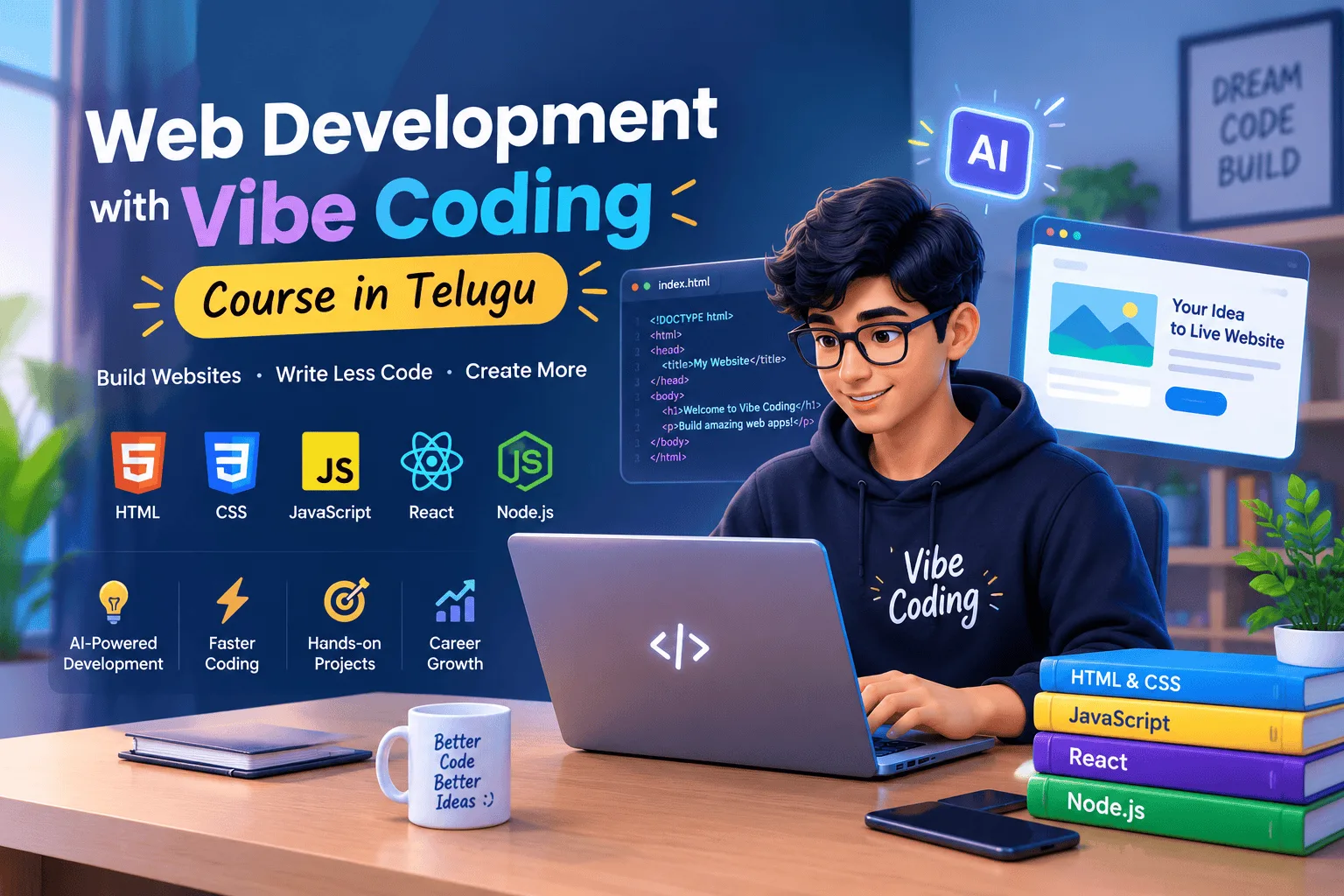
Modern web development is becoming more accessible with the help of artificial intelligence. Beginners no longer need to write every line of code manually to understand how websites work. AI-powered tools can help generate layouts, suggest code, identify errors, and simplify development tasks. The Web Development with Vibe Coding Course in Telugu helps learners understand how to use these tools while building practical web development skills.
One important concept to learn is the difference between frontend development and backend development. Both are essential for creating functional websites and web applications. By combining AI assistance with fundamental programming knowledge, learners can explore how complete websites are designed, developed, tested, and deployed.
What Is Frontend Development?
Frontend development focuses on the parts of a website that users see and interact with. It includes page layouts, navigation menus, buttons, forms, images, and responsive designs.
The main technologies used in frontend development are:
- HTML: Defines the structure of a web page.
- CSS: Controls colors, spacing, typography, and visual presentation.
- JavaScript: Adds interactive features and dynamic behavior.
- Frontend frameworks: Tools such as React help developers build reusable user interface components.
AI tools can assist with creating page layouts, generating CSS, improving mobile responsiveness, and explaining JavaScript functions. For example, a learner can describe a requirement for a course registration page and ask an AI coding assistant to generate an initial layout.
However, the generated output should be reviewed and tested to ensure that it works correctly across different screen sizes and browsers.
What Is Backend Development?
Backend development manages the operations that happen behind the user interface. It handles application logic, user authentication, database operations, server communication, and information processing.
Common backend technologies include:
- Node.js: Runs JavaScript on the server.
- Python: Supports backend applications and automation.
- Databases: MySQL and PostgreSQL store structured information.
- APIs: Allow different software systems to exchange data.
- Server frameworks: Help organize backend functionality and application logic.
AI assistants can generate starter code for APIs, explain database queries, and help investigate errors. For instance, a learner building an online course website can use AI to understand how a registration form sends information to a backend service.
AI-generated backend code requires particular care because security, data validation, access control, and error handling must be implemented correctly.
How AI Connects Frontend and Backend Development
AI-powered development tools can help learners connect different parts of a website. Consider an online learning platform with a course listing page and a registration form.
The frontend displays course information and collects user details. The backend validates the submitted information and communicates with a database. An API connects these components so that information can move between them.
With a well-written prompt, an AI tool can help generate a starter implementation for each component. Learners can then test the integration, identify problems, and improve the application step by step.
The Web Development with Vibe Coding Course in Telugu can be useful for understanding this workflow in a language learners are comfortable with, while developing practical knowledge of modern web technologies.
Practical Projects to Learn Frontend and Backend
Beginners can practise their skills through projects such as:
- Personal portfolio website: Build a responsive website with a profile, skills, projects, and contact information.
- Course registration application: Create a registration form and connect it to a backend.
- Task management tool: Allow users to add, update, and remove tasks.
- Blog application: Display articles and explore how content can be stored and retrieved.
- Student dashboard: Present course details, progress information, and basic user interactions.
These projects help learners understand how separate components work together in a complete application.
Benefits of Learning Web Development with AI
AI-assisted development can make the learning process more interactive. Beginners can request code explanations, explore alternative solutions, and troubleshoot common programming errors. It can also reduce repetitive work during prototyping.
Nevertheless, AI is an assistant rather than a replacement for technical understanding. Learners should understand the generated code, check its accuracy, test functionality, and follow secure development practices.
Frequently Asked Questions
1. Can AI build both frontend and backend applications?
Yes. AI tools can assist with both frontend interfaces and backend logic, but the output requires review, testing, and integration.
2. Do I need to learn HTML, CSS, and JavaScript?
Yes. These fundamentals help you understand, customize, and debug AI-generated websites.
3. Can beginners learn backend development with AI?
Yes. Beginners can start with simple APIs and database exercises, gradually learning authentication, validation, and security.
4. Is vibe coding useful for real-world projects?
It can accelerate prototyping and development, provided the application is carefully tested and maintained.
5. Can I learn these concepts in Telugu?
A Telugu-language course can make explanations easier to follow while you practise using industry-relevant development tools.
Conclusion
Frontend and backend development work together to create complete web applications. AI tools can help learners generate code, explore solutions, and build projects more efficiently, while programming fundamentals remain essential. The Web Development with Vibe Coding Course in Telugu offers a learning path for exploring AI-assisted development and practising how modern websites work from the user interface to the server.