
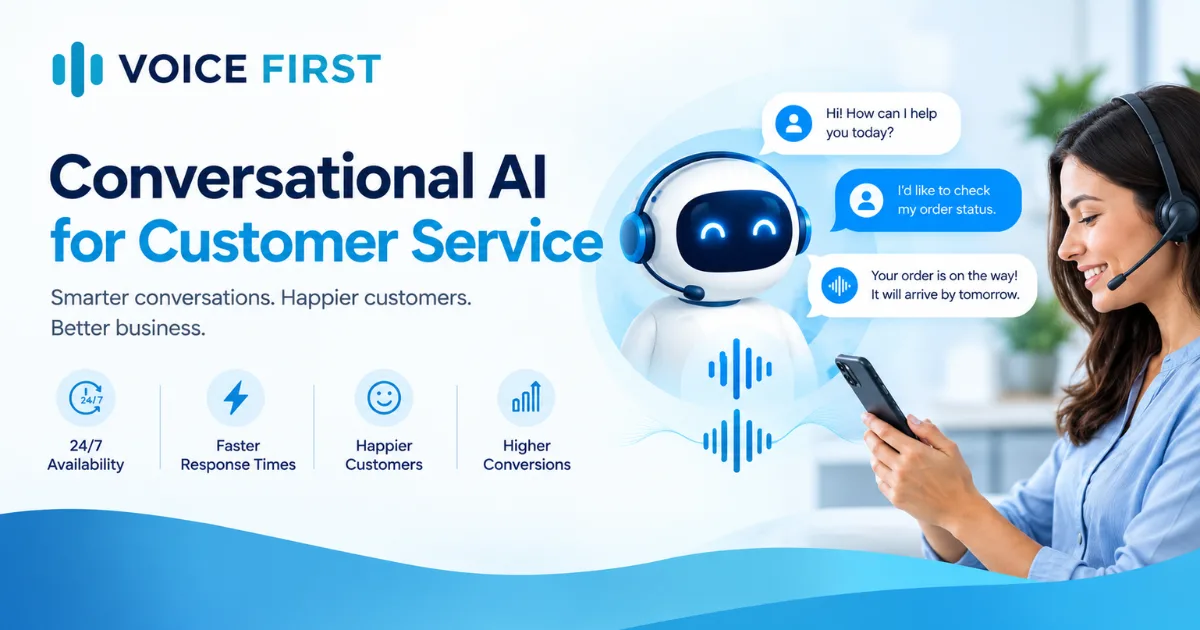
The way people interact with software is changing. For decades, digital experiences have relied on clicking buttons, navigating menus, filling out forms, and switching between screens. These methods remain useful, but they can also make simple tasks unnecessarily complicated. Voice First Technology offers another approach: allowing people to interact with software through natural conversation.
With advances in artificial intelligence (AI), speech recognition, and language understanding, voice interfaces are becoming more capable of handling complex requests. Businesses can explore new ways to support customers, simplify workflows, and create more accessible digital experiences.
For business leaders, product managers, developers, and innovation teams, understanding this shift is becoming increasingly important. Howard Tiersky's upcoming book, Voice First, explores how organizations can prepare for a future in which people communicate with software more naturally.
What Is Voice First Technology?
Voice First Technology is an approach to software design in which speaking and listening are central to the user experience rather than secondary features added to a traditional interface.
Instead of requiring users to navigate several screens, a voice-first application allows them to explain what they want to accomplish in everyday language. The application interprets the request, gathers additional information when necessary, and helps complete the task.
For example, a customer using a traditional banking application might navigate multiple menus to find a recent transaction. A voice-first experience could allow the customer to ask, "Can you show me my latest transactions?" and receive a relevant response.
The goal is not to eliminate screens entirely. It is to make interactions more convenient by choosing the interface that best suits the task.
Why Voice First Technology Matters for Businesses
Adopting new technology is most valuable when it solves a genuine business problem. Voice First Technology offers several opportunities for organizations looking to improve digital experiences.
1. Simplifying Customer Interactions
Customers often abandon digital processes when they become confusing or require too many steps. Voice interfaces can make common tasks easier by allowing users to describe their needs directly.
For example, an online retailer could help customers find products, check order statuses, or understand return policies through conversational interactions. A well-designed system can also ask follow-up questions when a request is unclear.
This creates an opportunity to reduce unnecessary friction and help customers reach their goals more efficiently.
2. Improving Employee Productivity
Employees frequently spend time searching for information, updating records, and navigating business applications. Voice-enabled workflows may simplify these activities, particularly when employees are working away from a desk or using their hands for other tasks.
A team member might ask an internal assistant to summarize a project update, locate a document, or prepare a meeting agenda. Depending on the system's integrations and permissions, the application could retrieve information or initiate an approved workflow.
Business leaders should evaluate these opportunities based on measurable outcomes, such as time saved, task completion rates, and employee satisfaction.
3. Supporting Accessibility and Inclusion
Voice interaction can provide an alternative for people who find typing, reading small text, or navigating complex interfaces difficult. It may also help users who are multitasking or accessing services in situations where hands-free interaction is useful.
However, voice should not be the only available option. Background noise, speech differences, hearing impairments, privacy concerns, and personal preferences can affect usability. Offering voice alongside visual and text-based alternatives creates a more inclusive experience.
Voice First Design: Building Experiences Around Conversation
Successful voice applications require more than accurate speech recognition. They need thoughtful Voice First Design that considers how people communicate, correct mistakes, and make decisions.
Several principles can help teams create better experiences:
- Understand intent: Focus on what the user wants to achieve rather than expecting exact commands.
- Maintain context: Use relevant information from the current interaction to handle follow-up questions.
- Ask for clarification: Confirm important details when a request could have multiple meanings.
- Support corrections: Let users change their instructions, interrupt responses, or reverse actions where possible.
- Manage expectations: Explain when a task is processing or when additional information is required.
- Protect user trust: Request permission before sensitive actions and communicate limitations honestly.
For example, if someone asks an application to schedule a meeting but does not specify a time, the system should ask a relevant follow-up question instead of making an unsupported assumption.
These design decisions help distinguish genuinely conversational software from traditional applications that simply accept spoken commands.
The Role of a Conversational AI Platform
A conversational AI platform provides technologies that help applications understand user requests and generate appropriate responses. Depending on the platform, these capabilities may include speech recognition, language models, conversation management, text-to-speech generation, and integrations with external systems.
When combined effectively, these components can support more flexible interactions than fixed command-and-response systems.
Consider a customer service application. A user might explain a problem in their own words, provide additional details when asked, and receive guidance based on relevant company information. If the issue requires human assistance, the application can help direct the conversation to the appropriate team.
Businesses evaluating a conversational AI platform should consider integration capabilities, data privacy, security, response speed, scalability, and the ability to monitor performance.
The technology should support the organization's objectives rather than being adopted simply because conversational AI is attracting attention.
AI Voice Agents and Application Development
An AI voice agent can go beyond answering questions. When properly configured, it can interpret requests, maintain conversational context, access authorized tools, and assist with multi-step tasks.
Potential applications include appointment scheduling, customer support, internal knowledge retrieval, and routine administrative workflows.
For teams exploring Voice Application Development, a practical starting point is to identify a clear use case and build a focused solution.
How to Build an AI Voice Agent
Organizations wondering how to build an AI voice agent can follow a structured development process:
- Define the objective: Identify the specific user problem the agent should solve.
- Choose the technology: Select suitable speech recognition, AI reasoning, and voice-generation components.
- Connect relevant data: Integrate approved business systems, knowledge sources, or APIs.
- Design the conversation: Plan how the agent handles follow-up questions, uncertainty, interruptions, and errors.
- Implement safeguards: Establish access permissions, privacy controls, and confirmation steps for important actions.
- Test real-world scenarios: Evaluate different accents, speaking styles, background noise, ambiguous requests, and response delays.
- Measure and improve: Track task completion, accuracy, customer satisfaction, and the frequency of unresolved requests.
Starting with a limited use case allows teams to learn from real interactions before expanding the agent's responsibilities.
Challenges Business Leaders Should Consider
Voice First Technology is promising, but it is not the best interface for every situation. Tasks involving detailed comparisons, complex forms, precise visual selection, or confidential information may work better with a graphical interface.
Organizations must also consider data protection, inaccurate responses, unexpected actions, integration costs, and user acceptance. A system that misunderstands requests or responds slowly can create more frustration than it removes.
The most effective strategy is to combine voice with other interaction methods where appropriate. Voice should make an experience easier, not force users to adopt a new way of working.
How Voice First Can Shape the Future of Digital Transformation
Digital transformation is not simply about introducing new tools. It involves rethinking how people interact with services, information, and technology to achieve meaningful outcomes.
Voice First Technology encourages organizations to reconsider the role of interfaces in everyday work. Instead of expecting users to learn complicated software processes, businesses can explore experiences that adapt more closely to how people express their needs.
In Voice First, Howard Tiersky examines the principles, design decisions, and technical considerations behind this evolution. His work offers business leaders, designers, and technology teams a framework for thinking about voice-native software and preparing for new approaches to digital interaction.
To explore these ideas further, visit VoiceFirst.ai, where you can discover the book, explore chapter previews, and join the early-reader list.
Conclusion
Voice First Technology represents an important opportunity to rethink digital experiences. From simplifying customer service to supporting employee workflows, voice-driven applications can help organizations make software more accessible and intuitive when applied to the right problems.
Success depends on more than adding an AI model or microphone to an existing product. It requires clear objectives, thoughtful Voice First Design, reliable technology, strong safeguards, and continuous testing.
For business and technology leaders, the next step is to identify where conversation can genuinely improve an experience. By starting with user needs and building carefully, organizations can prepare for a future in which software becomes easier to communicate with and more useful in everyday life.