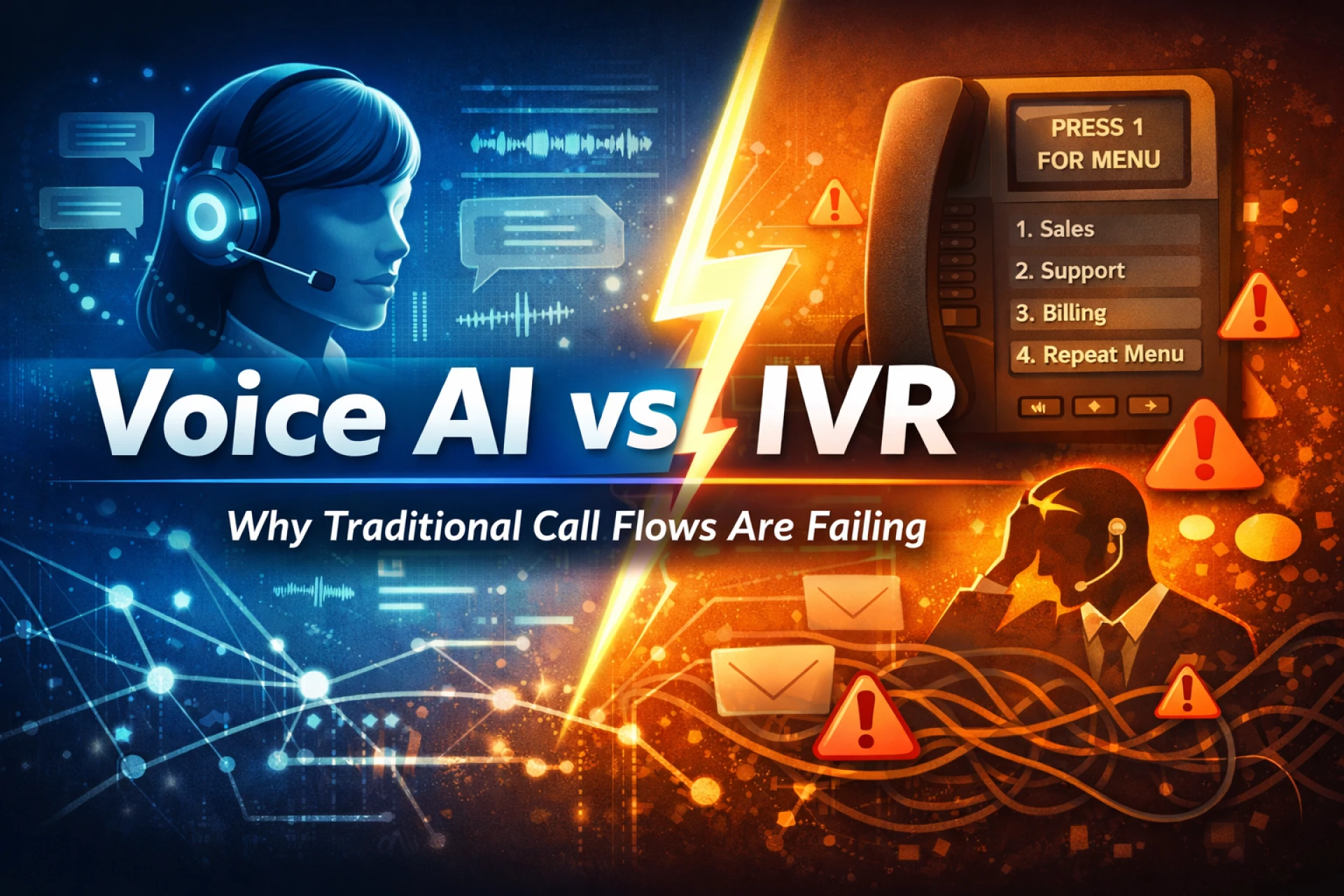
For decades, IVR systems have been the backbone of call centers. Press 1 for sales. Press 2 for support. Press 3 to repeat the options. At one point, this made sense. IVR helped businesses manage call volumes and reduce pressure on human agents.
Today, that same system has become a liability.
Customer expectations have changed, but traditional call flows have not. This gap is why many organizations are now moving away from IVR and toward Voice AI customer support as the primary way to handle inquiries.
The Core Problem With IVR Systems
IVR is built on assumptions that no longer match reality. It assumes callers know exactly what they need. It assumes issues can be categorized upfront. It assumes customers are patient enough to navigate menus.
In practice, none of this is true.
Customers often call because they are unsure, frustrated, or in a hurry. They guess menu options, get routed incorrectly, and end up repeating the same information multiple times. Each transfer increases call time and frustration.
From a business perspective, this leads to higher abandonment rates, longer handle times, and lower satisfaction.
Why IVR Fails at Scale
As call volume grows, IVR becomes harder to manage. Adding more menu options does not improve clarity. It increases complexity.
Edge cases are especially problematic. Any situation that does not fit neatly into a predefined path usually requires a human agent. That means IVR often deflects calls without resolving them.
The result is a system that appears automated but still depends heavily on human intervention.
How Voice AI Changes the Call Experience
Voice AI takes a fundamentally different approach. Instead of asking callers to adapt to a system, it adapts to how people actually speak.
With Voice AI, callers explain their issue in their own words. The system understands intent, responds in context, and asks follow-up questions when needed. Conversations feel natural because they are driven by understanding, not button presses.
A modern AI voice agent can answer calls instantly, handle routine support requests, book appointments, qualified leads, and escalate to a human with full context when necessary.
This removes friction for customers and reduces unnecessary workload for support teams.
Business Impact Beyond Convenience
The shift from IVR to Voice AI is not just about better conversations. It is about better outcomes.
Businesses see fewer missed calls because every call is answered immediately. This speed is critical for ROI; for example, we have seen how Voice AI for Clever leads helps contractors boost conversion with instant response, turning what would be a lost voicemail into a booked job.
First call resolution improves because issues are handled directly instead of being routed blindly. Average handle time drops because customers are not repeating themselves. Over time, these improvements translate into real operational savings and stronger customer trust.
This is why many organizations are now evaluating Voice AI customer support as a core solution, not just an add-on.
How Leaping AI Replaces Rigid Call Flows
Leaping AI is built specifically to move beyond traditional IVR limitations.
Instead of fixed menus, Leaping AI uses conversational intelligence to understand intent in real time. Its AI voice agent handles complete interactions, not just routing. When escalation is needed, calls are transferred smoothly with full context preserved.
This allows businesses to automate more of the call flow without sacrificing customer experience.
Leaping AI also integrates with existing systems such as CRM and scheduling tools, enabling real task completion rather than partial automation.
The Role of Humans in a Voice AI Model
Replacing IVR does not mean removing humans from customer service. It means using them more effectively.
With Voice AI handling repetitive and predictable calls, human agents focus on complex, sensitive, or high-value conversations. This improves both efficiency and job satisfaction.
The result is a balanced system where automation and human expertise work together instead of competing.
Why Traditional Call Flows Are Being Left Behind
IVR was designed for a time when technology could not understand natural speech. Voice AI exists because that limitation no longer applies.
Customers now expect immediacy and clarity. Businesses need systems that scale without creating friction. Traditional call flows cannot meet these expectations. Voice AI can.
Closing Perspective
The move from IVR to Voice AI is not a trend. It is a correction.
As businesses rethink how they handle customer conversations, rigid call flows are giving way to intelligent, adaptive systems. Voice AI is becoming the default because it aligns with how people actually communicate.
If you are exploring an AI voice agent to replace outdated IVR systems and modernize your call operations, you can book a demo with Leaping AI to see how real conversational automation works in practice.