For decades, employee training has largely followed the same pattern: classrooms, presentations, demonstrations, manuals, and hands-on practice. These methods remain useful, but modern industries are facing increasingly complex training requirements.
Employees may need to operate sophisticated machinery, respond to emergencies, understand technical processes, or perform specialised tasks where mistakes can be costly.
This is where Virtual Reality is becoming increasingly relevant.
A growing number of Indian organisations are exploring immersive technology to create realistic training environments where employees can practise skills before applying them in the real world. As adoption grows, the role of a Virtual Reality Company in India is evolving from simply developing VR experiences to solving practical workforce and operational challenges.
Why Is Virtual Reality Becoming Important for Indian Businesses?
India has a diverse industrial landscape, ranging from automotive and manufacturing to pharmaceuticals, energy, infrastructure, and engineering.
Many of these sectors depend on a skilled workforce. However, providing practical training at scale can be challenging.
Physical training environments can require:
- Expensive equipment
- Dedicated training facilities
- Consumable materials
- Instructor availability
- Safety precautions
- Production downtime
VR can complement these traditional approaches by creating a digital environment where employees can practise selected procedures repeatedly.
The technology does not necessarily replace physical training. Instead, it can create another stage in the learning journey—between theoretical knowledge and real-world practice.
Learning by Doing Instead of Watching
One of the biggest differences between VR and conventional digital learning is interaction.
A video can demonstrate how a task should be performed. A VR simulation can allow the learner to perform the task.
Consider an employee learning how to respond to an industrial emergency. Instead of watching an instructional video, the employee can enter a simulated environment, identify hazards, make decisions, and follow an emergency procedure.
The same principle can apply to machinery operation, welding, maintenance, painting, and other technical activities.
This creates a more experiential approach to learning.
Five Practical Applications of VR Training
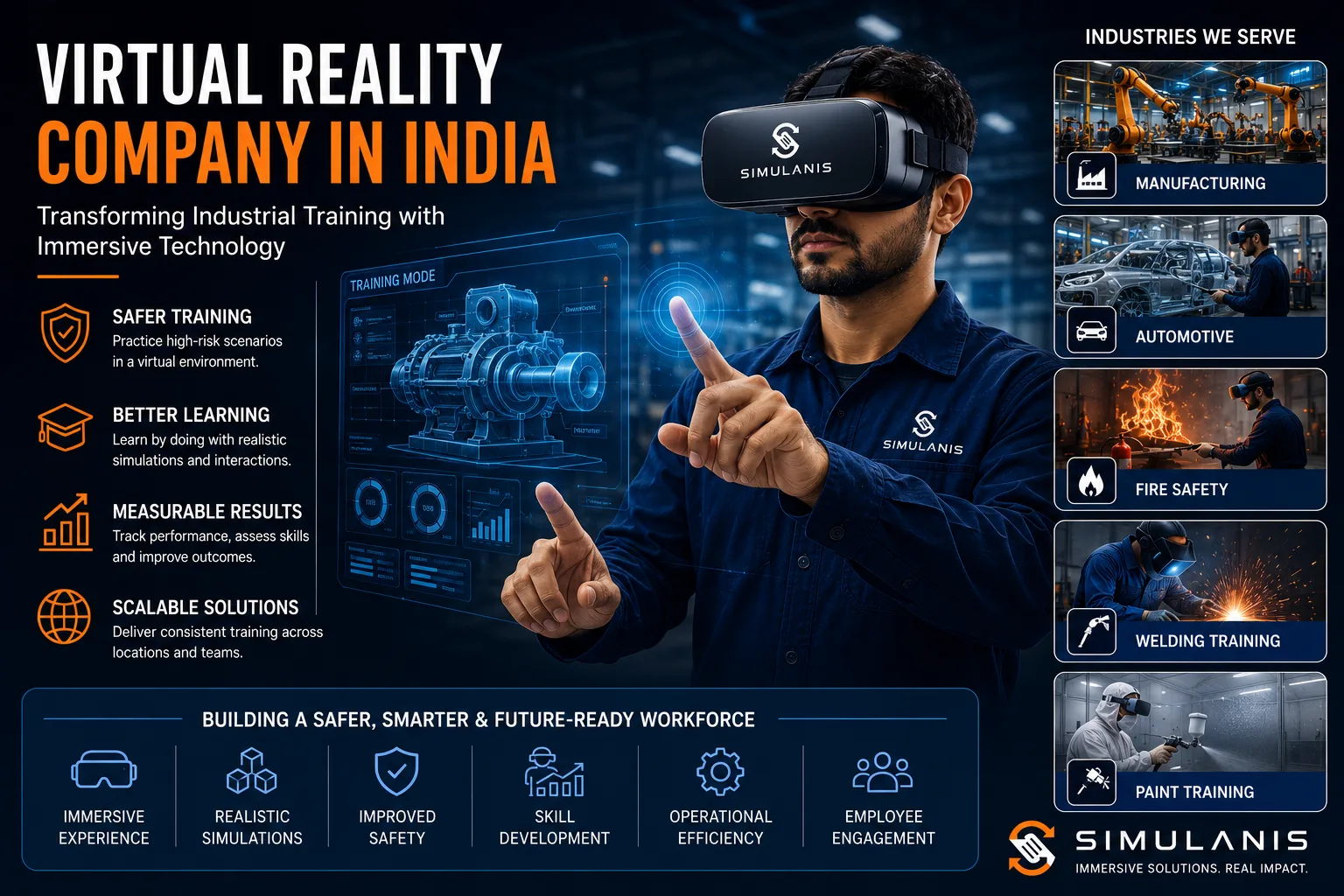
1. Industrial Safety
Safety training is one of the most obvious applications for immersive technology.
VR can recreate hazardous situations without exposing employees to the actual danger. Employees can practise identifying risks and responding to simulated incidents in a controlled environment.
For organisations operating in high-risk environments, this can provide an additional way to prepare employees for situations that may be difficult or dangerous to recreate physically.
2. Fire Safety
Fire emergencies require employees to respond quickly and follow appropriate procedures.
A VR fire safety simulation can recreate different emergency scenarios and allow employees to practise their response.
The experience can be repeated, giving learners opportunities to become more familiar with emergency procedures.
3. Welding and Technical Skills
Welding requires coordination, technique, and repeated practice.
A VR welding simulator can provide an immersive environment where trainees become familiar with welding procedures and techniques before progressing to physical equipment.
This approach can complement conventional practical training while providing an additional environment for practice.
4. Automotive Paint Training
Automotive painting involves technique, consistency, and an understanding of application processes.
A VR simulation can recreate the painting environment and allow trainees to practise selected techniques digitally.
This can be particularly useful during early-stage training, where repeated physical practice may consume paint and other materials.
5. Manufacturing and Machinery Training
Manufacturing environments often contain complex machinery and processes.
VR can simulate equipment, production environments, assembly processes, maintenance procedures, and other workflows.
Employees can become familiar with processes in a simulated environment before working with actual machinery.
What Makes a Good Virtual Reality Company in India?
Not every VR provider is necessarily suited to industrial training.
There is a significant difference between creating a visually impressive VR experience and developing a simulation that accurately supports a business process.
When selecting a Virtual Reality Company in India, organisations should consider several factors.
Understanding of the Industry
The provider should understand the environment in which the solution will be used.
A manufacturing simulation, for example, requires a different approach from a consumer entertainment application.
Realistic Simulation
The virtual environment should represent the relevant process clearly enough to support meaningful learning.
Accuracy and usability are often more important than simply adding visual effects.
Customisation
Every organisation has its own equipment, procedures, terminology, and training requirements.
A flexible VR solution should be capable of adapting to these requirements.
Performance Measurement
Training becomes more valuable when organisations can understand how employees are performing.
Analytics and reporting can provide information about progress, mistakes, completion, and other training indicators.
Scalability
A VR project may begin as a pilot involving a small group of employees.
If successful, it may eventually need to support hundreds or thousands of users across multiple locations.
The technology partner should therefore consider scalability from the beginning.
Simulanis and Immersive Industrial Training
Simulanis is an immersive technology company focused on VR, simulation, and extended reality solutions for industrial and enterprise applications.
Its work includes immersive solutions for areas such as manufacturing, automotive, fire safety, welding, painting, and workforce development.
The company's approach focuses on connecting immersive technology with real-world training requirements.
This distinction is important.
The objective of industrial VR is not simply to put an employee inside a virtual environment. The objective is to create an experience that helps the employee understand a process, practise a skill, or prepare for a real-world situation.
VR Is Part of a Larger Technology Ecosystem
Virtual Reality is also becoming connected with other technologies.
Artificial Intelligence can potentially support adaptive learning and intelligent feedback.
Analytics can help organisations understand training performance.
Digital twins can create digital representations of physical assets and environments.
Augmented Reality and Mixed Reality can extend digital information into physical workplaces.
Together, these technologies are creating new possibilities for workforce development.
What Could the Future Look Like?
The future of industrial training is unlikely to be completely virtual.
Instead, organisations may increasingly combine classroom learning, physical practice, VR simulations, AR-assisted work, and data-driven assessment.
An employee could learn the theory in a classroom, practise the procedure in VR, perform the task on real equipment, and then receive additional digital guidance through AR.
This blended approach could make workforce development more flexible and measurable.
For Indian industries facing the challenge of training large and diverse workforces, immersive technology may become an increasingly important part of that ecosystem.
Final Thoughts
Virtual Reality is no longer limited to gaming and entertainment. It is becoming a practical technology for organisations looking to improve training, safety, technical skills, and workforce readiness.
The right Virtual Reality Company in India can help businesses move beyond technology demonstrations and develop immersive solutions around genuine operational challenges.
For industries where employees need to learn complex or potentially hazardous procedures, VR provides an opportunity to practise in a controlled environment before entering the real world.
As India's industrial sector continues to embrace digital transformation, immersive learning could become an important part of how the next generation of workers is trained.
Simulanis is helping organisations explore this transition by developing immersive VR and simulation solutions designed around real-world industrial training needs.