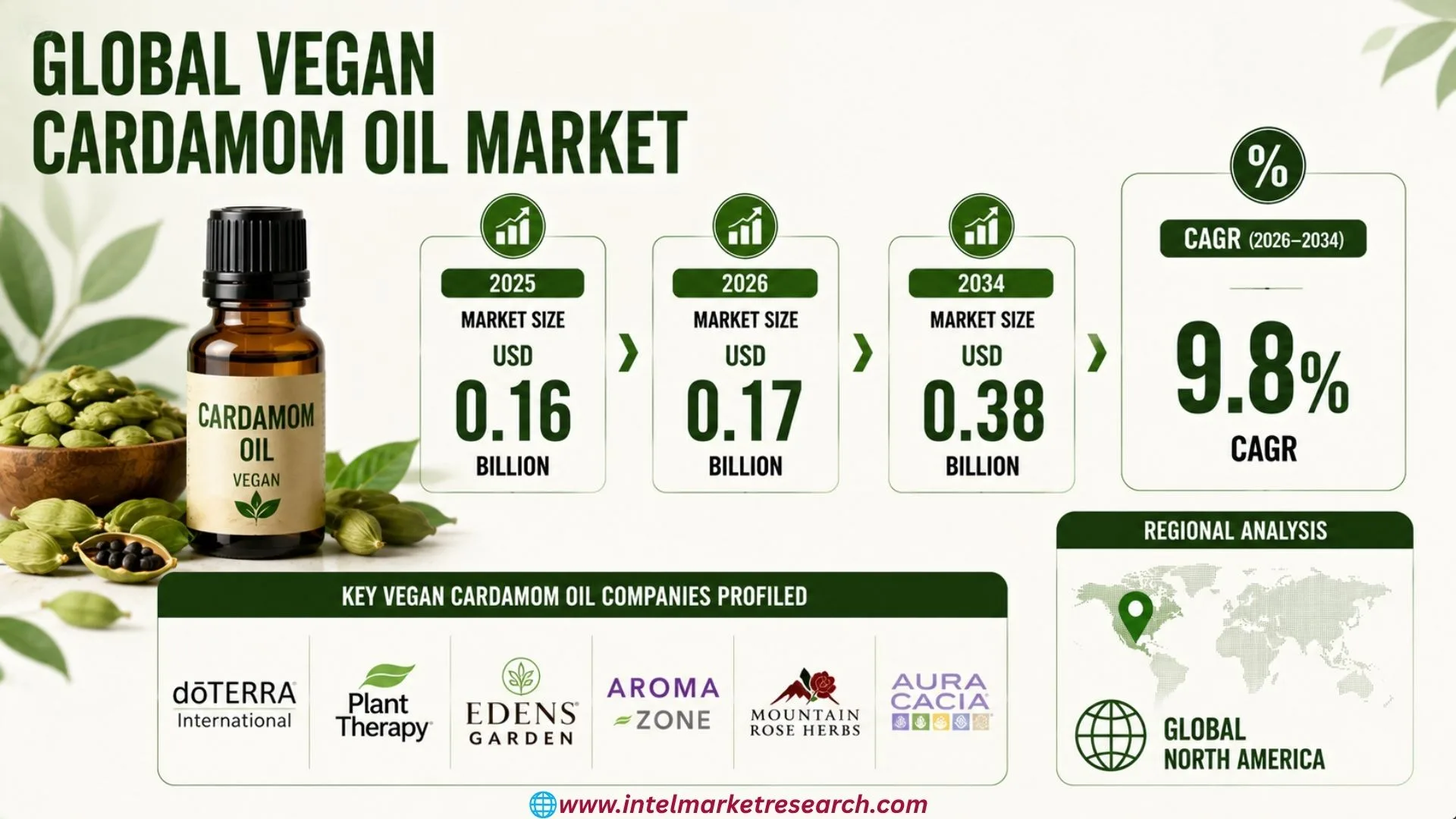
According to a new report from Intel Market Research, global Vegan Cardamom Oil market was valued at USD 0.16 billion in 2025 and is projected to reach USD 0.38 billion by 2034, growing at a robust CAGR of 9.8% during the forecast period (2026–2034). This growth is driven by the accelerating consumer shift toward plant‑based, clean‑label ingredients, the expanding portfolio of vegan ready‑to‑eat meals, and increasing adoption of natural essential oils in premium cosmetics and functional food applications.
Vegan cardamom oil is a plant‑derived essential oil obtained by cold‑pressing or super‑critical CO₂ extraction of cardamom seeds without any animal‑based solvents or additives. It offers a sweet‑spicy aroma, rich antioxidant profile, and excellent stability, making it highly suitable for clean‑label food formulations, high‑end cosmetics, and therapeutic aromatherapy products.
📥 Download FREE Sample Report:
Vegan Cardamom Oil Market — View in Detailed Research Report
This report provides a deep insight into the global Vegan Cardamom Oil market covering all essential aspects-from a macro overview of market size and growth trajectories to micro‑level details such as competitive landscape, innovation trends, niche applications, key growth drivers and challenges, SWOT analysis, and value‑chain assessment. The analysis equips readers with a clear understanding of market dynamics and actionable strategies for improving profitability and market positioning.
📥 Download Sample Report: https://www.intelmarketresearch.com/download-free-sample/53339/vegan-cardamom-oil-market
Key Market Drivers
Rising Consumer Demand for Plant‑Based Flavors
The Vegan Cardamom Oil Market is being propelled by a notable shift toward plant‑based diets, with consumers seeking natural flavor enhancers that align with vegan lifestyles. Recent surveys indicate that over 60 % of health‑conscious shoppers prefer vegan‑certified ingredients, prompting food manufacturers to expand product portfolios that feature vegan cardamom oil as a premium aromatic agent.
Sustainability and Ethical Sourcing
Companies are emphasizing sustainable cultivation of cardamom, reducing carbon footprints and supporting fair‑trade practices. This ethical positioning resonates with eco‑aware buyers and contributes to an estimated 8 % CAGR for the sector. The integration of vegan cardamom oil into clean‑label regulatory frameworks in Europe and North America further accelerates market adoption.
➤ “The integration of vegan cardamom oil into premium food and cosmetic lines has become a decisive factor for brand differentiation.”
Market Challenges
Price Sensitivity in Emerging Markets
While demand is robust in mature economies, price‑sensitive consumers in emerging regions often opt for lower‑cost flavor substitutes, limiting the penetration of premium vegan cardamom oil.
Supply Chain Volatility
Fluctuations in cardamom harvest yields due to climate variability can lead to inconsistent supply, raising procurement costs for manufacturers and creating uncertainty in long‑term contracts.
Market Restraints
Limited Awareness Among Small‑Scale Producers
Many small and medium‑size food producers remain unaware of the functional benefits and certification process for vegan cardamom oil, resulting in slower adoption rates.
Regulatory Complexities
Vegan certification requirements differ across jurisdictions, compelling producers to navigate a fragmented labeling landscape. The relatively high production cost compared with conventional cardamom extracts also discourages cost‑conscious manufacturers from making a swift switch.
Market Opportunities
Growth in Vegan Ready‑to‑Eat Meals
The surge in vegan ready‑to‑eat and meal‑kit offerings presents a fertile opportunity for the Vegan Cardamom Oil Market. Brands are actively seeking authentic, plant‑derived aromatics to enhance taste without compromising vegan integrity.
Expansion into Natural Personal‑Care
The cosmetics sector is increasingly exploring vegan essential oils for fragrance‑free, cruelty‑free products. This opens new B2B channels for cardamom oil suppliers, especially those with organic and fair‑trade certifications.
Agro‑Technology Investments
Investments in agronomic research, high‑yield cardamom varieties, and advanced extraction technologies can lower production costs, unlocking broader market access and strengthening competitive positioning.
Competitive Landscape
Vegan Cardamom Oil Market — Competitive Landscape Overview
The vegan cardamom oil segment is dominated by a handful of large essential‑oil distributors that have successfully integrated vegan certification into their product pipelines. doTERRA International leads the market by leveraging a vertically integrated supply chain, strict sourcing from certified organic farms in Guatemala and India, and transparent third‑party testing that meets vegan standards. This scale allows doTERRA to command premium pricing while offering consistent quality to food‑service, cosmetics, and natural‑flavor manufacturers.
Parallel to doTERRA, Plant Therapy and Edens Garden have captured growth by focusing on online retail channels, aggressive SEO strategies, and transparent batch‑by‑batch analysis that appeals to health‑conscious consumers. Their ability to bundle vegan cardamom oil with complementary vegan blends has reinforced market share and created barriers to entry for smaller players.
Beyond the leading tier, a diverse set of niche producers enriches the competitive landscape. AromaZone, Mountain Rose Herbs, and Aura Cacia differentiate through small‑batch processing, direct relationships with smallholder farmers, and certifications such as USDA‑Organic and Vegan Society approval. Companies like Bulk Apothecary and Organic Aromas exploit cost‑leadership by sourcing bulk quantities while maintaining vegan integrity, targeting large‑scale food manufacturers. Emerging brands such as Natural Scent, Essential Oils Academy, Herbalist & Co., Botanic Hearth, The Aromatics, Old Mother Earth and Sundara Botanics focus on specialty applications-including gourmet vegan sauces and premium spa formulations-leveraging storytelling and ethical sourcing to capture premium niche segments.
Market Trends
Rising Demand for Plant‑Based Flavor Solutions
The Vegan Cardamom Oil Market has observed a notable shift toward plant‑based flavoring agents in 2023 and early 2024. Food manufacturers are replacing traditional dairy‑based or synthetic aromatics with vegan‑certified cardamom oil to meet clean‑label expectations. Retail data shows a steady increase in shelf‑space allocation for vegan‑friendly spice extracts across major supermarket chains in North America, Europe, and parts of Asia‑Pacific. This growth aligns with broader consumer surveys that rank natural, cruelty‑free ingredients among the top purchasing drivers for health‑conscious shoppers. Consequently, suppliers are scaling production capacity, and distributors report shorter lead times for certified vegan cardamom oil compared with the previous year.
Sustainability and Ethical Sourcing
Supply‑chain transparency has become a core requirement for buyers of vegan cardamom oil. Producers are documenting seed origin, employing fair‑trade practices, and utilizing low‑energy CO₂ supercritical extraction. These steps reduce carbon footprint and appeal to brands that publish sustainability reports. Recent audits indicate that over 60 % of the volume shipped to Western Europe now carries a verified ethical label, encouraging further integration of vegan cardamom oil into premium product lines. Packaging innovations-such as recyclable amber glass bottles and biodegradable dropper caps-are being paired with the ethical sourcing narrative, while logistics providers report a decline in temperature‑sensitive spoilage incidents.
Expansion into Functional Food Applications
Beyond conventional culinary uses, the Vegan Cardamom Oil Market is entering functional food segments, including nutraceutical beverages and probiotic yogurts formulated for vegan consumers. The oil’s antioxidant profile and aromatic potency support product differentiation in a crowded market. Companies are leveraging its natural preservative qualities to extend shelf life without synthetic additives, thereby simplifying label claims. Early adopters report positive consumer feedback on taste and perceived health benefits, prompting wider rollout across retail and food‑service channels. Analysts project that the functional segment will account for a growing share of total sales as brands prioritize ingredient stories that combine taste, health, and sustainability.
Regional Analysis
North America
North America presents a dynamic and rapidly expanding market for vegan cardamom oil. Fueled by a growing consumer inclination toward plant‑based alternatives and an increasing awareness of natural ingredients, demand is experiencing significant upward momentum. The region’s established health and wellness industry, coupled with a rising number of vegan and vegetarian consumers, creates fertile ground for the market. Culinary innovators are incorporating the oil into gourmet and ethnic dishes, while nutraceutical and cosmetic firms explore its potential skin‑soothing and antioxidant benefits.
Europe
Europe exhibits a robust and mature market, driven by high consumer awareness regarding health, sustainability, and ethical sourcing. The strong emphasis on plant‑based diets and the burgeoning vegan population fuel demand for organic and fair‑trade certified vegan cardamom oil. Stringent regulatory frameworks ensure high quality and safety standards, reinforcing confidence among manufacturers and end‑users.
Asia‑Pacific
Asia‑Pacific represents a rapidly growing market, propelled by rising disposable incomes, urbanization, and a growing appetite for international cuisines. Countries such as Japan, South Korea, and Australia are witnessing a surge in demand, driven by sophisticated culinary scenes and health‑conscious consumers. The region offers a mix of established and emerging players, with significant potential for expansion across both consumer and industrial applications.
South America
South America presents a developing market with increasing interest from the food and beverage industry. Growing vegan populations and the rising popularity of plant‑based diets contribute to market expansion, although awareness remains limited and distribution networks are fragmented.
Middle East & Africa
The Middle East and Africa are emerging markets, driven by a growing focus on health and wellness and an expanding vegan and vegetarian consumer base. While opportunities are growing, challenges persist around import regulations and distribution infrastructure.
Report Scope
This market research report offers a holistic overview of global and regional markets for the forecast period 2025–2032. It presents accurate and actionable insights based on a blend of primary and secondary research.
📥 Download Sample Report: https://www.intelmarketresearch.com/download-free-sample/53339/vegan-cardamom-oil-market
📘 Get Full Report Here:
Vegan Cardamom Oil Market — View Detailed Research Report
About Intel Market Research
Intel Market Research is a leading provider of strategic intelligence, offering actionable insights in biotechnology, pharmaceuticals, and healthcare infrastructure. Our research capabilities include:
- Real-time competitive benchmarking
- Global clinical trial pipeline monitoring
- Country-specific regulatory and pricing analysis
- Over 500+ healthcare reports annually
Trusted by Fortune 500 companies, our insights empower decision‑makers to drive innovation with confidence.
🌐 Website: https://www.intelmarketresearch.com
📞 Asia-Pacific: +91 9169164321
🔗 LinkedIn: Follow