
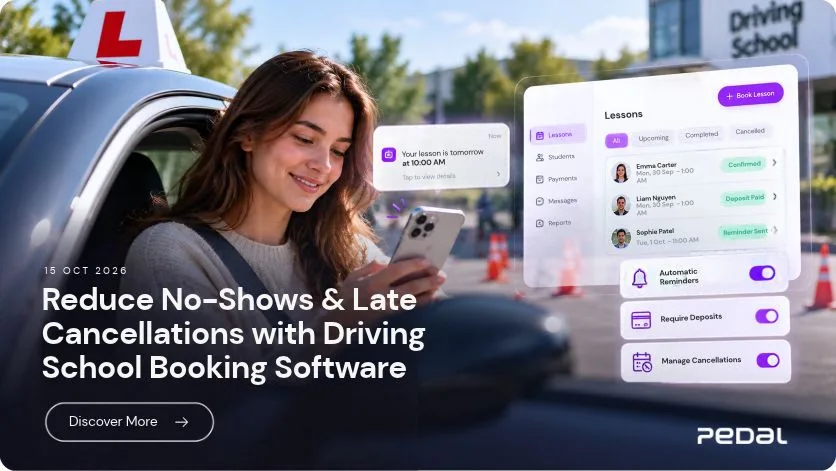
For driving schools, a missed lesson is rarely just a missed lesson. It is a block of instructor time that goes unused, a vehicle that sits idle, and a slot that could have gone to another student on a waiting list. When no-shows and last-minute cancellations happen regularly, they quietly erode both revenue and instructor productivity. Many driving schools still manage this through manual reminders and informal cancellation policies, which tend to break down as student numbers grow. Booking software built specifically for driving schools offers a more consistent way to address the problem, through deposit policies, automated reminders, and clearly enforced cancellation windows.
Why No-Shows and Late Cancellations Are Costly
Unlike many service businesses, driving lessons are time- and instructor-bound. A missed appointment cannot easily be filled on short notice, since it depends on an available instructor, a vehicle, and often a specific pickup location. When a student cancels an hour before a lesson or simply does not show up, that slot is effectively lost for the day.
Over time, this adds up. A driving school running a handful of no-shows each week across multiple instructors is losing paid lesson time that directly affects revenue. It also creates scheduling unpredictability, making it harder for school owners to plan instructor hours or estimate monthly capacity with any accuracy.
Deposit Policies as a First Line of Defense
One of the most effective ways booking software addresses this problem is through built-in deposit collection at the time of booking. Instead of confirming a lesson on a verbal or informal basis, students are asked to pay a partial deposit or the full lesson fee upfront through the booking platform.
This changes the psychology of the booking. A lesson that has already been paid for, even partially, carries more weight than one that was simply penciled into a calendar. Deposits give students a tangible reason to show up or to cancel with enough notice to avoid losing the payment. For driving schools, this also means that even if a cancellation does happen, the lost time is at least partially offset financially, rather than resulting in a complete loss.
Booking software typically allows schools to set deposit rules by lesson type, instructor, or even time slot, which gives school owners flexibility depending on how much risk a particular booking carries. Peak time slots, for example, can carry a higher deposit requirement than off-peak hours with more flexibility to rebook.
Automated Reminders Reduce Simple Forgetfulness
Not every no-show is intentional. In many cases, students simply forget, especially when lessons are booked days or weeks in advance. Automated reminders address this directly by sending confirmation messages through SMS, email, or app notifications at set intervals before the lesson, such as 48 hours and again two hours before the scheduled time.
This removes the burden from instructors or front desk staff, who would otherwise need to manually call or message each student individually. It also creates a consistent communication pattern that students come to expect, which reduces the likelihood of a lesson slipping their mind entirely. For driving schools running high lesson volumes across multiple instructors, automated reminders are one of the simplest ways to cut down on unintentional no-shows without adding administrative work.
Cancellation Windows Set Clear Expectations
A defined cancellation window, built directly into the booking system, gives students a clear rule to follow rather than relying on informal understanding. Common structures include allowing free cancellation up to 24 or 48 hours before a lesson, with a partial or full charge applied for cancellations made after that point.
Booking software enforces this consistently, without requiring staff to manually track individual cancellation timing or make judgment calls on a case-by-case basis. This consistency matters. When cancellation rules are applied unevenly, students quickly learn that the policy is negotiable, which undermines its effectiveness. A system that automatically applies the same rule to every booking removes ambiguity and reduces the number of last-minute cancellations that fall outside the agreed window.
Clear cancellation windows also make it easier for driving schools to offer that freed-up slot to another student, particularly when the cancellation happens with enough notice for the system to notify waitlisted students automatically.
Bringing These Elements Together
Deposit policies, automated reminders, and cancellation windows work best when used together rather than in isolation. A deposit alone does not prevent forgetfulness, and a reminder alone does not offset the financial impact of a late cancellation. Booking software that integrates all three creates a more complete system, where students are financially invested in their booking, consistently reminded ahead of time, and clearly informed of the rules around changing or canceling a lesson.
For driving schools managing multiple instructors and vehicles, this level of consistency is difficult to maintain manually. Automated systems apply the same standard to every booking, which reduces the administrative burden on staff while giving students a predictable, transparent process.
A More Reliable Way to Manage Lesson Scheduling
No-shows and late cancellations will likely never be eliminated, since some level of unpredictability is unavoidable when working with students, many of whom are juggling school, work, or family commitments. What booking software changes is the frequency and financial impact of these disruptions. Through deposit collection, automated reminders, and enforced cancellation windows, driving schools can protect instructor time, reduce revenue lost to empty slots, and create a more predictable operating rhythm across their entire scheduling system.
Visit, pedalmobility.com for more!