
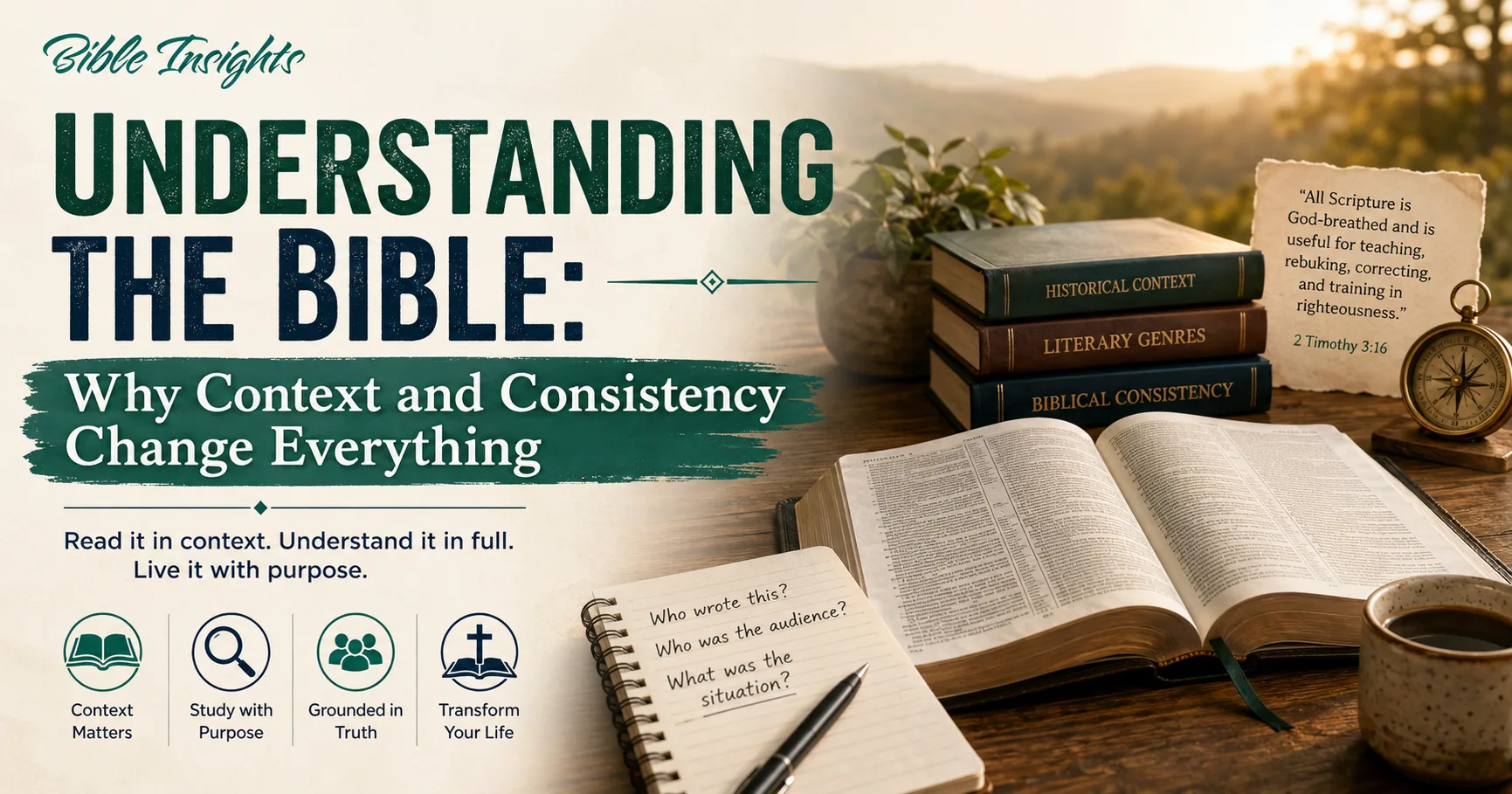
Most people who pick up a Bible for the first time in years aren't lacking faith. They're lacking a starting point. Understanding the Bible isn't about memorizing verses or winning arguments. It's about learning to read Scripture the way it was meant to be read: as a unified story, written across centuries, meant to shape how we live today. That shift in perspective, from collecting verses to following a story, changes almost everything about how a person approaches faith.
At Bible Insight Foundation, we hear the same question again and again. Why does the Bible feel so hard to follow sometimes? The honest answer is that it wasn't written to a modern audience, in a modern language, using modern literary conventions. It was written by real people, in real historical moments, using genres and idioms that don't always translate directly into how we communicate today. That gap is normal. It doesn't mean something is wrong with you as a reader.
Why Historical Context Isn't Optional
Here's something worth considering. When Paul wrote to the church in Corinth, he wasn't writing a general theology textbook. He was responding to specific problems in a specific city with a specific culture. Strip away that context, and a passage can be misread in ways the author never intended.
This is where many well-meaning readers get stuck. They open to a random page, read a verse in isolation, and try to apply it directly to their situation. Sometimes that works. Often it doesn't. Bible Insights grow when readers start asking who wrote this, who were they writing to, and what problem or moment prompted these words. Those three questions alone resolve a surprising number of confusing passages.
Consider the difference between reading a letter from a friend and reading a court ruling. Both are text. Both use words. But you'd read them completely differently, expecting different structures and purposes. Scripture contains letters, poetry, historical narrative, prophecy, wisdom literature, and legal instruction. Each genre asks something different of the reader.
Literary Genre Shapes Meaning
A psalm is not a history book. A parable is not a legal code. Yet many readers approach every page with the same flat, literal expectation, and that's where misunderstanding creeps in.
Take the poetic imagery in the Psalms. When David writes about mountains skipping like rams, no one assumes he means it literally. The genre signals that this is expressive, emotional language meant to convey awe and wonder. The same principle, once understood, protects readers from flattening apocalyptic literature or wisdom sayings into rigid, literal formulas they were never intended to carry.
Understanding the Bible at this level takes patience. It's not a weekend project. But once a reader starts noticing genre, historical setting, and original audience, the text opens up in ways that feel almost like discovering a new book entirely.
Building Habits That Actually Stick
Knowledge without practice fades quickly. That's true of anything, and Scripture is no exception. The readers who grow most aren't necessarily the ones with the most theological training. They're the ones who show up consistently.
A few habits tend to make the biggest difference:
Read in context. Before jumping to a single verse, skim the surrounding chapter. Notice what comes before and after.
Ask questions honestly. Confusion is not a failure. It's often the beginning of real understanding.
Return to difficult passages. Some sections take years, not days, to settle in a person's heart and mind.
Truthfully, consistency matters more than intensity. Fifteen focused minutes a day will shape a person's understanding far more than an occasional three hour deep dive followed by weeks of silence. That perspective changes everything about how people plan their study time.
Common Misunderstandings Worth Naming
Not every misreading comes from bad intentions. Often it's simply unfamiliarity with how ancient texts work. One common pattern is treating every promise in Scripture as a universal, unconditional guarantee, when many were spoken to specific people in specific circumstances. Another is ignoring the literary structure of a book, missing how an author builds an argument across chapters rather than in isolated verses.
None of this is meant to make anyone feel judged for how they've read before. Nearly every serious student of Scripture has made these same mistakes early on. The goal isn't perfection. It's growth.
Why This Work Matters
At its core, Understanding the Bible is a lifelong pursuit rather than a destination you arrive at and check off. The organizations, teachers, and resources that support this kind of study, including the work done through Bible Insight Foundation, exist to walk alongside readers rather than hand them shortcuts.
Bible Insights deepen slowly, through repetition, honest questions, and a willingness to sit with difficult passages rather than rush past them. One thing many readers discover, often years into their journey, is that the moments of confusion were actually turning points. They pushed toward deeper study rather than away from it.
Scripture rewards patience. It rewards people who return to it again and again, willing to be surprised, willing to be corrected, and willing to let an ancient text speak into a modern life. That kind of steady, honest engagement is what Understanding the Bible has always been about, long before study guides and commentaries existed to help along the way.