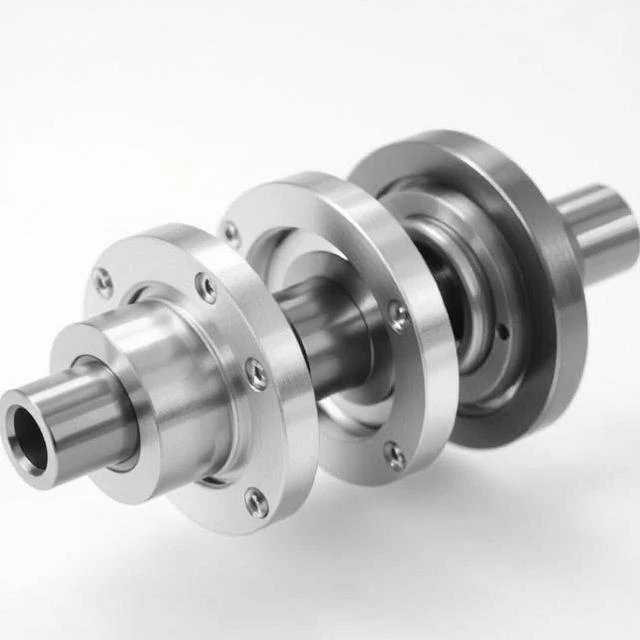
High-speed motor systems are a cornerstone of modern industrial applications, powering equipment ranging from conveyors and pumps to CNC machines and robotics. In these systems, couplings play a critical role by connecting motor shafts to driven equipment, ensuring smooth torque transmission, reducing vibration, and compensating for misalignment. Choosing the right coupling type and material is essential for maintaining system efficiency, reliability, and safety in high-speed operations.
The Role of Shaft Couplings in High-Speed Motors
Shaft couplings serve as mechanical connectors between two rotating shafts, transmitting torque while accommodating minor misalignments, vibration, and shock loads. In high-speed motor systems, even slight misalignment can cause excessive wear, energy loss, or premature component failure. Couplings help prevent these issues by:
- Providing torsional rigidity for precise torque transmission
- Absorbing vibration and shock loads
- Allowing minor angular, axial, or parallel misalignment
- Reducing noise and wear on bearings and shafts
Selecting the appropriate coupling ensures that the motor system operates smoothly and reliably, even under high rotational speeds and demanding conditions.
Key Challenges in High-Speed Motor Systems
High-speed motors pose unique challenges that make the choice of couplings critical:
- Vibration and Resonance: High RPMs can amplify shaft vibration, potentially leading to noise, mechanical wear, and system instability.
- Thermal Expansion: Rapid rotation can generate heat, causing shafts to expand slightly. Couplings must accommodate this without affecting alignment.
- Backlash Sensitivity: In precision applications, any lost motion between connected shafts can reduce accuracy and performance.
- Shock Loads: Sudden acceleration or deceleration can create torsional shocks, which couplings must absorb to protect equipment.
Properly designed couplings address these challenges while improving efficiency and extending component life.
Types of Couplings for High-Speed Motor Systems
Disc Couplings
Disc couplings consist of thin, flexible metal discs that transmit torque while allowing angular and axial misalignment. They are torsionally stiff, backlash-free, and ideal for precision high-speed applications.
Applications:
- CNC machines
- Robotics and automation
- High-speed spindles
Disc couplings are low-maintenance, durable, and maintain accuracy under high RPM conditions.
Bellows Couplings
Bellows couplings use a metallic bellows to connect shafts. They provide excellent flexibility, accommodate misalignment, and are completely backlash-free.
Applications:
- Servo motor drives
- Laboratory automation equipment
- Semiconductor manufacturing machines
Bellows couplings offer high torsional stiffness, making them suitable for systems requiring precision motion control at high speeds.
Jaw Couplings
Jaw couplings consist of two hubs and an elastomeric spider that transmits torque while absorbing vibration and accommodating misalignment.
Applications:
- Pumps and compressors
- Packaging machines
- Conveyor drives
Jaw couplings are easy to install, vibration-dampening, and ideal for medium torque applications in high-speed systems.
Oldham Couplings
Oldham couplings handle parallel misalignment efficiently. Their sliding central disc allows smooth torque transfer without backlash.
Applications:
- Compact servo systems
- Robotic arms
- Small high-speed machinery
Oldham couplings are lightweight and provide precise motion for small-scale high-speed motors.
Factors to Consider When Choosing High-Speed Couplings
Torque and Load Capacity
The coupling must handle the motor’s continuous and peak torque without slippage or deformation. Overloading a coupling can lead to catastrophic failure.
Speed and Rotational Limits
High-speed applications require couplings designed for minimal centrifugal stress. Unbalanced or heavy couplings can generate additional vibration, reducing efficiency.
Misalignment Tolerance
Assess the expected angular, axial, and parallel misalignment in the motor system. Couplings should accommodate these without transmitting excessive stress to the shafts or bearings.
Material Selection
Materials impact strength, flexibility, and thermal expansion characteristics. Common high-speed coupling materials include stainless steel, aluminum, and high-performance alloys for durability and stability under continuous high-speed operation.
Maintenance and Longevity
Maintenance-free couplings are preferred in high-speed motor systems to reduce downtime. Proper lubrication, alignment, and regular inspection enhance the service life of both couplings and connected machinery.
Benefits of Using the Right Couplings in High-Speed Motors
- Vibration Reduction: Minimizes noise and protects components from premature wear.
- Backlash Elimination: Ensures precise torque transmission and accurate motion.
- Shock Absorption: Protects the motor and driven equipment from torsional shocks.
- Operational Efficiency: Reduces energy loss and improves torque transfer efficiency.
- Extended Equipment Life: Proper couplings minimize maintenance and component replacement frequency.
Applications of Shaft Couplings in High-Speed Systems
- CNC Machines: Disc and bellows couplings maintain precise motion at high rotational speeds.
- Robotics and Automation: Oldham and bellows couplings enable accurate, vibration-free motion.
- Pumps and Compressors: Jaw and disc couplings absorb shock loads and vibration.
- Packaging Lines: Jaw and flexible couplings ensure smooth torque transfer for high-speed conveyor systems.
- Aerospace and Laboratory Equipment: Lightweight, backlash-free couplings support high-speed precision drives.
Conclusion
High-speed motor systems require careful selection of couplings to ensure precise torque transfer, vibration reduction, and long-term reliability. Disc, bellows, jaw, and Oldham couplings each offer unique benefits, allowing engineers to match the coupling type to specific speed, load, and alignment requirements. By considering torque capacity, misalignment tolerance, material properties, and maintenance needs, industries can optimize motor performance while reducing downtime and extending equipment life. For dependable, high-quality coupling solutions in high-speed applications, rathi couplings offers products engineered to meet demanding industrial standards and enhance system efficiency.