
Singapore’s REIT market (S-REITs) is one of the most developed in Asia, offering investors stable yields, global exposure, and access to high-quality property assets. But while REITs are often viewed as defensive investments, not all S-REIT sectors perform the same way—especially as economic conditions change.
Understanding how each sector behaves across different market cycles can help you choose the right REITs for income, growth, or long-term stability.
In this guide, we break down the major S-REIT sectors and reveal which ones tend to outperform in expansions, recessions, high-inflation periods, and recovery cycles.
What Are S-REIT Sectors?
S-REITs (Singapore Real Estate Investment Trusts) are grouped into multiple sectors based on the type of properties they own. The main categories include:
- Retail REITs (shopping malls, retail centres)
- Office REITs (corporate and commercial buildings)
- Industrial REITs (logistics, business parks, warehouses)
- Hospitality REITs (hotels, serviced residences)
- Healthcare REITs (hospitals, nursing homes, medical facilities)
- Data Centre REITs (digital infrastructure, server facilities)
Each sector behaves differently depending on consumer spending, business activity, interest rates, tourism flows, and overall economic health.
How Each S-REIT Sector Performs Across Market Cycles
Below is a sector-by-sector breakdown to help you understand which S-REITs typically outperform in different environments.
1. Retail REITs
Best when: Consumer spending is strong, tourism is recovering
Challenged when: Economic slowdowns reduce foot traffic
Retail REITs own shopping malls and retail spaces across Singapore and the region. Their performance depends heavily on:
- consumer confidence
- retailer sales
- tourism trends
- tenant occupancy rates
During economic expansions or tourist recoveries, retail REITs often see higher rental reversions, stronger tenant demand, and improved footfall. However, in recessionary periods, retail sales may soften—making this sector more cyclical.
Examples: CapitaLand Integrated Commercial Trust (CICT), Frasers Centrepoint Trust (FCT)
2. Office REITs
Best when: Corporate hiring and business expansion are strong
Challenged when: Companies downsize or shift to hybrid work
Office REITs benefit when demand for corporate office space increases. Their performance is influenced by:
- business confidence
- office supply/demand balance
- employment growth
In economic slowdowns—or during remote work shifts—leasing activity may soften. Still, office REITs with high-quality Grade A assets or diversified locations often remain resilient.
Examples: Keppel REIT, Mapletree Pan Asia Commercial Trust (MPACT)
3. Industrial & Logistics REITs
Best when: E-commerce demand is high, manufacturing is stable
Challenged when: Global supply chains weaken
Industrial S-REITs include warehouses, logistics hubs, and business parks. This sector is considered one of the most resilient because:
- Logistics demand remains stable across cycles
- Leases are often long-term
- Contracts may include built-in rental escalations
Industrial REITs also benefit from long-term megatrends such as e-commerce growth, supply chain optimisation, and manufacturing expansion.
Examples: Ascendas REIT, Mapletree Logistics Trust (MLT)
4. Hospitality REITs
Best when: Travel demand rebounds, tourism grows
Challenged when: Travel restrictions or recessions occur
Hospitality REITs are highly cyclical because their revenue comes from hotel occupancy, room rates, and tourism flows.
They tend to outperform during:
- global tourism recovery
- event-driven demand (e.g., concerts, major conferences)
- economic growth cycles
But they are also among the hardest hit during downturns or travel restrictions. For investors seeking growth during cyclical rebounds, hospitality REITs offer strong upside.
Examples: CDL Hospitality Trusts, Far East Hospitality Trust
5. Healthcare REITs
Best when: Markets are uncertain or in recession
Challenged when: Interest rates rise significantly
Healthcare REITs are considered defensive because demand for healthcare is stable regardless of economic conditions. Key advantages include:
- long lease structures
- predictable rental income
- aging population tailwinds
This makes healthcare REITs ideal for income-focused investors seeking stability through market volatility.
Examples: Parkway Life REIT, First REIT
6. Data Centre REITs
Best when: Demand for cloud computing and digital infrastructure rises
Challenged when: Utility or capital costs surge
Data centre REITs are one of the fastest-growing property sectors globally. They thrive in environments where:
- Cloud adoption increases
- AI and digital services expand
- Businesses require more storage capacity
While sensitive to rising interest rates (due to high capital expenditure), data centre REITs benefit from very stable, long-term tenants and strong global demand.
Examples: Keppel DC REIT
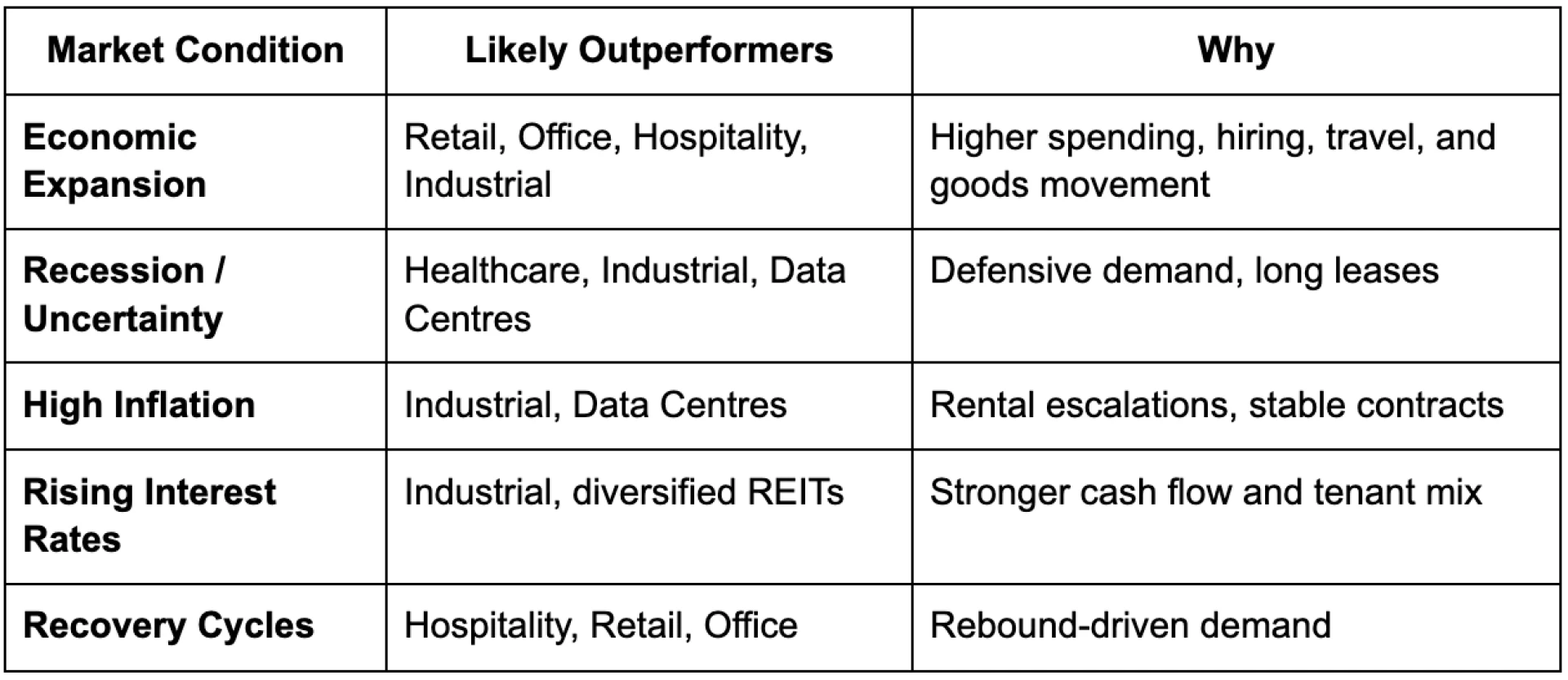
Which S-REIT Sectors Perform Best in Different Market Cycles?
Below is a simple comparison to guide portfolio planning:
How to Build a Resilient S-REIT Portfolio
A well-diversified REIT portfolio typically includes:
1. Defensive REITs
For income stability
- Healthcare
- Industrial
- Data Centres
2. Growth-Oriented REITs
For capital appreciation
- Hospitality
- Office (Grade A)
3. Income + Growth REITs
Balanced exposure
- Retail REITs
- Large diversified REITs (CICT, MPACT)
The right combination depends on your risk appetite, income needs, and view of future economic conditions.
S-REITs remain a powerful way for investors to access high-quality real estate across Singapore and global markets. By understanding how each sector behaves during different market cycles, you can:
- make smarter investment decisions
- reduce volatility
- capture opportunities at the right time
- build a portfolio that performs across economic environments
Whether you’re an income seeker or long-term investor, the diversity of the S-REIT market offers ample opportunities to grow and protect your wealth.