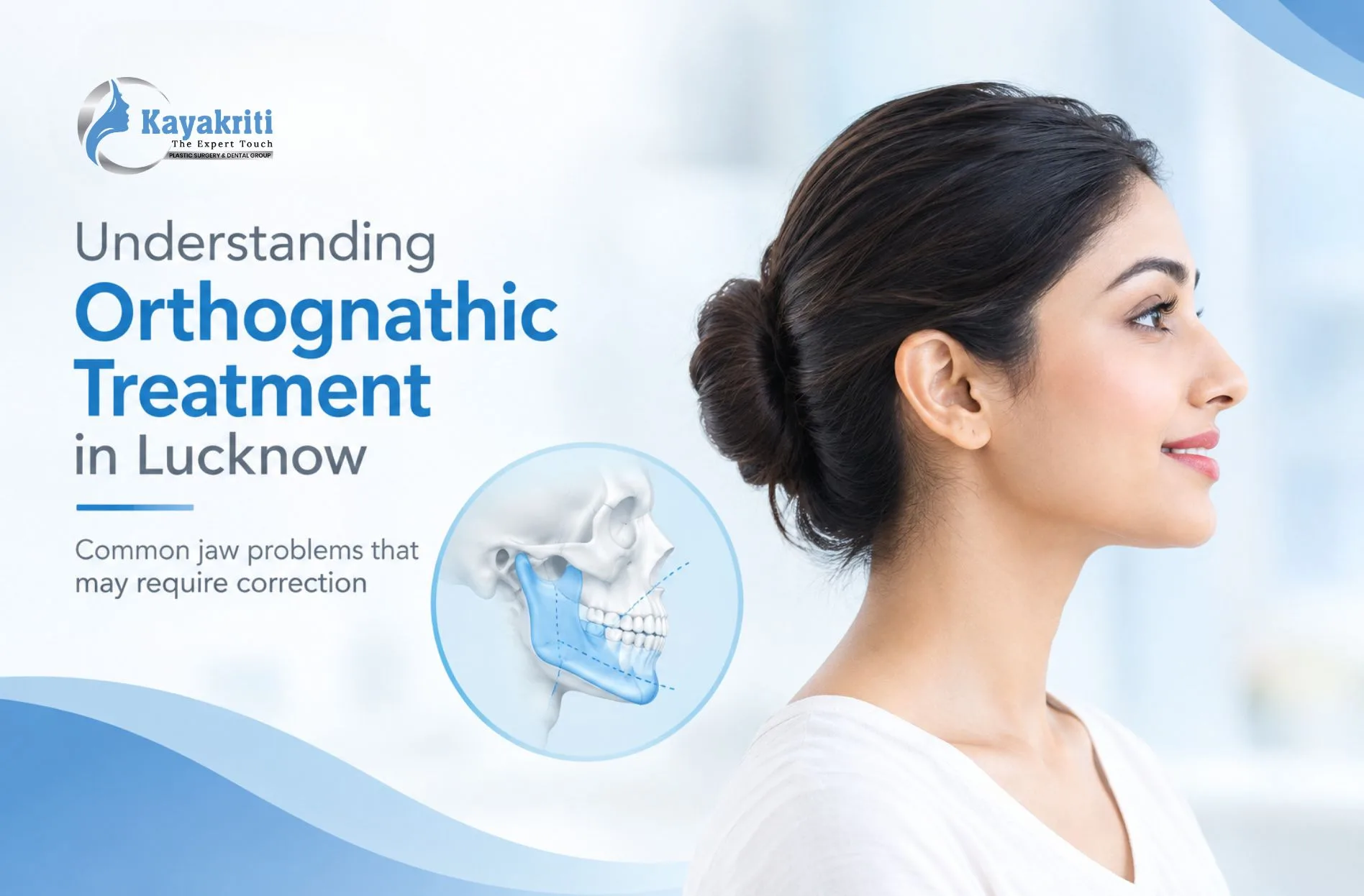
Jaw alignment plays an important role in how the teeth meet, how efficiently a person chews, and how the lower face appears. When the upper and lower jaws develop differently, the resulting skeletal discrepancy may affect the bite, facial balance, and, in some cases, speech or breathing. Orthognathic treatment in Lucknow may be considered when these problems cannot be adequately corrected with orthodontic treatment alone.
Unlike procedures that focus only on the teeth, orthognathic treatment addresses the underlying position and relationship of the jaw bones. Depending on the diagnosis, corrective jaw surgery, orthodontics, or a combination of both may be considered.
Understanding common jaw problems can help people recognise when a professional assessment may be appropriate and what an evaluation for orthognathic surgery may involve.
What Is Orthognathic Treatment?
Orthognathic treatment refers to the planned management of skeletal discrepancies involving the upper jaw, lower jaw, or both. When surgery is required, orthognathic surgery repositions the jaw bones to improve their relationship and the way the teeth come together.
The term "jaw correction surgery" is often used interchangeably with "corrective jaw surgery". However, not every jaw discrepancy requires an operation. Orthodontic treatment can correct many problems when the underlying issue is primarily dental. Surgery may be considered when the discrepancy is skeletal and cannot be adequately addressed by moving the teeth alone.
This distinction is important because orthognathic treatment in Lucknow should begin with diagnosis rather than automatically proceeding to surgery.
What Jaw Problems Can Orthognathic Treatment Address?
Several types of jaw discrepancies can affect the relationship between the upper and lower teeth. Common problems include:
- Underbite: The lower front teeth extend beyond the upper front teeth, often because of a relatively prominent lower jaw, an underdeveloped upper jaw or a combination of factors.
- Overbite: The upper front teeth overlap the lower teeth excessively. A significant skeletal discrepancy may sometimes contribute to this relationship.
- Open bite: Some upper and lower teeth do not meet when the mouth is closed. This can affect biting and chewing.
- Jaw asymmetry: One side of the jaw may develop differently from the other, causing the chin or dental midline to shift.
- Protruding jaw: The upper or lower jaw may project forward relative to the rest of the facial skeleton.
- Receding jaw: A jaw, particularly the lower jaw, may sit farther back than expected and contribute to an imbalanced facial profile.
These are among the problems that corrective jaw surgery may address when they are caused by significant skeletal discrepancies. Professional organisations such as AAOMS and ASPS identify underbite, overbite, open bite, facial asymmetry, and under- or over-development of the jaws as conditions that may be considered for orthognathic surgery.
Understanding Underbite and Protruding Lower Jaws
An underbite occurs when the lower teeth sit ahead of the upper teeth when the mouth is closed. While mild cases can sometimes be related mainly to tooth position, a pronounced underbite may reflect a skeletal relationship between the maxilla and mandible.
A protruding lower jaw can influence both function and appearance. Depending on its severity, a person may notice difficulty biting into certain foods, uneven tooth contact, or a more prominent lower facial profile.
In selected cases, jaw correction surgery may reposition the lower jaw, upper jaw, or both. For example, Kayakriti describes bilateral sagittal split osteotomy (BSSO) as a procedure that can reposition the mandible forward or backward and correct deviations of the lower jaw.
However, the appropriate procedure depends on the individual’s skeletal anatomy and bite. Orthognathic treatment is therefore not a single standard operation.
How Can Jaw Misalignment Affect Chewing or Speaking?
Jaw alignment affects how the upper and lower teeth come together. If the bite is significantly altered, the teeth may not contact efficiently during chewing. Some patients may also experience difficulty biting or swallowing, excessive tooth wear, or restricted jaw movement.
Speech can also be influenced because jaw position interacts with the lips, tongue, and other structures involved in producing speech. Not every person with a jaw discrepancy develops a speech problem, but skeletal abnormalities can be associated with altered speech production.
This is why orthognathic treatment in Lucknow may be considered for functional as well as facial reasons. The purpose is not simply to change the appearance of the face; appropriate corrective jaw surgery aims to improve the underlying skeletal relationship and, where relevant, associated functions.
What Is an Open Bite, and Why Can It Matter?
An open bite occurs when certain upper and lower teeth remain apart even when the jaws are closed. An anterior open bite, for example, may leave a visible space between the front teeth.
Depending on the cause, an open bite may be related to tooth position, jaw development, or a combination of factors. If the underlying problem is skeletal, orthodontic treatment alone may not provide adequate correction.
Orthognathic surgery can be considered in appropriately selected cases where the jaw discrepancy contributes substantially to the open bite. AAOMS lists open bite among the conditions that may indicate corrective jaw surgery, while also emphasising comprehensive assessment before determining whether surgery is appropriate.
Can Facial Asymmetry Be Related to a Jaw Discrepancy?
Yes. Facial asymmetry can sometimes be associated with differences in the development or position of the upper or lower jaw.
For example, if the lower jaw deviates to one side, the chin may appear off-centre. A difference in the position or size of the jaws can also affect the facial profile and the way the teeth meet.
However, facial asymmetry does not automatically mean that orthognathic treatment is necessary. Minor asymmetry is common, and other factors—including soft-tissue differences, dental position, and previous injury—can contribute to facial imbalance.
When a significant skeletal discrepancy is present, jaw correction surgery may sometimes be used to improve both the bite and facial proportions. AAOMS recognises maxillary and mandibular asymmetry among skeletal abnormalities associated with malocclusion and functional concerns.
Protruding and Receding Jaws: More Than an Appearance Concern
A protruding or receding jaw can be noticeable from the side profile, but its significance is not necessarily cosmetic alone.
A lower jaw that sits significantly behind the upper jaw may contribute to an overjet or other bite discrepancy. Conversely, excessive forward projection of the mandible may be associated with an underbite.
In some patients, jaw position may also be relevant to airway function. Orthognathic procedures can be considered as part of treatment for certain patients with obstructive sleep apnoea, although suitability depends on individual anatomy and medical assessment.
This is one reason reconstructive surgery and craniofacial surgery require careful diagnosis rather than a purely appearance-based approach.
When Should a Person Seek an Evaluation for Jaw Misalignment?
A professional evaluation may be appropriate when jaw alignment is associated with persistent functional or noticeable structural concerns.
Consider seeking assessment if you experience:
- Difficulty biting or chewing food
- A pronounced underbite, overbite, or open bite
- A jaw that appears significantly shifted to one side
- Difficulty bringing the lips together comfortably
- Noticeable facial imbalance associated with the jaws
- Significant tooth wear related to an abnormal bite
- Difficulty with certain aspects of speech associated with jaw position
- Persistent jaw-function problems or restricted movement
- A bite that remains problematic despite orthodontic treatment
- Concerns about a protruding or receding jaw
These signs do not mean that surgery is automatically necessary. They indicate that a detailed evaluation may help identify whether the problem is dental, skeletal, or a combination of both. AAOMS recommends assessment by an appropriately trained surgeon working with orthodontic professionals when considering corrective jaw surgery.
How Is Orthognathic Treatment Planned?
Planning for orthognathic treatment in Lucknow typically starts with a detailed clinical assessment. The evaluation may consider the bite, facial proportions, jaw movement, dental condition, medical history, and the stability of the temporomandibular joints.
Imaging and digital planning can help the treatment team understand the three-dimensional relationship between the jaws and teeth. Kayakriti states that its orthognathic planning can incorporate facial photographs, dental impressions, cephalometric analysis, and CT-based 3D models.
Orthodontics may also form an important part of the process. In suitable cases, teeth are positioned before surgery so that the jaws can subsequently be aligned correctly. Post-surgical orthodontics may then help refine the final bite.
This means orthognathic surgery should generally be viewed as part of a treatment journey rather than an isolated procedure.
Who May Perform Orthognathic and Corrective Jaw Surgery?
Because jaw correction surgery involves the facial skeleton and bite, patients should seek assessment from an appropriately qualified specialist with relevant experience in orthognathic or craniofacial procedures.
At Kayakriti Lucknow, Dr. Amit Agarwal is identified as the Chief Plastic, Aesthetic & Reconstructive Surgeon. His qualifications include FRCS (Edinburgh), American Board Certification, MCh, DNB, FACS, and FICS, and Kayakriti lists craniofacial and orthognathic surgery among his areas of specialisation.
Dr. Amit Agarwal also has fellowship training in microsurgery and facial surgery, while Kayakriti describes its orthognathic service as involving personalised planning for individual anatomy and functional requirements.
Patients considering orthognathic treatment should still discuss their individual diagnosis, alternatives, expected benefits, risks, recovery, and long-term follow-up during consultation.
What About Cost and Treatment Transparency?
The cost of orthognathic treatment in Lucknow can vary depending on whether one or both jaws require surgery, the complexity of the skeletal discrepancy, hospital and anaesthesia requirements, orthodontic treatment, and any additional procedures.
A proper estimate should therefore be based on the individual’s treatment plan rather than a generic advertised figure. Kayakriti provides a transparent written estimate for orthognathic surgery, outlining the relevant surgical and hospital components.
Patients should also look for clear, transparent pricing and ask about the treatment cost and what is included in the quoted amount. This can make it easier to understand the financial commitment associated with a treatment that may involve several stages.
Transparent pricing should complement, rather than replace, proper clinical counselling. The most appropriate treatment should be determined by diagnosis and individual needs, not simply by the lowest quoted price.
Understanding the Role of Reconstructive Surgery
The term "reconstructive surgery" covers a broad range of procedures intended to restore or improve form and function after congenital conditions, trauma, disease, or other structural problems.
Within the broader field of facial and craniofacial surgery, orthognathic surgery focuses specifically on correcting skeletal discrepancies of the jaws. Kayakriti lists orthognathic procedures within its reconstructive-surgery services and describes personalised planning for skeletal jaw problems.
Therefore, reconstructive surgery and orthognathic treatment should not be treated as identical terms. Orthognathic procedures represent a specialised category of jaw correction that may be used when a skeletal discrepancy affects function, facial balance, or both.
Making an Informed Decision About Jaw Correction
Understanding the underlying problem is the first step toward making an informed decision. Underbite, overbite, open bite, jaw asymmetry, and protruding or receding jaws can have different causes and may require very different approaches.
For some people, orthodontic treatment may be sufficient. For others, a skeletal discrepancy may make corrective jaw surgery an appropriate consideration. The decision should follow a detailed assessment rather than be based solely on appearance.
For people researching orthognathic treatment in Lucknow, Kayakriti Lucknow offers orthognathic and craniofacial surgical services under Dr. Amit Agarwal, with treatment planning based on individual anatomy and functional goals.
Ultimately, orthognathic treatment in Lucknow is best understood as a personalised process aimed at addressing the underlying jaw discrepancy. A timely professional evaluation can help determine whether the concern is primarily dental or skeletal and whether orthognathic surgery, orthodontics, or another approach may be appropriate.
Disclaimer:
This article is intended for general educational and informational purposes only and should not be considered a substitute for professional medical or dental advice, diagnosis, or treatment. Jaw alignment problems vary significantly between individuals, and not every underbite, overbite, open bite, or facial asymmetry requires surgery. The suitability of orthognathic treatment, corrective jaw surgery, or any other procedure can only be determined after an appropriate clinical evaluation by a qualified specialist. Treatment outcomes, risks, recovery periods, and costs may vary from patient to patient.