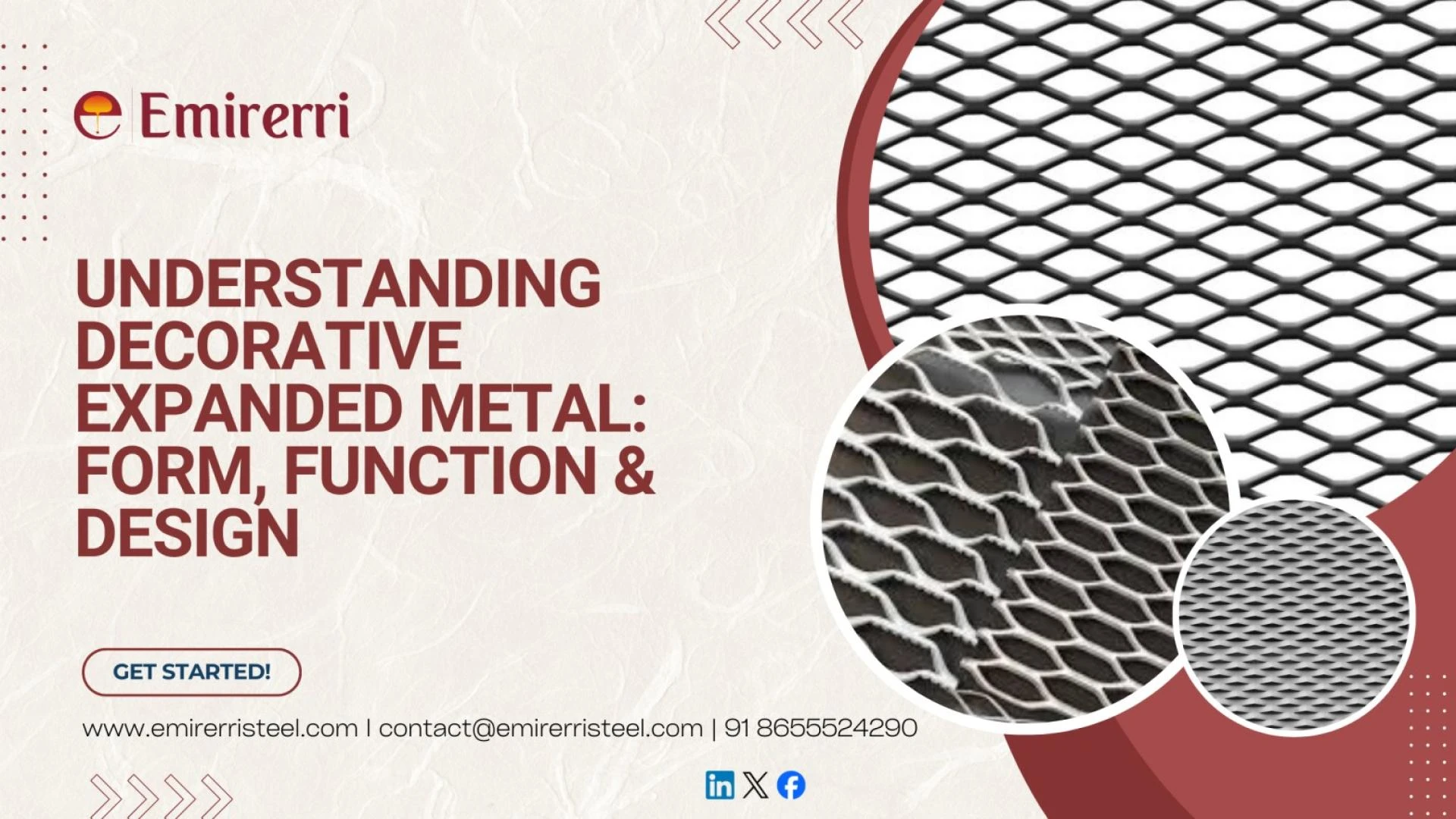
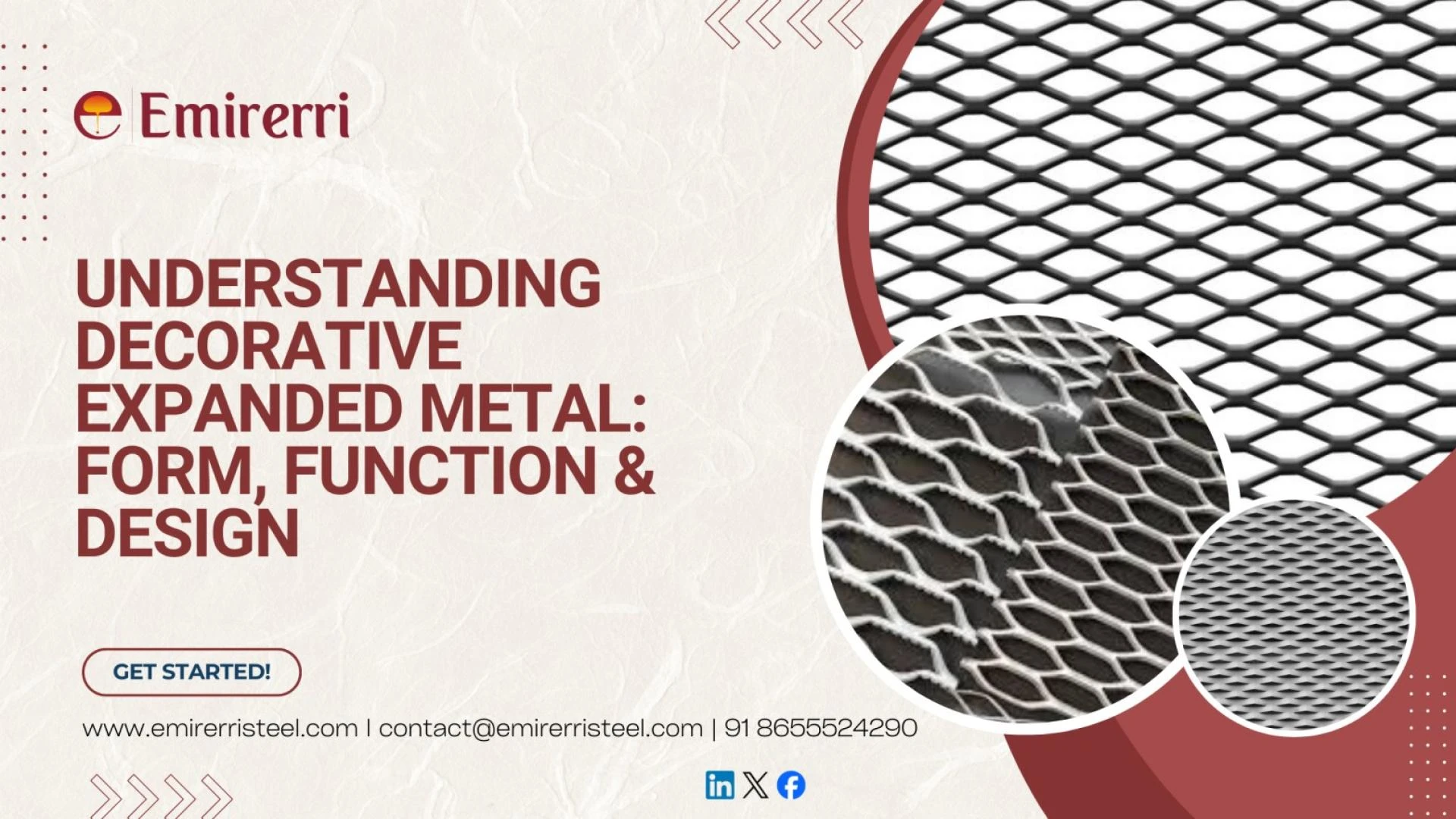
In modern architecture, interior design, and industrial applications, decorative expanded metal is becoming a go-to material that blends aesthetics and utility. But what exactly is expanded metal, and how does one choose appropriate expanded metal size, expanded metal dimensions, and types of expanded metal for a project? This article explores the concept, specifications, and applications of decorative expanded metal — with particular reference to the offerings from Emirerri Steel.
What Is Expanded Metal?
Expanded metal is a sheet of metal that has been slit and stretched to form a mesh pattern, without welding or punching out pieces. In other words, the process involves cutting narrow slits into a metal sheet and then stretching (or expanding) those slits so that the material forms a network of openings and strands. The result is a strong, lightweight, and rigid mesh with continuous metal strands and voids.
Decorative expanded metal is a subtype designed not just for structural or utilitarian uses, but for aesthetic environments — facades, partitions, screens, architectural features — where visual appeal is as important as mechanical performance. Emirerri Steel defines it as “a stylish and durable material perfect for architectural, commercial, and design-focused applications,” combining “visual appeal with unmatched durability and versatility.” Emirerristeel
Types of Expanded Metal
When choosing expanded metal, one must consider the types of expanded metal available, as each type offers different mechanical and visual characteristics:
- Standard Expanded Metal
- The most common variety — produced by expansion so that the mesh retains its original thickness. It offers high strength and is used where structural integrity is a priority.
- Flattened Expanded Metal
- After expansion, the material is run through a flattening press, which reduces thickness and produces a smoother surface. This is often preferred for decorative or architectural applications because it’s flatter, easier to finish, and visually more refined.
- Expanded Metal Grating / Heavy Duty
- Thicker and more robust, this type is intended for heavy industrial applications, walkways, platforms, and supports.
- Small-Hole Expanded Metal
- As the name implies, this version has very fine openings (small holes), giving it a more delicate appearance — useful in screens, grills, or decorative panels where you want a fine mesh.
Emirerri Steel includes in their product portfolio “Standard Expanded Metal,” “Flattened Expanded Metal,” “Small Hole Expanded Metal,” and also “Decorative Expanded Metal.” Emirerristeel
Beyond basic types, aesthetic or custom patterns (diamond, hexagonal, square, round, or bespoke shapes) are also considered when ordering decorative expanded metal. Emirerristeel
Expanded Metal Dimensions & Expanded Metal Size
One of the trickiest areas for buyers is selecting expanded metal dimensions and expanded metal size. Several key terms and metrics are used to define the mesh:
- SWM (Short Way of Mesh) – the smaller dimension of the opening (i.e. width of the void)
- LWM (Long Way of Mesh) – the longer dimension of the opening (i.e. length of the void)
Emirerri Steel’s decorative expanded metal offers SWM from 3 mm to 50 mm, and LWM from 5 mm to 200 mm or more depending on the design. Emirerristeel
Other dimensional factors include:
- Strand Width – the width of the metal “bars” or ribs between the openings (often from 0.5 mm upward).
- Thickness (Gauge) – how thick the original sheet (and thus the strands) are — for decorative use, lighter to medium gauges are common.
- Sheet Size – the overall panel dimensions of the expanded metal sheet. Standard sheet sizes listed by Emirerri Steel are 4 ft × 8 ft (1,220 mm × 2,440 mm) and 6 ft × 12 ft (1,830 mm × 3,660 mm). Custom sizes are also offered. Emirerristeel
Thus, when someone states “expanded metal size,” they may refer to the combination of mesh opening (SWM × LWM), strand width, thickness, or the overall sheet area. A full specification typically includes all these parameters.
Why Choose Decorative Expanded Metal?
Selecting decorative expanded metal offers many benefits:
- Aesthetic versatility: Because the mesh can be made in diamond, hexagonal, square, round, or custom patterns, it allows architects and designers to make creative expressions. Emirerristeel
- Light and ventilation: The open mesh lets light pass through and air circulate, which is ideal for facades, solar screens, ventilated partitions, and ceilings.
- Durability & strength: Like any expanded metal, the continuous strands lend a high strength-to-weight ratio.
- Corrosion resistance: Application of finishes (such as powder coating, anodizing, or other treatments) enhances resistance to rust and weathering. Emirerristeel
- Customization: Every dimension, pattern, and finish can be tailored. Emirerri promotes “custom sizes” and “tailored solutions” to fit design visions. Emirerristeel
- Sustainability: As a material that is recyclable and uses less waste (since material is only cut and expanded, not “punched out”), decorative expanded metal is more environmentally friendly. Emirerristeel
Because of these attributes, decorative expanded metal finds use in building facades, partitions, balustrades, ceiling panels, signage, sculptures, fencing, and feature walls.
Specifying Decorative Expanded Metal for a Project
When preparing specifications or tender documents for decorative expanded metal, one should clearly articulate:
- Material (e.g. carbon steel, stainless steel, aluminum, copper, brass) — Emirerri mentions all these material possibilities. Emirerristeel
- Type / classification (standard, flattened, decorative)
- Expanded metal dimensions (SWM × LWM), strand width, and thickness
- Sheet size (or custom panel dimensions)
- Pattern type (diamond, hexagon, square, round, or custom motif)
- Finish / coating (powder coat, anodize, custom color)
- Tolerance / certification (e.g. standard compliance, quality control)
By combining these details, one defines the desired expanded metal size, aesthetic, and structural properties. For example, one might request a panel of decorative expanded metal in stainless steel, with diamond openings measuring 10 mm × 30 mm, strand width 2 mm, thickness 1.5 mm, to be cut to 1,200 mm × 2,400 mm sheets, with a colored powder-coat finish.
Challenges and Best Practices
- Balancing openness and strength: Too large mesh openings or too thin strands may weaken the panel. Choosing the right expanded metal dimensions is critical.
- Corrosion in aggressive environments: In marine or industrial atmospheres, proper coatings or alloy choice (e.g. stainless / aluminum) become essential.
- Fabrication and mounting: Because the expanded mesh has voids, care must be taken in how it is fixed or joined to support structures so that it remains flat and stable.
- Cutting and edges: After expansion, the edges may require trimming or finishing.
- Cost vs customization: Custom patterns, nonstandard dimensions, or specialty materials may increase costs and lead times.
Conclusion
Decorative expanded metal brings together aesthetics and structural functionality: a mesh material that is visually engaging yet physically robust. Understanding what is expanded metal, the available types of expanded metal, and mastering the language of expanded metal dimensions and expanded metal size is essential to leveraging this material effectively.
Whether for facades, interior partitions, artistic installations, or commercial displays, suppliers like Emirerri Steel offer a broad range of decorative expanded metal — with customizable sizes, patterns, finishes, and materials to suit any design vision. With proper specification and installation, decorative expanded metal can transform ordinary surfaces into architectural statements without compromising strength or functionality