
Market Overview
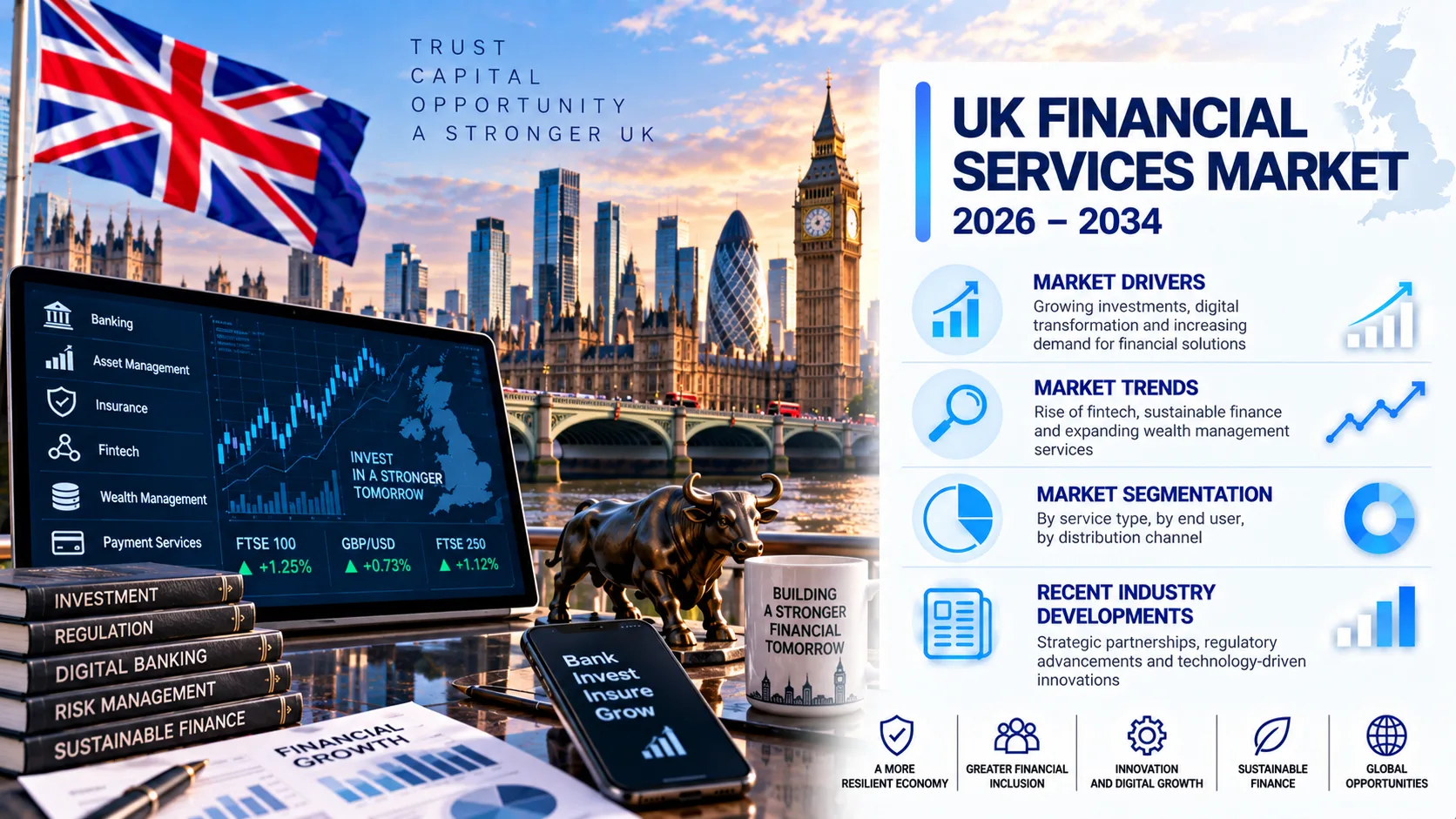
The UK financial services market size reached USD 349.9 Billion in 2025 and is projected to reach USD 547.8 Billion by 2034, growing at a compound annual growth rate (CAGR) of 4.95% from 2026 to 2034. The market is driven by digital transformation, with 86% of UK adults using online banking in 2024 and digital-only accounts rising from 24% in 2023 to 36% in 2024, the growing importance of sustainable finance as ESG criteria increasingly shape investment decisions, and ongoing regulatory evolution by the Prudential Regulation Authority (PRA) and the Financial Conduct Authority (FCA).
Request a Sample Report for In-Depth Market Insights: https://www.imarcgroup.com/uk-financial-services-market/requestsample
UK Financial Services Market Summary
- The UK financial services market encompasses lending and payments, insurance, reinsurance and insurance brokerage, investments, and foreign exchange services, serving small and medium businesses and large businesses.
- These services are valued for enabling saving, borrowing, payments, risk protection, investment, and international trade, and for supporting the UK economy and its role as a global financial centre.
- The ecosystem includes banks, insurers and reinsurers, brokers, asset and wealth managers, payment firms and fintechs, market infrastructure providers, regulators such as the Bank of England, PRA, and FCA, and individuals, corporates, government, and investment institutions.
- Major segments identified in the market include type (lending and payments, insurance, reinsurance and insurance brokerage, investments, foreign exchange services), business size (small and medium business, large business), end user (individuals, corporates, government, investment institution), and region (London, South East, North West, East of England, South West, Scotland, West Midlands, Yorkshire and The Humber, East Midlands, others).
- The market is benefiting from digital banking adoption, AI and data analytics investment, green finance, and evolving regulation of payments and digital assets.
- In September 2026, the Bank of England's Financial Policy Committee kept the countercyclical capital buffer at 2% and judged that UK banks remain appropriately capitalised, while noting that risks to financial stability have risen.
PORTER'S FIVE FORCES ANALYSIS
- Competitive Rivalry: High. Large banks, insurers, asset managers, challenger banks, and fintechs compete on price, product range, digital experience, and trust. Business implication: Firms must differentiate through customer experience, technology, and specialized propositions.
- Supplier Power (Technology, Data, and Capital): Moderate. Cloud, data, and technology providers have growing influence, and funding costs depend on market conditions, though many suppliers compete. Business implication: Firms should manage third-party concentration risk and build operational resilience.
- Buyer Power (Individuals and Corporates): Moderate to High. Customers can switch providers easily through open banking and comparison tools, and corporate clients negotiate pricing and terms. Business implication: Providers must focus on value, transparency, and long-term relationships.
- Threat of Substitutes: Moderate. Fintech platforms, peer-to-peer services, and digital assets offer alternatives to traditional banking, payments, and investment products. Business implication: Incumbents should embrace digital innovation and partnerships rather than defend legacy models.
- Threat of New Entrants: Moderate. Strict authorization, capital, and compliance requirements are barriers, but fintech-friendly regulation and cloud technology lower the cost of entry in niche segments. Business implication: Established firms should invest in innovation and regulatory credibility.
MARKET GROWTH DRIVERS
Digital TransformationDigital channels are now central to UK financial services maket. About 86% of UK adults used online banking in 2024, and digital-only accounts grew from 24% in 2023 to 36% in 2024. Firms are investing in AI and data analytics, with HM Treasury's Financial Services AI Adoption Plan, published in July 2026, aiming to support responsible AI use across the sector and prepare for developments such as agentic payments.
Sustainable FinanceESG criteria increasingly influence investment decisions, and the UK government's net-zero targets are encouraging growth in green finance. The PRA's expanded climate risk requirements push firms to strengthen governance and climate scenario analysis, while investors and corporate clients seek sustainable financing and investment products.
Regulatory EvolutionUK regulators continue to modernize the framework. In June 2026, the FCA published its final rules for the cryptoasset regime, set to take effect in October 2027, and in July 2026 HM Treasury opened a consultation on restructuring payment services regulation. These changes aim to support innovation while protecting consumers and financial stability, and they shape product development and compliance priorities across the sector.
UK FINANCIAL SERVICES MARKET SEGMENTATION
Type Insights:
- Lending and Payments
- Insurance
- Reinsurance and Insurance Brokerage
- Investments
- Foreign Exchange Services
Business Size Insights:
- Small and Medium Business
- Large Business
End User Insights:
- Individuals
- Corporates
- Government
- Investment Institution
Regional Insights:
- London
- South East
- North West
- East of England
- South West
- Scotland
- West Midlands
- Yorkshire and The Humber
- East Midlands
- Others
COMPETITIVE LANDSCAPE
The UK financial services market features major banks, insurers, asset managers, payment companies, and a vibrant fintech sector. Competition is shaped by digital capability, trust and brand, pricing, regulatory standing, and the ability to use data and AI effectively. Market dynamics include rising digital-only banking, investment in AI, growth of embedded and open banking services, and evolving rules for payments and digital assets.
Key players mentioned in the report context include:- Admiral partnered with Google Cloud in February 2024 to use AI and data analytics in its insurance business.
- Open Payment Technologies launched its Kuady digital wallet in July 2024.
- Starling and Lloyds were named as sources of the AI Champions who developed HM Treasury's Financial Services AI Adoption Plan in July 2026.
REGIONAL ANALYSIS
- London: The leading hub, home to major banks, insurers, asset managers, the Lloyd's insurance market, and the largest concentration of financial and professional services in the UK.
- South East: A significant market with strong retail banking, insurance, and wealth management activity, supported by proximity to London and a high-income population.
- North West: A growing center for financial and professional services, with Manchester and Liverpool hosting large operations for banks, insurers, and fintechs.
- Scotland: An established market, particularly Edinburgh's asset management, banking, and insurance sector and Glasgow's growing financial services base.
- Other Regions: The West Midlands, Yorkshire and The Humber, East Midlands, East of England, and South West host significant regional banking, insurance, and back-office operations, increasingly supported by digital delivery.
RECENT INDUSTRY DEVELOPMENTS
September 2026: The Bank of England's Financial Policy Committee met on 25 September 2026, kept the countercyclical capital buffer at 2%, and judged that UK banks remain appropriately capitalised, with bank return on tangible equity of 17.1% in the second quarter of 2026, while noting that the likelihood of risks crystallizing had risen.
August 2026: HM Treasury announced a secondary payments innovation objective for the Bank of England, explicitly covering tokenisation and distributed ledger technology, on 27 August 2026.
July 2026: HM Treasury published the Financial Services AI Adoption Plan on 14 July 2026 and opened a consultation on modernising payment services regulation, which closes on 6 October 2026.
June 2026: The FCA published its final rules package for the cryptoasset regime on 30 June 2026, covering admissions, stablecoins, regulated activities, prudential requirements, and Consumer Duty application, with implementation on 25 October 2027.
Key Aspects Required for the UK Financial Services Market
- Market Performance: USD 349.9 Billion in 2025, with a projected trajectory to USD 547.8 Billion by 2034.
- Market Outlook: A 4.95% CAGR through 2034 indicates steady growth across lending and payments, insurance, investments, and foreign exchange, driven by digitalization and regulation.
- Growth Drivers: Digital transformation; sustainable finance; and regulatory evolution.
- Competitive Landscape: A market of banks, insurers, asset managers, payment firms, and fintechs competing on digital capability, trust, and compliance.
- Value Chain Analysis: From capital and funding providers, through banks, insurers, asset managers, and payment firms, to individuals, corporates, government, and investment institutions, overseen by the Bank of England, PRA, and FCA.
- Industry Trends: Growth of digital-only banking; AI adoption and cyber resilience; evolving payments and cryptoasset regulation; green finance; and tokenisation.
- Strategic Recommendations: Invest in digital and AI capabilities with strong governance; strengthen operational and cyber resilience; prepare for new payments and cryptoasset rules; expand sustainable finance offerings; and focus on customer outcomes under the Consumer Duty.
Note: If you need any specific information that is not currently covered within the scope of the report, we will provide the same as a part of customization.
Speak to an analyst: https://www.imarcgroup.com/request?type=report&id=24809&flag=C
Report Format, Delivery, and Customization Details
- Report Format Mode: PDF and Excel (Editable version in PPT/Word format available on special request)
- Report Delivery Mode: Online Delivery, Physical Delivery
- Report Delivery Time: report delivered over email within 24 to 48 hours. If requested by the client, a physical copy will be delivered within three to ten days.
- Report Confirmation Mode: Yes, via email
- Report Customization Mode: Yes, via Email / Call
- Report Table of Content: Yes
- Report List of Figures: Yes
- Report Methodology Mode: Yes
- Request For Sample Report: Yes