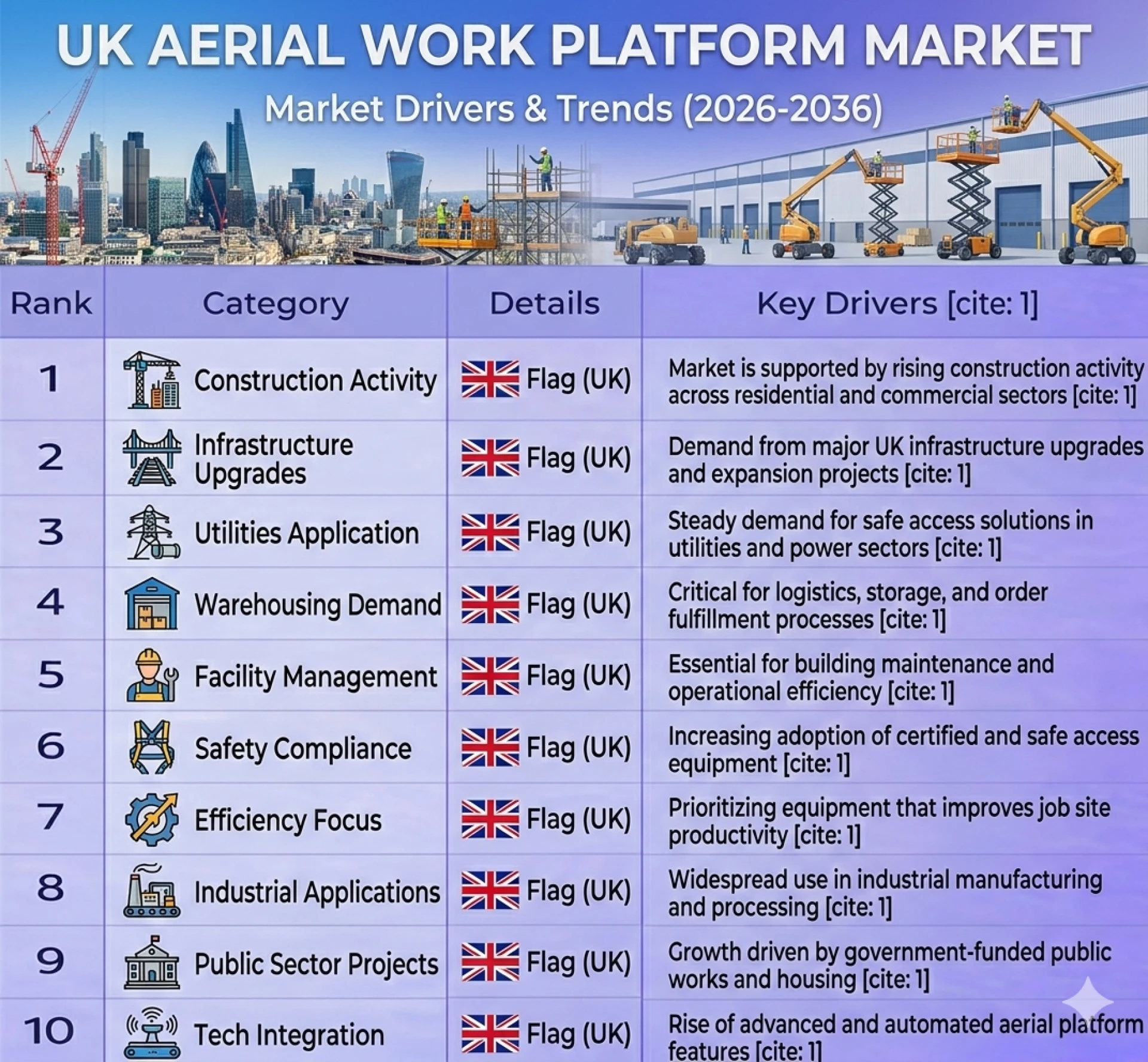
The UK aerial work platform market is projected to experience steady growth over the next decade, supported by rising construction activity, infrastructure upgrades, and increasing adoption of safe and efficient access equipment across industrial sectors. According to the latest analysis by Future Market Insights (FMI), the market is expected to expand at a healthy CAGR between 2026 and 2036, reflecting consistent demand from construction, utilities, warehousing, and facility management applications.
Market expansion is being driven by stricter workplace safety regulations, growing urban redevelopment projects, and the need for efficient vertical access solutions in both indoor and outdoor environments. Technological advancements, including electric-powered and hybrid aerial platforms, are further contributing to market momentum as sustainability and emission-reduction targets gain importance across the United Kingdom.
Explore In-Depth Analysis-Click Here to Access the Report!
https://www.futuremarketinsights.com/reports/sample/rep-gb-20004
UK Aerial Work Platform Market Snapshot (2026–2036)
- Forecast period: 2026–2036
- Market outlook: Steady expansion driven by infrastructure and industrial demand
- Primary growth sector: Construction and infrastructure development
- High-demand equipment types: Scissor lifts and boom lifts
- Key growth drivers: Safety compliance, electrification, rental market expansion
- Leading growth region: England, followed by Scotland and Wales
Momentum in the Market
Beginning in 2026, the UK aerial work platform market is expected to benefit from renewed investments in residential and commercial construction projects. Government-backed infrastructure initiatives, smart city developments, and modernization of public facilities are strengthening equipment demand.
Between 2030 and 2036, growth is anticipated to accelerate as contractors increasingly shift from traditional scaffolding systems to mechanized aerial platforms. Rental penetration is also expanding significantly, allowing small and mid-sized contractors to access advanced lifting solutions without heavy capital investment.
Electrification of equipment fleets is another major momentum factor. The growing preference for low-emission and battery-operated AWPs is reshaping procurement strategies, especially for indoor operations in warehouses, airports, and commercial complexes.
The Reasons Behind the Market’s Growth
1. Expansion in Construction and Infrastructure
Large-scale redevelopment projects across urban centers are driving demand for safe and flexible access equipment. High-rise construction, façade maintenance, and renovation projects require reliable lifting solutions, boosting adoption rates.
2. Strict Workplace Safety Regulations
Compliance with UK health and safety standards has become a key priority for contractors and facility managers. Aerial work platforms offer enhanced operator protection, stability, and controlled elevation, reducing accident risks compared to traditional methods.
3. Growing Rental Market
The UK rental industry plays a crucial role in market expansion. Contractors prefer renting AWPs due to cost efficiency, fleet flexibility, and access to the latest technology models without long-term ownership burdens.
4. Sustainability and Electrification
Electric and hybrid aerial work platforms are gaining strong traction as emission regulations tighten. These machines reduce noise levels and carbon output, making them ideal for indoor and environmentally sensitive job sites.
Top Equipment Segment
Scissor Lifts Lead Market Demand
Scissor lifts account for a significant share of the UK aerial work platform market due to their widespread use in maintenance, installation, and warehousing operations. Their vertical lifting capability, stability, and suitability for indoor tasks make them highly preferred across commercial environments.
Boom Lifts Maintain Strong Presence
Boom lifts continue to see solid demand, particularly in large construction and outdoor infrastructure projects. Their extended reach and flexibility enable operators to access complex work areas efficiently.
Regional Development: England Anchors Market Expansion
England remains the dominant region in the UK aerial work platform market, driven by concentrated construction activity in London and other metropolitan hubs. Scotland and Wales also contribute steadily, supported by industrial development and infrastructure modernization projects.
Urban redevelopment initiatives, transportation upgrades, and renewable energy projects across these regions are expected to maintain consistent equipment demand throughout the forecast period.
Challenges, Trends, Opportunities, and Drivers
Drivers
- Rising construction and infrastructure projects
- Strong emphasis on workplace safety compliance
- Growing adoption of mechanized access solutions
- Expansion of equipment rental networks
Opportunities
- Development of advanced electric and hybrid platforms
- Integration of telematics and fleet management systems
- Increased demand from renewable energy installations
- Expansion of compact AWPs for urban environments
Trends
- Electrification of equipment fleets
- Shift toward rental-based procurement models
- Adoption of smart monitoring and predictive maintenance technologies
- Increased focus on operator training and certification
Challenges
- High initial capital cost for ownership
- Economic fluctuations impacting construction spending
- Maintenance and compliance costs
- Supply chain constraints affecting equipment availability
Competitive Environment
The UK aerial work platform market is characterized by strong competition among global manufacturers and domestic rental providers. Market participants focus on product innovation, electrification, safety enhancements, and fleet expansion strategies to strengthen their presence.
Leading companies compete through technological upgrades, strategic partnerships, and expansion of rental service networks to meet evolving customer demands. Emphasis on low-emission platforms and digital fleet management capabilities is becoming a key differentiator across the competitive landscape.
Conclusion
The UK aerial work platform market is poised for steady and sustainable growth through 2036, supported by infrastructure development, regulatory compliance, and technological innovation. As electrification trends and rental penetration continue to rise, the market is expected to evolve toward safer, more efficient, and environmentally responsible lifting solutions.
For a comprehensive strategic outlook and detailed numerical analysis of market size, segmentation, and competitive dynamics through 2036, readers can explore the full report on the official Future Market Insights website - https://www.futuremarketinsights.com/reports/uk-aerial-work-platform-market