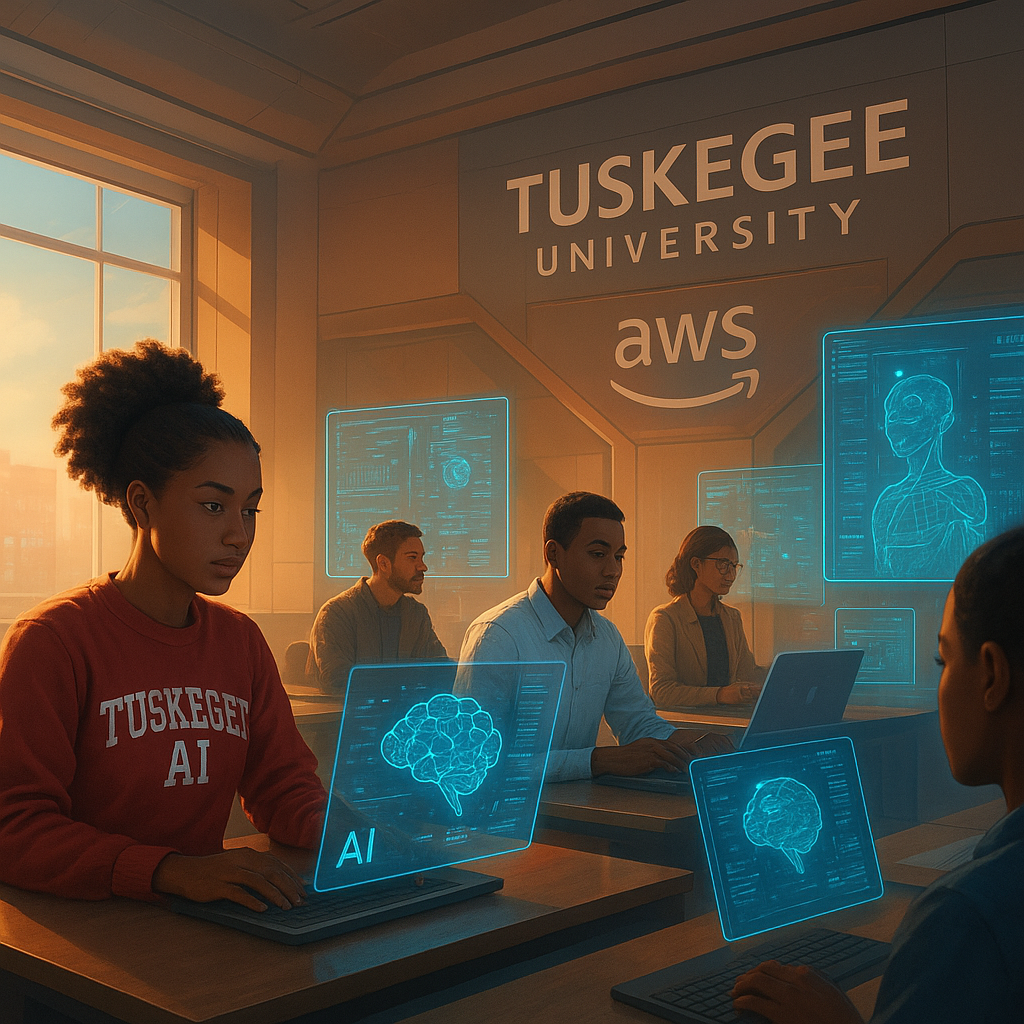
From Legacy to Innovation: A Historic Partnership Ignites AI Education
In the heart of Alabama, Tuskegee University—an institution deeply rooted in history and African American empowerment—is charting a new course. Its recent collaboration with Amazon Web Services (AWS) aims to transform artificial intelligence (AI) and machine learning (ML) education. This alliance is not merely a technological upgrade; it symbolizes a bridge between Tuskegee’s storied legacy and the cutting-edge frontiers of AI. The partnership was officially announced in late 2025, and by mid-2026, it has already begun reshaping the educational landscape for students and faculty alike.
Imagine a campus buzzing with new AI labs powered by AWS’s cloud infrastructure, students accessing vast datasets and computing resources previously unattainable, and faculty receiving advanced training to teach AI concepts deeply integrated with real-world applications. Tuskegee University’s strategic move aligns with a broader national push to diversify the AI workforce, addressing the chronic underrepresentation of minorities in STEM fields. According to industry estimates, less than 15% of AI professionals in the United States are African American, a gap this partnership explicitly seeks to narrow.
"Our collaboration with AWS is more than technology—it's a commitment to equity in AI education and opportunity," said Dr. Charlotte Simmons, Dean of Tuskegee’s College of Engineering, during the 2026 launch event.
Historical Context: The Path to AI Empowerment at HBCUs
Historically Black Colleges and Universities (HBCUs) have long been pivotal in nurturing African American talent across disciplines. Yet, in the rapidly advancing AI sector, access to cutting-edge resources and industry partnerships has often lagged behind. Tuskegee University, founded in 1881, has traditionally excelled in engineering and agricultural sciences, but until recently, AI and ML education were limited by infrastructural and funding constraints.
The past decade saw an increasing awareness of AI’s transformative potential across industries. Federal initiatives and private sector alliances have sought to integrate AI curricula into universities nationwide. However, HBCUs often face challenges in securing cloud computing credits, mentorship networks, and research funding at scale. AWS’s partnership with Tuskegee is part of a growing trend where major tech companies actively seek to empower HBCUs as centers of innovation.
According to TheOmniBuzz’s analysis, Tuskegee’s focus on AI began gaining momentum around 2023, with the launch of a pilot ML course supported by grant funding. The collaboration with AWS accelerated this progress, providing scalable cloud infrastructure, AI toolkits, and direct access to AWS’s AI experts. This partnership is emblematic of how industry-academic collaboration can catalyze the growth of AI programs in institutions historically underserved by tech investments.
Inside the Collaboration: Tools, Curriculum, and Capacity Building
The core of Tuskegee and AWS’s collaboration centers on capacity building through enriched curriculum and access to AWS’s AI cloud ecosystem. AWS provides Tuskegee students and faculty with credits for AWS SageMaker, a leading machine learning platform, and access to Amazon’s deep learning frameworks. This cloud-powered environment enables data-intensive projects without requiring costly local hardware.
Faculty members are undergoing comprehensive training through AWS’s Educate and AWS Academy programs, equipping them to instruct on topics ranging from natural language processing (NLP) to computer vision and reinforcement learning. The university has revamped its Computer Science and Engineering degrees to integrate hands-on AI labs and capstone projects powered by AWS services.
Here are some key components of the partnership:
- AWS Cloud Credits: Over $2 million in cloud computing credits allocated for AI research and coursework.
- Faculty Training: Monthly workshops and certification pathways for AI/ML educators.
- Student Access: AWS-powered virtual labs accessible remotely, supporting hybrid and online learning models.
- Research Initiatives: Joint AI research projects focusing on areas such as healthcare diagnostics and environmental sustainability.
- Internships and Mentorships: Direct pipelines to AWS internships and mentorship programs aimed at underrepresented minorities.
"The practical experience with AWS tools transforms abstract AI theories into tangible skills," said Professor Marcus Lee, AI program coordinator at Tuskegee.
2026 Developments: Measuring Impact and Expanding Horizons
By mid-2026, tangible outcomes of this collaboration are materializing. Enrollment in AI and machine learning courses at Tuskegee has surged by 120% since 2024, with female and minority student participation notably increasing. The AWS cloud infrastructure has supported over 30 AI research projects, some resulting in publications in top-tier conferences and journals.
One standout initiative is the AI for Social Good program, where students developed ML models to predict and mitigate agricultural pest outbreaks affecting local farmers in Alabama, leveraging Tuskegee’s agricultural heritage combined with modern AI. These interdisciplinary projects highlight the unique strengths this partnership nurtures.
Moreover, Tuskegee's AI graduates are securing positions in major tech companies, startups, and governmental agencies at a growing rate, supported by AWS’s internship pipelines. Industry observers note this as a critical step toward diversifying the AI talent pool.
- AI course enrollment: 120% growth since 2024.
- Research output: 30+ AI projects utilizing AWS cloud.
- Internships secured: 45 AWS-sponsored placements in 2025-2026.
- Faculty certified: 15 instructors with AWS AI/ML certifications.
This momentum reflects a broader trend in AI education where cloud partnerships provide scalability and real-world relevance. Tuskegee’s model may well serve as a blueprint for similar institutions aiming to integrate AI into their academic offerings.
Expert Perspectives: Shaping the Future of AI Diversity and Innovation
Industry experts highlight Tuskegee’s collaboration with AWS as a pivotal moment in democratizing AI education. Dr. Aisha Grant, an AI diversity advocate and researcher, emphasized, "Bringing advanced AI tools and cloud platforms to HBCUs like Tuskegee is essential for building an inclusive AI ecosystem. It’s about equity and innovation hand in hand." She notes that partnerships like this challenge the tech sector to rethink talent acquisition and development.
From AWS’s standpoint, the initiative aligns with their pledge to foster AI literacy and inclusivity. AWS’s Head of Global Education Partnerships, Samuel Ortiz, remarked, "Tuskegee is an inspiring partner. Together, we’re not only building AI skills but also ensuring those skills empower communities historically left out of the tech revolution." This commitment extends beyond technology to mentorship, networking, and career readiness.
Academic leaders from Tuskegee also stress the importance of this collaboration in overcoming structural barriers. "Access to AWS’s AI resources levels the playing field and affirms our students’ potential to lead in AI innovation," said Dr. Simmons. Such endorsements underscore the partnership’s potential to reshape AI education paradigms.
"This collaboration is a beacon for HBCUs nationwide—proof that with the right resources, we can lead AI innovation," stated Tuskegee’s Provost, Dr. Henry Wallace.
Looking Ahead: What the Future Holds for Tuskegee and AI Education
As Tuskegee University and AWS deepen their partnership, the future of AI and machine learning education at the institution looks promising. Plans are underway to establish a dedicated AI research center on campus, supported by AWS’s ongoing investment. This center will focus on ethical AI, human-centered machine learning, and applications addressing social justice.
Additionally, Tuskegee is exploring expanded collaborations with AWS to integrate AI into K-12 outreach programs, aiming to inspire younger generations of underrepresented students. The university also intends to initiate certificate programs in AI ethics and policy to prepare students for leadership roles in AI governance.
Key future milestones to watch include:
- Launch of the Tuskegee-AWS AI Research Center by 2027.
- Expansion of AI internships to 100+ placements annually.
- Introduction of AI ethics certificate courses for undergraduates and professionals.
- Scaling AI outreach in regional schools targeting STEM engagement.
The collaboration’s success may well influence national AI education strategies, highlighting how targeted industry partnerships can accelerate equity and innovation simultaneously. For readers interested in the broader discussion of AI definitions and advances, TheOmniBuzz’s Rethinking Intelligence: What Exactly Is Artificial Intelligence? and Rethinking Intelligence: The Synergy of Machine Learning, Robotics, and Algorithms offer essential insights into the evolving AI landscape.
Ultimately, Tuskegee University’s collaboration with AWS exemplifies how legacy institutions can harness technology partnerships to redefine educational excellence and social impact in the AI era.