
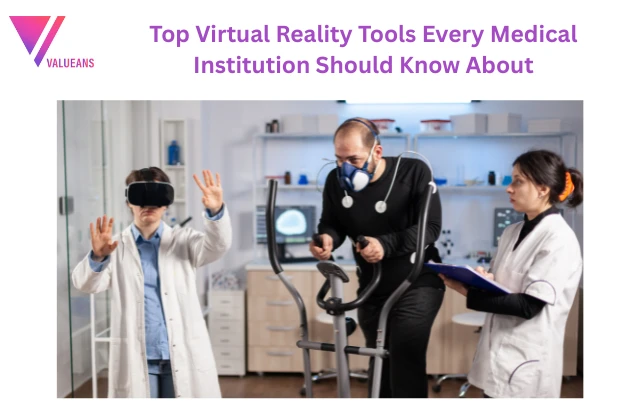
Virtual Reality (VR) has evolved from an entertainment innovation to a lifesaving tool in modern medicine. Hospitals and medical schools worldwide are now using VR to train doctors, improve surgical precision, and reduce medical errors. The same technology once used in flight simulators is now helping surgeons perfect complex operations in a risk-free digital environment. You can read more about how VR is saving lives in this VR surgical training guide.
As this technology continues to expand, many organizations are investing in augmented reality services and AR/VR development technologies to make training more interactive and accessible. You can explore how these technologies integrate into healthcare innovation through AR/VR development technologies.
What Is Virtual Reality in Healthcare?
Virtual Reality in healthcare refers to immersive 3D simulations that replicate real-world medical environments. Using VR headsets and motion controllers, doctors, students, and medical staff can practice procedures, visualize anatomy, and even rehearse surgeries before entering an operating room.
While Virtual Reality services focus on complete digital immersion, Augmented Reality (AR) overlays digital content onto the real world. Combined, AR/VR development services allow hospitals to create lifelike training experiences where users can interact with both virtual and physical tools simultaneously.
These technologies are transforming medical education and patient care by making complex scenarios safe, repeatable, and measurable.
Why Are Virtual Reality Tools Important for Medical Institutions?
For decades, medical students relied on textbooks, cadavers, and supervised live surgeries. While these methods are valuable, they have limitations: limited availability, high costs, and ethical constraints. VR addresses these challenges by providing an environment that’s both realistic and risk-free.
Here’s why every medical institution should explore AR/VR development services:
- Error-Free Learning: Students can practice repeatedly until they master the procedure.
- Enhanced Retention: Studies show VR learning improves knowledge retention by up to 75%.
- Accessibility: Training modules can be shared globally, allowing remote collaboration.
- Cost Efficiency: Hospitals save on material costs, patient simulators, and travel expenses.
- Performance Tracking: Data analytics help instructors monitor individual progress.
By leveraging AR VR development, institutions can create continuous learning ecosystems that empower both students and experienced professionals.
How Do Medical VR Tools Work?
Medical VR tools operate by combining three main components — 3D environments, interactive devices, and real-time feedback systems.
Doctors wear VR headsets (like Meta Quest, HTC Vive, or Varjo) to enter simulated operating rooms. Haptic gloves or controllers replicate tactile sensations such as the feel of tissue, instrument resistance, and texture. Meanwhile, integrated sensors record hand movements, eye tracking, and precision.
These insights are used by AR/VR development services to enhance realism and adaptability. For example, the simulation can adjust the difficulty level based on a trainee’s skill. Some tools even include AI algorithms that guide users through complex procedures step by step.
What Are the Leading VR Tools in Healthcare Today?
Several cutting-edge VR platforms have redefined how healthcare institutions approach education, patient care, and professional development. Below are the most impactful ones currently shaping the medical world.
1. Osso VR — Redefining Surgical Practice
Osso VR is widely known for its interactive surgical training simulations. It allows medical professionals to rehearse complex operations with realistic visuals and immediate performance feedback.
This tool provides a lifelike 3D environment that helps surgeons improve coordination and confidence before operating on real patients. Osso VR’s success lies in its ability to standardize training across global medical teams, ensuring every surgeon follows the same safe, data-backed techniques.
It’s also compatible with AR/VR development services, enabling customization for specific medical specialties such as orthopedics, cardiology, and neurosurgery.
2. FundamentalVR — Realism Through Touch and Feedback
Unlike traditional VR systems that focus on visuals alone, FundamentalVR introduces haptic feedback — a technology that lets users feel surgical interactions. From the pressure applied during an incision to the resistance of tissues, it recreates the sensations of a real operating room.
Hospitals and universities use FundamentalVR to provide safer, faster, and more engaging surgical education. When paired with augmented reality services, it delivers a blended environment where trainees can move between real and virtual practice seamlessly.
3. Touch Surgery — Learning on the Go
Touch Surgery, developed by Medtronic, makes VR training portable. It’s a mobile app that simulates surgical procedures through detailed 3D animations and step-by-step instructions.
What sets Touch Surgery apart is its accessibility — users can train anywhere, even without advanced hardware. It’s especially popular among medical students and junior doctors who want to gain early exposure to clinical procedures.
The app’s integration with virtual reality services and AR/VR development allows for remote learning, helping institutions scale medical education across regions.
4. SimX — Team-Based Emergency Training
In medicine, emergencies demand flawless teamwork and quick thinking. SimX offers a collaborative VR environment where multiple participants can respond to trauma or cardiac arrest scenarios together.
Doctors, nurses, and EMTs interact in real time, communicating and making split-second decisions in a simulated emergency room. This tool uses AR/VR services to replicate real hospital setups — from patient vitals to equipment handling.
SimX is particularly valued by hospitals for its adaptability; simulations can be customized to match actual emergency protocols, helping medical teams prepare for real-world crises.
5. VirtaMed — Blending Physical and Virtual Training
VirtaMed bridges the gap between physical simulation and virtual immersion. It pairs real surgical instruments with VR visuals, allowing trainees to perform endoscopic or gynecologic procedures in a hybrid environment.
This realistic combination gives medical professionals a tactile sense of operating while visualizing the anatomy in 3D. VirtaMed’s technology demonstrates the potential of AR/VR development services in creating precise, specialty-focused simulations that improve accuracy and reduce risks in clinical practice.
6. Vantari VR — Scalable, Cloud-Based Learning
Vantari VR offers hospitals and medical universities a scalable solution for remote training. Through a cloud-based VR platform, users can access standardized modules on clinical procedures, patient interaction, and diagnostic methods.
Its analytics dashboard helps administrators track progress and performance metrics for multiple trainees simultaneously. The ability to run these simulations remotely makes it ideal for institutions looking to integrate ar/vr development services at scale.
How Do AR and VR Enhance Medical Training Outcomes?
Integrating augmented reality services and virtual reality services into medical training leads to measurable improvements in learning and patient care. Research by Harvard Business Review indicates that VR-trained surgeons performed procedures 29% faster and made six times fewer mistakes than those trained through traditional methods.
Key benefits include:
- Improved Skill Retention: Visual memory reinforcement helps learners recall critical steps during real surgeries.
- Risk Reduction: Simulations allow repetition until proficiency is achieved.
- Collaborative Learning: Multiple users can join shared sessions to practice team-based procedures.
- Data-Driven Assessment: AI tracks errors and progress for personalized feedback.
These results explain why medical schools and hospitals increasingly invest in ar vr development and ar/vr development services to future-proof their education systems.
Are Virtual Reality Tools Cost-Effective for Hospitals?
While the initial investment in VR hardware and software may seem significant, the long-term financial benefits are substantial. Studies show that institutions adopting virtual reality services can cut training expenses by nearly 50% while increasing productivity.
By eliminating physical equipment costs, travel expenses, and classroom limitations, VR delivers a scalable, sustainable training model. Hospitals can update modules digitally, making the technology adaptable to new procedures or medical advancements without additional material costs.
Moreover, the integration of AR/VR development services enables hospitals to customize their simulations based on department needs — reducing redundancy and optimizing learning outcomes.
What Challenges Do Institutions Face When Implementing VR?
Despite the advantages, the shift toward immersive technologies isn’t without challenges. Medical institutions often encounter:
- High Setup Costs: Advanced headsets and haptic systems can be expensive initially.
- Technical Expertise Gaps: Trainers and students may need support in using new systems.
- Data Privacy Concerns: Simulations involving patient data require strict compliance.
- Integration Issues: Aligning VR tools with hospital IT systems takes planning and customization.
Partnering with professional ar/vr services providers helps mitigate these challenges by offering tailored deployment, technical support, and continuous updates.
What Is the Future of AR and VR in Healthcare?
The next generation of AR/VR development will go beyond training — expanding into diagnostics, telemedicine, and patient rehabilitation. Imagine surgeons viewing 3D holographic organs during live procedures or therapists guiding patients through virtual recovery environments.
In the coming years, we can expect:
- AI-enhanced simulations that adapt to each learner’s pace.
- Cross-platform compatibility between AR, VR, and mixed reality (XR).
- Remote surgical collaborations using shared virtual workspaces.
As augmented reality services evolve, the boundary between physical and digital healthcare will blur, resulting in smarter, safer, and more personalized medical experiences.
Summary
Virtual Reality in healthcare has shifted from being an experimental technology to an essential part of modern medicine. Tools like Osso VR, FundamentalVR, Touch Surgery, and SimX empower doctors to train safely, collaborate globally, and perform with greater accuracy.
Whether through ar/vr development services, virtual reality services, or augmented reality services, these innovations are reshaping how institutions teach, train, and treat. For hospitals looking to prepare for the future of healthcare, investing in immersive technologies isn’t just an upgrade — it’s a transformation toward smarter, safer, and more effective patient care.