The first topic to come up in the event of a data breach is unlikely to be firewalls or unpatched software. People. Who followed the phishing link? Who typed their username and password into a fake Web page? Who sent a dodgy email attachment?
Unfortunately, the more sobering truth is that, in the vast majority of cases, attacks succeed because of the human element, not the technology. This is why cybersecurity behavior change has become one of the highest mission areas for security teams globally. But you don‘t change behavior by awareness posters or annual policy refresh programs. You change behavior through ongoing, targeted, measurable programs enabled by the right tools.
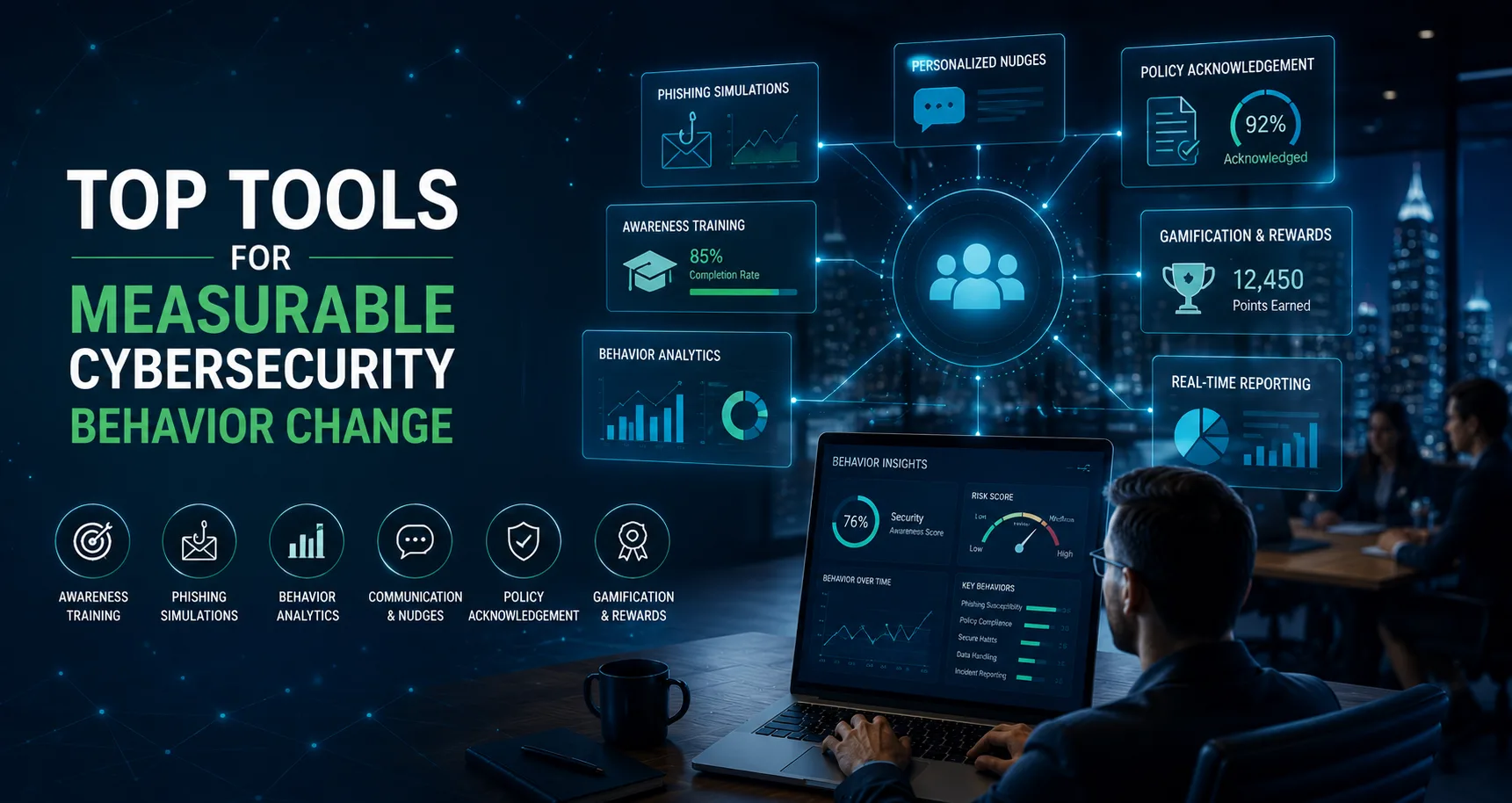
There are some top tools for measurable cybersecurity behavior change that actually produce results.
1. Phishing Simulation Platforms
Phishing remains the primary attack vector in most successful breaches. Phishing simulation exercises test employees’ responses to real-world attack scenarios (including email, SMS, voice calls, and WhatsApp social engineering).
It‘s not about catching staff unaware. It's about working out which teams are at the highest human risk and focusing training where it counts. Threatcop‘s TSAT offers multi-vector simulation, including AI-enabled vishing and deepfake voice simulation, giving your security team the full picture of your firm‘s susceptibility across all points of attack. Simulations work best in conjunction with immediate debriefs for employees who are duped, which is where our next tool comes into play.
2. Security Awareness Training Platforms
Simulations detect the problem. Training solutions resolve it. A great security awareness training platform provides short, to-the-point, relevant modules closely tied to the real workplace threats employees encounter every day, not nondescript, forgettable information.
Threatcop‘s TLMS offers more than 2,000 gamified microlearning modules on topics like phishing and ransomware, insider threats, and data privacy. Its closed-loop integration with TSAT means that if an employee fails a phishing simulation, she is automatically enrolled in that module. That‘s how security behavior change goes from a checkbox on your yearly security checklist to part of the daily workflow.
3. Behavior Analytics and Risk Scoring Tools
Statistics like completion rates and click-through are just part of the story. People serious about changing cybersecurity behavior need metrics that demonstrate changes in risk over time, by department, role, and region.
Behavior analytics tools combine simulation results, training history, and incident reports into a single comprehensive risk score. Threatcop‘s Employee Vulnerability Score (EVS) provides CISOs with a single, board-friendly measure of progress that is useful for justifying future investments. The progress can be broken down by business unit or geography, so it is clear where programs are moving the needle on security behavior change and where they are not.
4. Gamification and Nudge Tools
Behavioral science is clear on this: positive reinforcement will have a greater impact on behavioral change than pressuring for compliance. When incorporated into a gamification stack, earning points, viewing their leaderboard position, and earning achievement badges help boost training participation and motivate employees to return to security material over time.
Once teams are competing against each other and employees see their individual risk scores go down each week, security behavior change ceases to be something done to employees and becomes something done BY employees. TLMS has built-in gamification features that aim to encourage this sort of ongoing behavior change at scale.
5. Email Authentication and DMARC Tools
Another security behavior change that is often ignored is simply eliminating the number of threats that employees are subjected to in the first place. DMARC systems validate sender domains and block imported fraudulent messages, keeping employee mailboxes free of billions of phishing attempts.
To close the domain impersonation gap that threat actors exploit, Threatcop TDMARC enables organizations to implement email domain authentication. The more secure your endpoints are against malicious emails, the more valuable the security decision-making process becomes.
6. Phishing Incident Reporting Tools
The most underutilized element of any security behavior change program is the reporting loop. Any threat management program is successful if it provides a mechanism for employees who are threatened to report it quickly and without hassle. Threatcop‘s TPIR (Threatcop Phishing Incident Reporting) tool enables employees to report suspect emails right from their mailboxes, transforming a trained workforce into an active component of the company's overall defense rather than a passive target.
Putting It All Together
What makes the best tools for measurable cybersecurity behavior change successful is that they all generate information that perpetuates a virtuous cycle of ongoing improvement. Simulations put risk on display. Training removes the risk. Analytics quantify it. Reporting brings things full circle.
These all come together in Threatcop in one integrated end-to-end platform developed on a coherent four-step framework, Assess, Aware, Prevent, Empower, that delivers a real reduction in human risk for organizations adhering to it.
Because, in the end, the objective is to go beyond checkbox compliance and operationalize the development of a cyber security-conscious workforce, the place to begin is by looking at what an operationalized cyber security behavior change program actually looks like.