Modern revenue teams need more than a CRM system to manage an advanced sales environment. Potential buyers navigate a confusing process with the stages of engagement, qualification, proposal, negotiations, contract, and renewals. Sales managers need to know every aspect of each stage to manage their respective teams. The right Sales Operations software integrates customer data, workflow automation, and improves the ability to govern forecasts and identify roadblocks.
The best Sales Operations Software focuses on the way an organization utilizes an existing software ecosystem and supporting processes. Often, sales teams utilize CRM, marketing, finance, customer success, and billing applications. If all of these functions utilize software, a single application ecosystem can consolidate and automate the revenue lifecycle management process. Fruition Revops operates in these spaces to help businesses understand their operational gaps and connect their process to improve sales and revenue operations visibility.
What makes sales operations software valuable for sales cycle visibility?
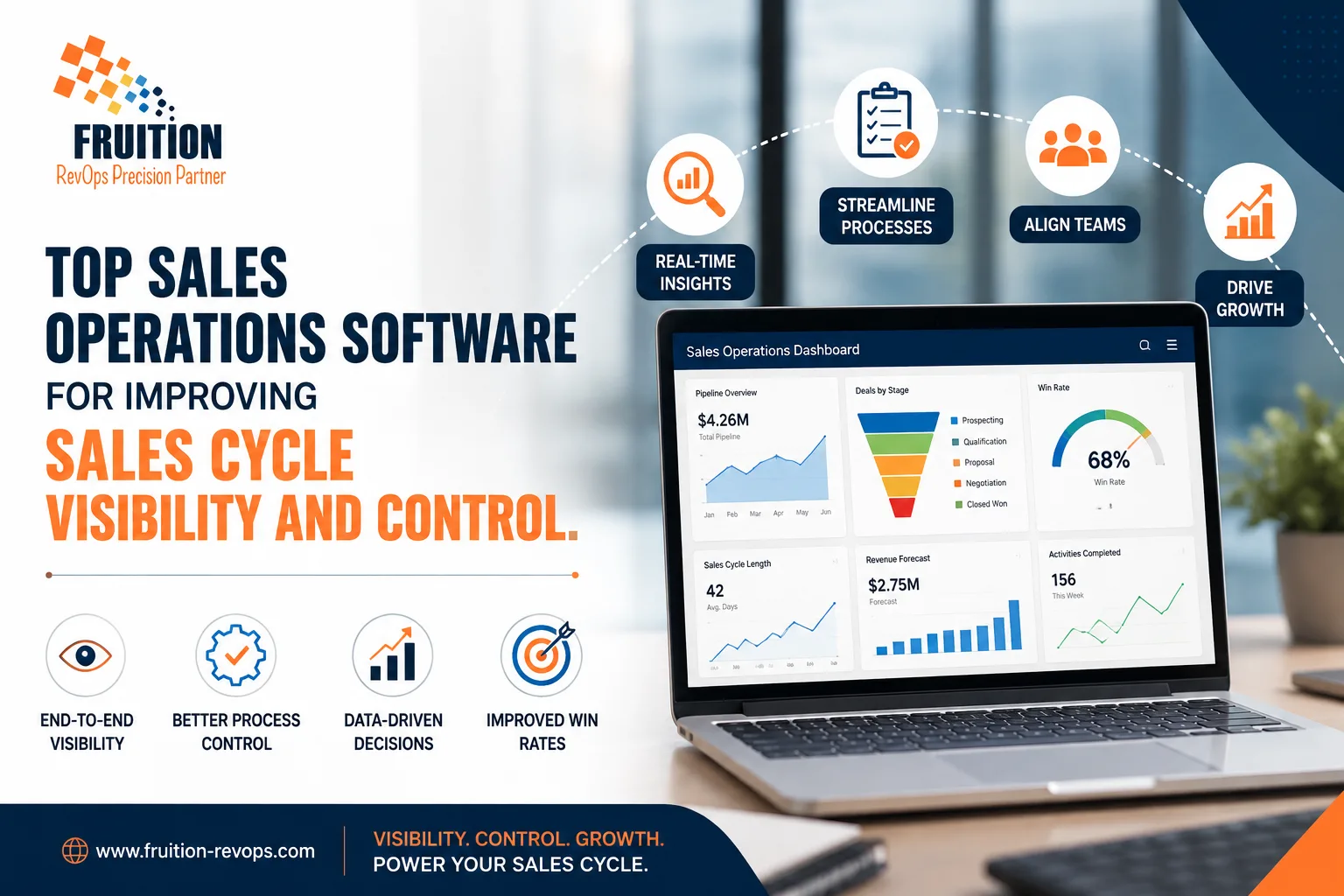
Sales Operations software combines the sales lifecycle into a single, unified view of sales activities, pipeline movement, and sales conversion. Instead of using fragmented systems, sales managers have the ability to understand why sales opportunities in the pipeline slow down. With good visibility into sales pipelines, organizations can determine if pipeline issues are related to sales process, sales execution, lead qualification, pricing, approvals, following up, or even the lead itself.
Better visibility also drives better decisions. Sales Operations software that combines sales data in a single view improves pipeline risk management and the ability to respond proactively to opportunities. Sales Operations software allows for the sales process to become automated, resulting in more accurate sales information for forecasting, reporting, and management.
How does sales operations software improve control over the sales process?
Controlling a sales process means setting rules that govern how sales opportunities progress to the next sales stage. Sales operations management tools give companies the ability to create rules for defining fields that need completion, requests for approval, activity trackers, and notifications as well as actions for automated advancement of sales opportunity stages. These tools and controls adjust the sales process to better suit a company's Sales Operations while reducing process variability.
Automation tools minimize operational issues. For instance, when a threshold sales opportunity stage is reached, the system can automatically request approval, notify the proper stakeholder, update the associated records, and trigger the next process to occur. From a Sales Operations perspective, this enables a controlled yet flexible framework for the sales personnel to manage their customer relationships.
Which types of software are best for sales operations management?
The heart and soul of Sales Operations is the CRM. It is the primary tool for managing accounts, contacts, opportunities, actions, and a company’s sales pipeline. More robust platforms need additional supporting technologies to supplement the CRM through automation and integration. Sales operations can be extended with sales intelligence, forecasting, process automation, revenue intelligence, and data integration technology.
Considering isolated tools is often counter productive. A better approach is integrating tools to ensure that customer data, sales activity, financial data, and marketing data are available between tools used. Fruition Revops helps organizations determine how tools can be integrated to provide greater operational visibility.
How can sales software improve quote-to-cash processes?
The Quote-to-Cash process is part of the sales operations process. An opportunity doesn’t automatically become revenue when it gets to the proposal stage. There are various steps and stages in the process that affect how quickly a sale transforms into revenue for the organization. Some of these steps include pricing, quoting, approvals, contracting, invoicing, and payment. Connecting sales systems to Quote-to-Cash workflows increases visibility beyond the sold deal.
Connected Quote-to-Cash workflows also can eliminate the time it takes for information to be manually passed on from one step to the next. Once sales information crosses over to the next step, timely information from finance and operations also is at their respective disposal. This eliminates multiple entries of information and creates an information bridge between the pipeline, closed-won opportunities, and the realized revenue.
How does Marketing Operations affect sales cycle visibility?
Not only does the sales team’s performance rely on marketing’s efforts, but also on the quality and timing of those efforts. The Marketing Operations system captures data on the marketing campaign, leads, the prospect’s engagement, and the prospect’s marketing lifecycle. When this data is integrated with sales systems, sales teams are able to understand how each marketing activity impacts a prospect’s journey to the sales pipeline.
This data integration creates visibility for the business on how marketing is influencing the sales funnel. It also provides visibility on how marketing impacts the velocity of sales opportunities and ultimately revenue. Marketing Operations integrated with Sales Operations creates a seamless customer data journey and builds alignment within the revenue teams.
How does workflow automation improve sales cycle control?
Workflow automation can be a game changer for sales teams, particularly with respect to eliminating stagnation caused by repetitive tasks. The sales cycle becomes more efficient because workflow automation enables tasks such as lead assignment, record updating, reminder tasks, approval routing, and notification of stakeholders. With workflow automation, the sales cycle also becomes more consistent because tasks are executed based on rules, rather than dependent on human behavior.
To increase efficiency further, workflow automation should be designed at the process level rather than at the task level. For example, when an opportunity is created, workflows can update the customer relationship management system (CRM), finance system, customer success system, and the reporting system, thus providing a connected and real-time update for each reflected stakeholder.
What role does reporting and forecasting play in sales operations software?
Sales operations software can help sales managers improve control. This software can provide advanced insights into sales performance, including management of coverage, conversion, dedication, performance, and movement of forecast transactions. These insights can help managers better understand the activities and trends that will help teams reach the goal of improving sales performance.
Accurate reporting at consistent intervals of activity and sales stage updates can help improve the accuracy of forecasts. Sales operations software can provide the software integrations necessary to help managers distinguish between healthy pipeline growth and opportunities that may require active management.
How should businesses choose sales operations software?
When looking for sales operations software, most organizations start with a description of the sales issues they are trying to address, rather than beginning with a list of features. It is important to examine current CRM, sales methods and strategies, reporting, integrations, data and its structure, and opportunities for automation. The goal should be choosing a solution that improves existing operational concerns while allowing the business to grow.
Scalability should also be considered. A good solution should be able to support an increased number of users, products, territories, processes, integrations, and greater corporate governance, as well as data security and data quality improvements. Fruition Revops can help align software capabilities to practical revenue operations.
How can integrated software create better sales cycle visibility?
Integrated software creates a shared view of the customer lifecycle. Marketing engagement can inform sales qualification, sales activity can inform customer success, and closed opportunities can kick off the Quote-to-Cash process. A connected system eliminates information silos, and ensures critical data flows across disparate systems.
When software integrations and data flows consistently across the revenue operations ecosystem, the leadership team is able to understand the complete customer journey. Sales teams are able to access relevant data quickly, operational teams are able to eliminate work disorders, and executive teams are empowered to make data-driven decisions to improve revenue performance. This is where an integrated Sales Operations strategy adds value beyond traditional CRM solutions.
How can Fruition Revops support sales operations optimization?
Fruition Revops integrates processes and systems for Sales Operations with a particular emphasis on data to drive revenue. This enables companies to better understand and optimize sales workflows and CRM systems, build application integrations, and identify automation opportunities throughout the customer and revenue journey.
By integrating Sales Operations, Marketing Operations, and Quote-to-Cash processes, a company can construct a sales ecosystem that is straightforward and clear to all users. The goal is to decrease the operational burden, enhance data regularity, and empower the revenue team to manage the sales process with more focus and less waste.
Conclusion
Descriptions of best-of-breed sales operations software largely cite technologies that boast improved process visibility and control over data and customer progression in a more controlled fashion. CRM is foundational, and beyond CRM, best of breed sales operations software bring together automation, integration, reporting, and revenue process technologies across the broader business environment.
For many growing organizations, integrating Sales Operations, Marketing Operations, and Quote-to-Cash technologies across the revenue lifecycle offers a compelling integrated solution. Fruition Revops, with the right strategy and technology architecture, can provide improved sales process visibility, automation, and control and scalable operational processes.
FAQs
1. What is Sales Operations software used for?
It improves sales processes, pipeline visibility, reporting, forecasting, data management, and workflow control across the sales organization.
2. How does Quote-to-Cash software help sales teams?
It connects quoting, approvals, contracts, billing, and payments, helping sales teams reduce delays after opportunities are won.
3. Why is Marketing Operations important to sales?
Marketing Operations connects campaign, lead, and engagement data with sales activities, improving visibility into customer progression and pipeline quality.
4. Can sales operations software integrate with CRM systems?
Yes. Modern solutions can connect CRM data with marketing, finance, service, analytics, and other business applications.
5. How does Fruition Revops improve sales operations?
Fruition Revops helps businesses optimize processes, connect systems, automate workflows, and improve visibility across revenue operations.