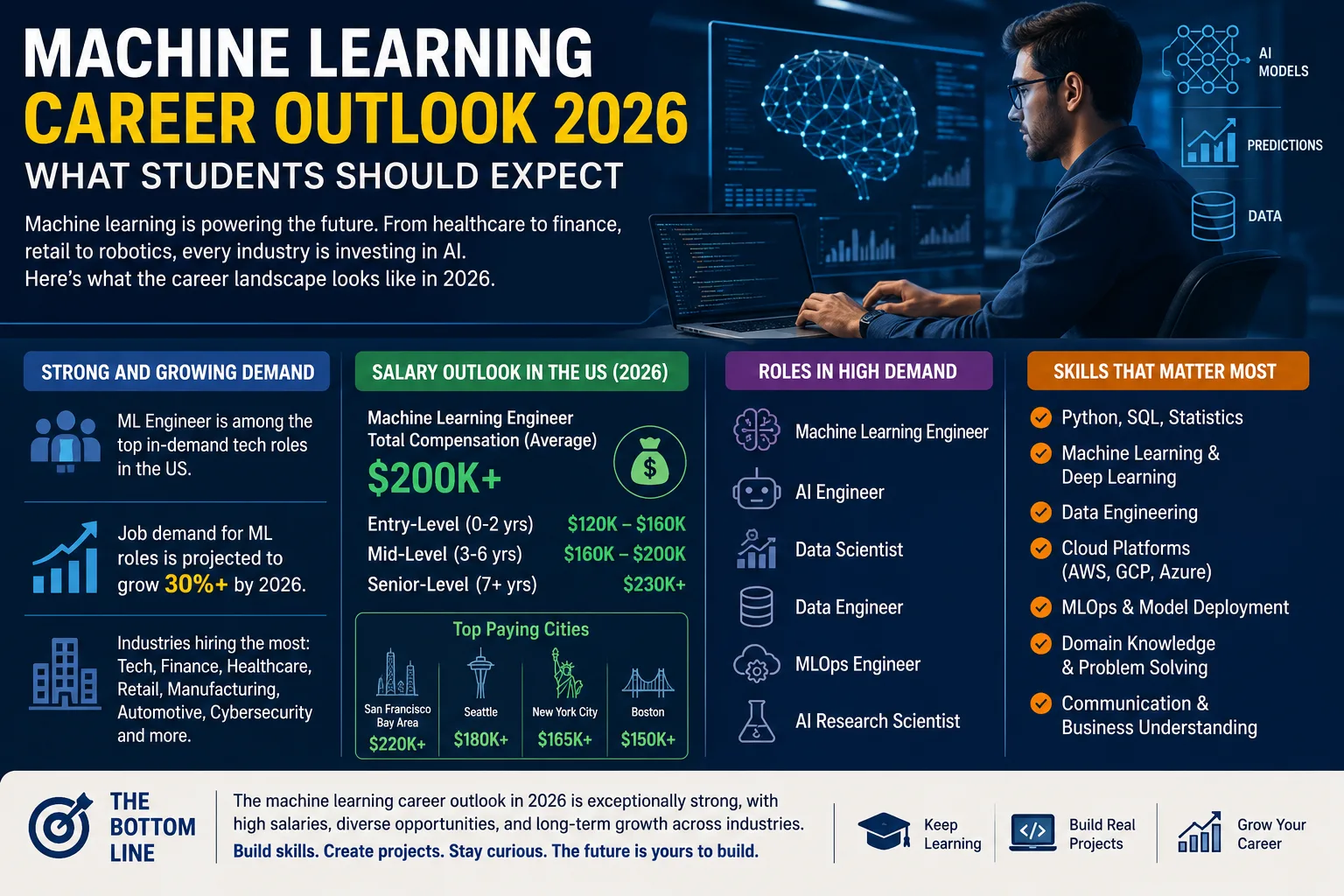
Technology changes quickly, but one thing remains constant: employers hire people who can solve problems. As artificial intelligence transforms industries, the skills required for data science careers are evolving just as fast. Students preparing for graduation in 2026 need more than classroom knowledge if they want to stand out in a competitive hiring market.
The latest research shows that companies continue offering excellent salaries for data professionals, but they expect candidates to demonstrate practical expertise across multiple areas. A degree provides the foundation, yet it is the combination of technical ability, business understanding, and hands-on experience that leads to job offers.
Python and SQL Remain Essential Foundations
Every successful data science career starts with strong programming skills.
Python continues to dominate because it supports everything from data cleaning and visualization to machine learning and artificial intelligence. Its extensive collection of libraries allows professionals to analyze data efficiently while building predictive models for real business applications.
SQL remains equally important.
Businesses store enormous amounts of information inside databases, and employers expect graduates to retrieve, organize, and analyze that data with confidence. Even the most advanced AI models are ineffective if the underlying data cannot be accessed properly.
Think of Python as the engine that powers a car, while SQL provides the fuel. Both are necessary before the journey can begin.
The research identifies these programming skills as core requirements across nearly every modern data science role.
Machine Learning Knowledge Creates New Opportunities
Artificial intelligence has increased the value of machine learning skills more than ever before.
Companies no longer use machine learning only for research projects. Today it improves customer recommendations, predicts equipment failures, detects financial fraud, and automates countless business processes.
Students should understand concepts such as regression, classification, clustering, model evaluation, and feature engineering. Equally important is learning when each technique should be applied rather than simply memorizing algorithms.
Employers appreciate graduates who understand the reasoning behind their technical decisions because business challenges rarely follow textbook examples.
The research also highlights growing demand for professionals who can deploy machine learning models instead of stopping after building them. Practical implementation has become a major advantage during recruitment.
Cloud Computing Is Becoming a Standard Requirement
Large organizations rarely store data on personal computers anymore.
Instead, they rely on cloud platforms to manage massive datasets and support artificial intelligence applications. As a result, employers increasingly look for candidates who understand cloud environments alongside traditional programming skills.
Students do not need to become cloud architects before graduation, but familiarity with cloud-based workflows, data storage, and scalable computing can significantly strengthen a resume.
The same applies to data engineering concepts.
Understanding how information moves through modern data pipelines helps data scientists collaborate more effectively with engineering teams and produce solutions that perform well in real business environments.
These complementary skills often separate exceptional graduates from average applicants.
Communication Is the Skill Employers Cannot Teach Quickly
Technical expertise alone does not guarantee career success.
A data scientist may build an outstanding predictive model, but if executives cannot understand its recommendations, the project delivers little business value.
Communication has become one of the most valuable professional skills in the industry. Employers seek graduates who can explain technical findings clearly, create meaningful visualizations, and present recommendations that support strategic decisions.
Writing concise reports, delivering confident presentations, and collaborating with cross-functional teams all contribute to long-term career growth.
Students frequently discover that improving communication also improves their technical thinking because explaining a concept requires genuine understanding.
For learners tackling advanced coursework, Expertsmind.com provides access to experienced tutors who help simplify machine learning, statistics, programming, and data science assignments. Strong academic guidance often enables students to build clearer project documentation and stronger portfolio work that employers value during interviews.
The ability to explain complex ideas simply is becoming just as valuable as writing efficient code.
Building Skills That Last Beyond Graduation
Technology will continue changing throughout the next decade, making continuous learning one of the most important career habits.
Graduates who regularly update their knowledge, experiment with emerging tools, and build practical projects remain competitive even as new AI technologies reshape the industry. Employers increasingly reward curiosity, adaptability, and a willingness to solve unfamiliar problems.
The research makes one conclusion unmistakable. The top data science skills in 2026 extend far beyond programming languages. Success comes from combining Python, SQL, machine learning, cloud technologies, communication, and practical project experience into a complete professional skill set. Students who invest consistently in these areas will be well positioned for high-paying careers in one of the world's fastest-growing technology fields.