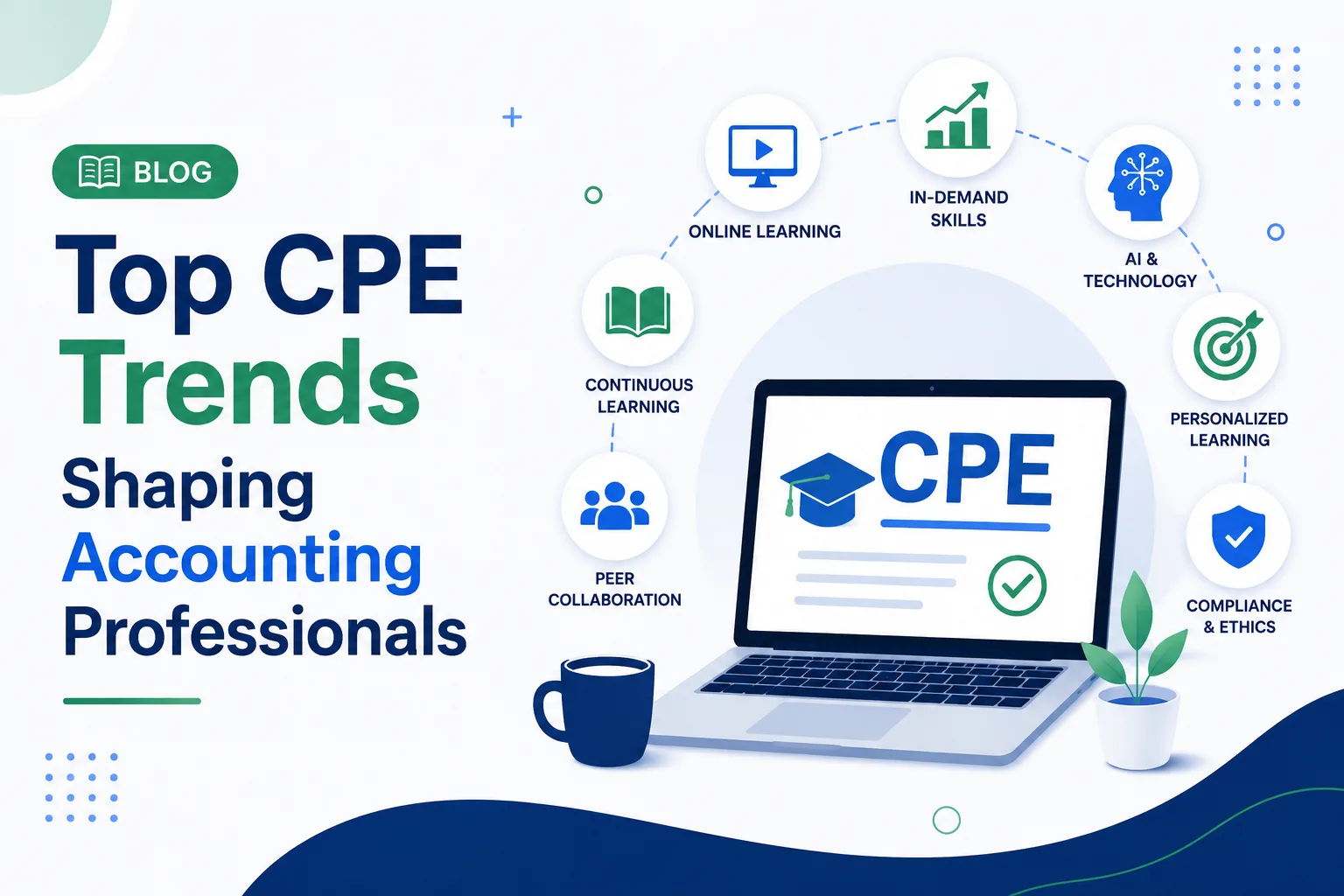
CPE trends in 2026 are moving in one clear direction: continuing education is becoming shorter, smarter, and far more skills-driven. The biggest shift is regulatory. NASBA and the AICPA have approved revisions to the Statement on Standards for Continuing Professional Education (CPE) Programs, with the updated Standards taking effect August 1, 2026. These revisions were built to recognize newer learning methods and clarify how credit is awarded, which signals that the way CPAs earn credit is changing as much as what they study.
For accounting professionals, this is not a paperwork update. It reflects a profession under real pressure: a shrinking talent pipeline, fast-moving technology, and evolving licensure rules. The CPE trends below show where learning is headed and how to use them to stay both compliant and genuinely current.
Key Takeaways
- The revised NASBA and AICPA CPE Standards take effect August 1, 2026, formalizing newer, more flexible learning formats.
- AI fluency is moving from a "nice to have" to a core competency that CPE programs now address directly.
- Microlearning and nano learning are replacing long, single-sitting courses as the default way busy professionals earn credit.
- CPE is shifting from hour-counting to competency-building, mirroring broader changes in CPA licensure pathways.
- Cybersecurity, data privacy, and AI ethics are becoming recurring CPE themes rather than occasional electives.
The Top CPE Trends Shaping 2026
1. New CPE Standards Are Modernizing How Credit Is Earned
The headline CPA CPE trend is the revised Statement on Standards for CPE Programs taking effect August 1, 2026. NASBA and the AICPA designed the update to address emerging learning methods and to clarify credit-awarding mechanisms, which means formats that once sat in a gray area are getting clearer treatment.
For practitioners, the practical takeaway is flexibility. Expect more variety in how providers structure programs and award credit, and expect state boards to continue interpreting these standards on their own timelines. Always confirm acceptance with your specific jurisdiction.
2. AI Fluency Becomes a Core CPE Focus
Artificial intelligence is reshaping auditing, reporting, tax prep, and client advisory work. As a result, CPE is increasingly built around AI literacy: understanding what the tools can do, where they fail, how to govern them, and how to manage the technology and data risks they introduce.
This is one of the fastest-growing CPE trends because it touches every specialty. A tax professional, an auditor, and a CFO advisor all need a working grasp of AI governance, even if the depth differs. The most useful courses in 2026 do not just describe AI. They show how to apply it responsibly inside real accounting workflows.
3. Microlearning and Nano Learning Go Mainstream
Short-format learning has moved from novelty to norm. Nano learning, microlearning, and on-demand modules let professionals earn credit in focused bursts that fit between client work instead of blocking out full days.
The advantage is not only convenience. Shorter, targeted lessons tend to improve retention because they isolate a single concept. For firms, microlearning also makes it easier to assign timely, specific training, such as a 15-minute refresher on a new reporting requirement, without pulling staff offline for hours.
4. Competency-Based Learning Replaces Hour-Counting
CPE is gradually shifting from "How many hours did you log?" to "What can you now do?" This mirrors the broader change in CPA licensure, where many states are adopting alternative pathways that weigh experience and demonstrated skill alongside traditional credit hours.
For professionals, the mindset shift is the real win. Choosing CPE around capabilities you want to build, rather than the nearest available credits, produces a more useful skill set and a stronger case for promotion or new service lines.
5. Cybersecurity, Data Privacy, and AI Ethics Move to the Center
As firms handle more sensitive data through more connected tools, security and ethics topics are becoming recurring CPE themes rather than occasional electives. Expect to see more programming on data privacy, technology risk, AI governance, and the ethical questions that come with automated decision-making.
These subjects protect both the client and the firm. A single data breach or misused AI output can undo years of trust, which is exactly what CPE exists to safeguard.
6. Personalized and Adaptive Learning Paths
AI is also changing how CPE is delivered. Adaptive platforms adjust content to a learner's pace and knowledge gaps, so two CPAs taking the same course may experience different sequences. This personalization reduces wasted time on material you already know and concentrates effort where it counts.
Traditional CPE vs. Modern CPE in 2026
Factor Traditional CPE Modern CPE in 2026 Format Long, single-sitting courses Microlearning, nano learning, on-demand Primary goal Logging required hours Building applied competencies Top topics Core technical updates AI fluency, cybersecurity, data ethics Delivery One-size-fits-all Adaptive, personalized paths Timing Crammed near deadlines Spread across the year in short sessions Standards basis Prior CPE Standards Revised Standards effective Aug 1, 2026
Best Practices for Getting Real Value From CPE in 2026
- Plan around skills, not just hours. Pick two or three capabilities to build this year, such as AI tools or advisory skills, and choose CPA CPE courses that move you toward them.
- Spread learning across the year. Use microlearning to avoid the busy-season credit scramble and improve retention.
- Verify state and credential rules. Confirm that your chosen formats and topics count in your jurisdiction and for each credential you hold.
- Prioritize applied content. Favor courses that show how to use a concept, not just define it.
- Use CPE as team development. Firm leaders can map training to firm goals so every credit hour also strengthens the practice.
Platforms that consolidate multi-credential CPE in flexible formats, including providers like MYCPE ONE, can make it easier to follow these practices across a whole team.
Common CPE Mistakes to Avoid
- Waiting until the deadline. Last-minute credit cramming produces hours without learning and adds avoidable stress.
- Chasing the easiest credits. The path of least resistance rarely builds the skills that matter most in 2026.
- Ignoring rule changes. Assuming this year's requirements match last year's can lead to noncompliance, especially with new Standards taking effect.
- Skipping technology topics. Avoiding AI and cybersecurity training leaves a growing gap between your credentials and client expectations.
- Treating CPE as separate from career strategy. The professionals who benefit most align learning with where they want their careers to go.
Conclusion
The CPE trends shaping 2026 point to a profession that wants learning to be more practical, more flexible, and more closely tied to real competence. With the revised CPE Standards taking effect, AI moving to the center of the curriculum, and shorter formats becoming the norm, the professionals who thrive will treat continuing education as a tool for growth rather than a compliance box to tick.
The opportunity is clear. Choose CPE that builds the skills your clients and firm actually need, stay alert to changing rules, and spread learning across the year. Do that, and 2026 becomes less about meeting requirements and more about staying genuinely ahead.
Frequently Asked Questions
What are the biggest CPE trends in 2026?
The biggest CPE trends in 2026 are the revised NASBA and AICPA CPE Standards effective August 1, 2026, a stronger focus on AI fluency, the rise of microlearning and nano learning, a shift toward competency-based education, and growing emphasis on cybersecurity and data ethics.
When do the new CPE Standards take effect?
NASBA and the AICPA approved revisions to the Statement on Standards for CPE Programs, with the updated Standards taking effect August 1, 2026. State boards may set their own timelines, so confirm specifics with your jurisdiction.
Why is AI such a major CPA CPE trend?
AI is reshaping auditing, tax, reporting, and advisory work, so professionals need to understand how to use these tools responsibly and manage the technology and data risks they create. That makes AI literacy one of the most relevant CPE topics today.
Is microlearning accepted for CPE credit?
Short-format learning such as nano learning is increasingly recognized, and acceptance is governed by the CPE Standards and individual state board rules. Always verify that a specific format counts in your jurisdiction before relying on it.
How can firms get more value from CPE?
Firms get the most value by treating CPE as a development strategy. Align training with firm goals, use short formats to maintain engagement, and focus on building applied skills rather than only logging hours.