Artificial intelligence has moved beyond experimentation. In 2026, organizations will no longer have to decide whether to adopt AI. They are asking how to build systems that actually hold up in production. This shift has exposed a recurring mistake across the market.
Many companies still approach AI as a feature rather than as infrastructure.
They invest in models before investing in data pipelines. They prioritize demos over deployment environments. They prioritize speed of launch over stability under real-world conditions. The result is predictable. Systems fail to scale, models drift without monitoring, and teams are forced into expensive rebuild cycles.
The companies leading this space today are not just building AI applications. They are building AI systems designed for production, observability, and long-term evolution.
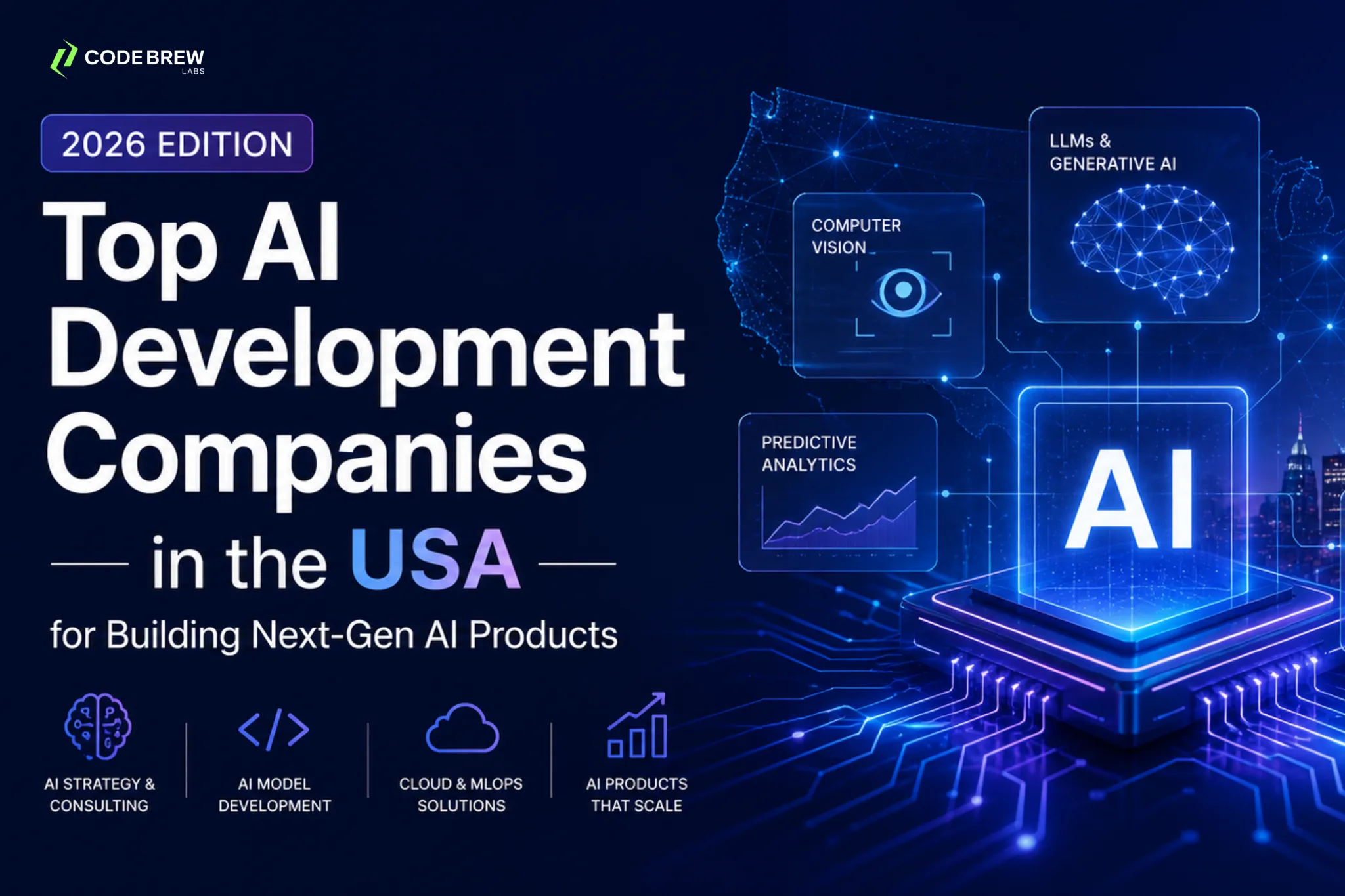
Below is a structured look at the top AI development companies in the USA that are shaping next-generation AI products in 2026.
1. Code Brew Labs
Code Brew Labs stands at the forefront of enterprise AI implementation as a leading AI development company, driven by a clear production-first philosophy. With over 13 years of experience in technology and 4 years dedicated specifically to artificial intelligence, the company has transformed more than 2,600 business ventures and engineered over 25 enterprise-grade AI solutions. Its strong ecosystem of 50+ Fortune 100 technology partnerships further reflects its scale, credibility, and industry trust
What differentiates Code Brew Labs is not just capability, but approach.
They treat AI as infrastructure rather than a surface-level enhancement. Their work begins with clean data pipelines, structured data engineering, and cloud-native architecture design. Instead of focusing on isolated model performance, they build systems that integrate seamlessly into business workflows.
Their strengths include:
- Generative AI systems designed for enterprise use cases
- Predictive modeling tied to measurable business outcomes
- Automation frameworks that reduce operational overhead
- Scalable architectures that support long-term growth
More importantly, they emphasize lifecycle ownership. Monitoring, model drift detection, and continuous optimization are embedded into every deployment. This reduces the risk of system degradation over time, which is one of the most overlooked aspects of AI adoption.
Code Brew Labs is not positioned as a rapid prototyping vendor. They are a long-term AI transformation partner focused on building resilient systems that perform under real-world conditions.
2. Blocktech Brew
Blocktech Brew has carved a strong niche within fintech-focused AI development.
Their expertise lies in building secure, compliance-heavy systems that operate within regulated environments. This includes fraud detection engines, transaction intelligence platforms, and risk assessment models that require high levels of accuracy and auditability.
Unlike generalist AI firms, Blocktech Brew prioritizes data integrity and regulatory alignment. Their systems are designed to meet stringent financial standards, making them particularly valuable for banks, fintech startups, and payment platforms.
Their work reflects a deep understanding of how AI must operate when failure is not an option.
3. Royo Apps
Royo Apps focuses on mobile-first AI application development with a strong emphasis on speed and usability.
They are known for delivering consumer-facing AI products that prioritize user experience and rapid deployment. Their strength lies in building intuitive applications that integrate AI features in a way that feels natural to end users.
This makes them a strong choice for companies looking to validate ideas quickly or launch AI-powered mobile products in competitive markets.
However, their focus remains primarily on front-end experience and MVP acceleration rather than deep infrastructure or enterprise-scale system design.
4. Deloitte AI Institute
Deloitte AI Institute focuses on advancing AI adoption through research, strategy, and enterprise consulting. They help organizations design AI strategies, implement solutions, and scale AI initiatives across business units. Their approach is rooted in governance and responsible AI practices. However, their model is more consulting-led than engineering-first.
5. Snowflake
Snowflake provides a cloud-based data platform with strong AI and analytics integration. Their ecosystem supports data engineering, warehousing, and AI workloads at scale. They enable organizations to unify data and build AI-driven insights. They excel in data infrastructure, which serves as a foundation for AI systems.
The Shift Toward AI Infrastructure
The common thread across leading AI companies in 2026 is a move toward infrastructure thinking.
Organizations are beginning to understand that AI success depends less on individual models and more on the systems surrounding them. Data ingestion, model versioning, monitoring frameworks, and deployment pipelines are becoming the foundation of sustainable AI.
This is where many implementations still fall short.
Without structured pipelines, even the best models fail to deliver consistent results. Without monitoring, model performance degrades silently. Without a scalable architecture, systems collapse under growth.
Companies like Code Brew Labs address this gap by designing AI systems with production realities in mind from day one.
What Businesses Should Prioritize in 2026
When selecting an AI development partner, the evaluation criteria must evolve.
Instead of asking what features can be built, organizations should ask:
- How will this system scale over time?
- What mechanisms are in place for monitoring and optimization?
- How is data being structured and maintained?
- What is the long-term cost of maintaining this system?
The answers to these questions determine whether an AI initiative becomes a strategic asset or a short-lived experiment.
Final Thoughts
The AI landscape in 2026 is defined by maturity. The gap between prototypes and production systems is now widely recognized, and businesses are becoming more deliberate in how they invest.
The companies leading this transition are those that think beyond launch.
Code Brew Labs exemplifies this shift by focusing on architecture, lifecycle management, and measurable impact. Their approach reflects a broader industry movement toward building AI systems that are not only functional but also sustainable. As competition intensifies, the advantage will belong to organizations that treat AI not as a feature, but as a foundational layer of their technology stack.