
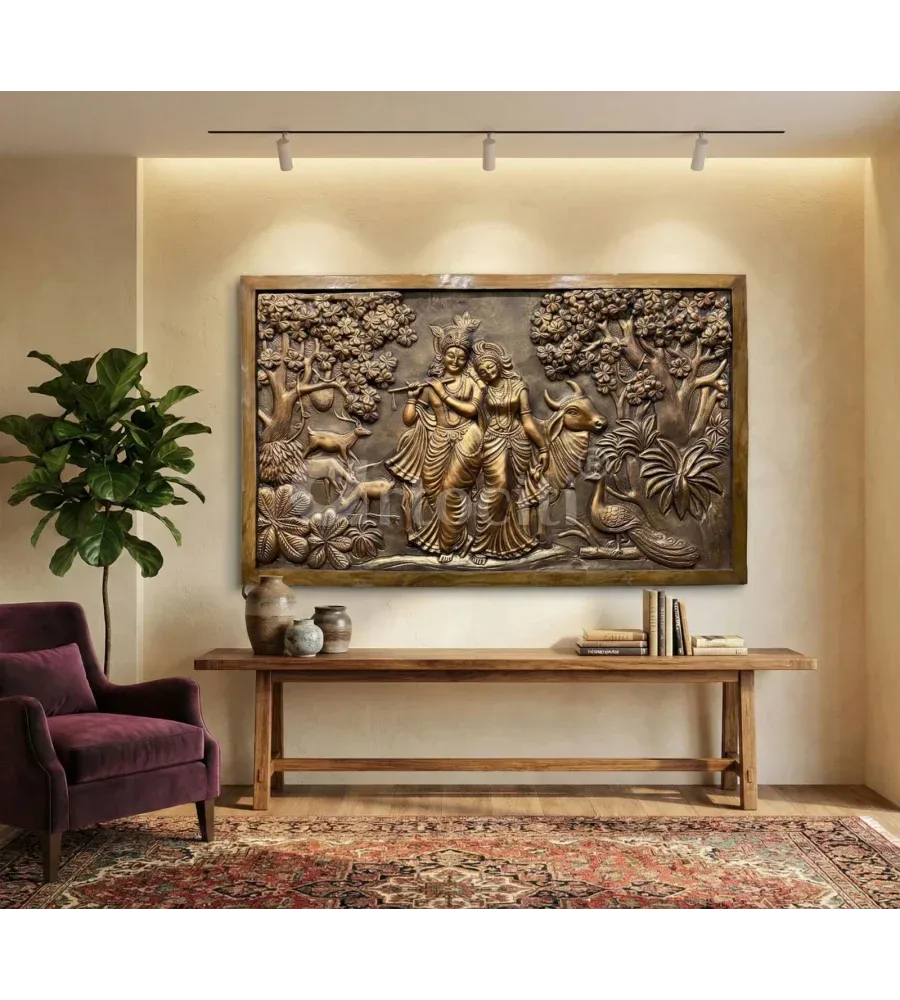
Lord Krishna is perhaps the most painted figure in all of Indian art. Across centuries, regions, and schools of artistic thought, his image has been interpreted and reinterpreted with remarkable creativity — each tradition bringing its own visual vocabulary, spiritual emphasis, and artistic genius to the same beloved subject.
Whether you are a seasoned collector or someone newly discovering Indian art, understanding these distinct styles completely transforms how you experience a lord krishna painting. Here are ten of the most iconic styles that have shaped this tradition.
1. Pichwai Style
Born in Nathdwara, Rajasthan, Pichwai paintings are large-format devotional works created specifically as backdrops for the idol of Shrinathji — a form of Krishna. These paintings are extraordinarily detailed, rich in gold and jewel-toned pigments, and follow strict iconographic rules tied to festivals and seasons. A pichwai painting depicting Krishna among lotus flowers or surrounded by cows is one of the most visually opulent expressions of devotion in all of Indian art.
2. Pattachitra Style
From the village of Raghurajpur in Odisha, Pattachitra paintings depict Krishna and the Jagannath tradition with bold outlines, natural pigments, and intricate floral borders. Figures are stylised and symbolic rather than realistic. The entire painting — canvas, colours, and brushes — is handmade by chitrakars following methods passed down across generations.
3. Madhubani Style
Originating in the Mithila region of Bihar, Madhubani brings Krishna to life through geometric precision, bold outlines, and vibrant flat colour. The Bharni sub-style is most associated with Krishna imagery — particularly the Radha-Krishna union, depicted with lotus motifs, peacocks, and serpentine vines that carry layers of symbolic meaning.
4. Tanjore Style
Tanjore painting from Tamil Nadu is unmistakable — characterised by rich gold leaf work, embedded semi-precious stones, and a luminous depth that gives the figures an almost three-dimensional presence. Krishna in Tanjore art is frequently depicted as Bal Krishna (the divine child) or in the Venugopala form — standing in tribhanga pose, flute raised to his lips.
5. Rajput Miniature Style
The Rajput courts of Rajasthan and the hills of Himachal Pradesh produced some of the most emotionally expressive Krishna paintings in history. Miniature works depicting the Raas Leela, the lifting of Govardhan Hill, or the intimate moments of Radha and Krishna are rendered with extraordinary finesse — tiny brushstrokes building entire worlds in compositions no larger than a book page.
6. Mughal-Influenced Style
As Mughal and Rajput courts interacted, a fascinating hybrid emerged. Krishna's form began to absorb Mughal naturalism — more lifelike faces, softer colour gradients, and landscape settings that owed as much to Persian miniature traditions as to Indian devotional art. The result is visually refined and historically fascinating.
7. Kerala Mural Style
The temples of Kerala contain some of India's most dramatic Krishna murals. Characterised by bold outlines, a warm earthy palette of red, yellow, green, and black, and figures of commanding scale, Kerala mural art depicts Krishna in his most heroic and cosmic forms — slaying demons, revealing the Vishwarupa, lifting mountains. The visual drama is unmatched.
8. Pahari Style
Emerging from the hill kingdoms of Himachal Pradesh and Jammu in the 17th and 18th centuries, Pahari paintings are celebrated for their lyrical beauty. The landscape plays an equally important role as the figures — moonlit forests, monsoon clouds, and flowering trees create an atmosphere of romantic longing that perfectly suits the Radha-Krishna theme.
9. Bengal Patachitra Style
Distinct from Odisha's Pattachitra, Bengal's Patachitra tradition developed its own visual language — scroll paintings narrated by wandering bards called Patuas. Krishna's stories unfold panel by panel in long vertical scrolls, with a directness and folk energy that is entirely different from courtly traditions. The style is raw, expressive, and deeply human.
10. Contemporary and Abstract Interpretations
Today, artists across India and the world are reinterpreting Krishna through modern eyes — mixing traditional iconography with abstract form, digital media, and mixed-media canvas work. These contemporary takes honour the spiritual essence while breaking free of classical constraints. Much like how buddha painting has found powerful expression in minimalist and abstract modern art, Krishna too has become a subject that bridges ancient devotion and contemporary aesthetics seamlessly.
What Unites These Traditions
Across all ten styles, certain constants remain — the blue complexion, the peacock feather, the flute, the tribhanga stance. What changes is the emotional register. Some traditions approach Krishna with awe, others with tender intimacy, and still others with joyful celebration. Each style is essentially a different answer to the same question: how do you paint the infinite?
Final Thoughts
The diversity of Krishna's artistic representation is itself a kind of spiritual teaching — that the divine can be approached from infinite directions, through infinite forms, and with infinite creative expression. Whichever tradition speaks to you most deeply, what matters is that it moves you. Because at its best, art about Krishna doesn't just show you a painting. It makes you feel, for a moment, that you are standing in Vrindavan.