
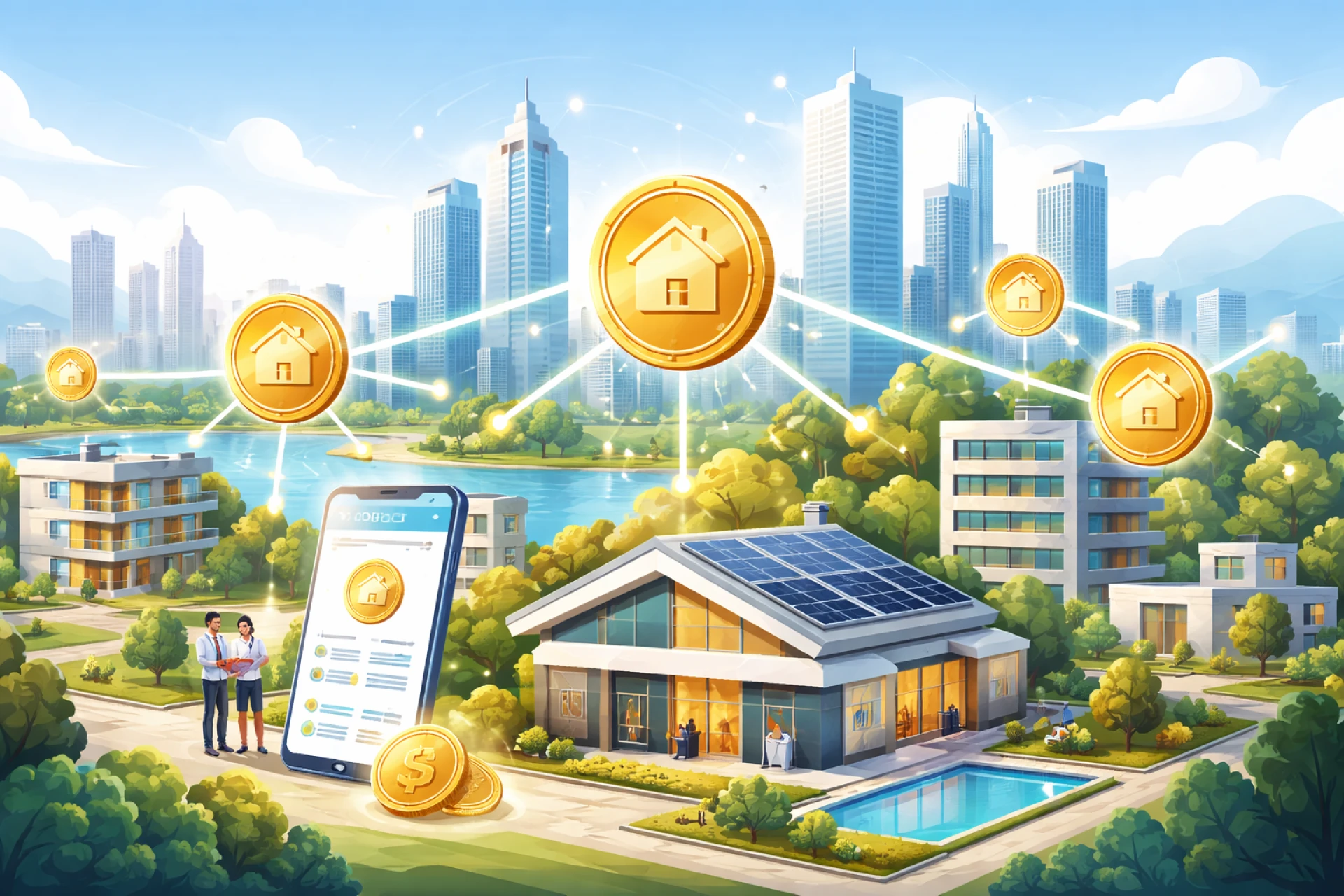
The global real estate industry is undergoing a foundational transformation in 2026. Traditional models of property ownership, investment, and transfer are being challenged by the rise of the tokenized real estate platform. What was once a rigid, capital-intensive, and slow-moving asset class is now becoming digital, programmable, and globally accessible.
Tokenized real estate platforms are redefining ownership by converting physical property rights into blockchain-based digital tokens. These tokens represent fractional or full ownership and can be issued, traded, and managed with unprecedented efficiency. This shift is not incremental. It represents a structural evolution in how real estate is financed, accessed, governed, and scaled.
In 2026, tokenization is no longer an experimental concept. It is emerging as an enterprise-grade infrastructure layer for property markets, reshaping investor behavior, developer strategies, and regulatory frameworks worldwide.
Understanding Tokenized Real Estate Platforms
What Is a Tokenized Real Estate Platform
A tokenized real estate platform is a digital system that enables real-world property assets to be represented as blockchain-based tokens. Each token corresponds to a defined ownership stake, economic right, or governance privilege associated with a property.
At its core, the platform integrates legal ownership structures with smart contract logic to ensure that digital tokens accurately reflect real-world rights.
Key characteristics include
- Digital representation of property ownership
- Blockchain-backed immutability and transparency
- Smart contracts for automation
- Fractional ownership capabilities
- Secure secondary market access
These platforms act as a bridge between physical real estate and on-chain financial ecosystems.
Why Traditional Property Ownership Models Are Breaking Down
Structural Limitations of Legacy Real Estate Systems
Conventional real estate ownership models have remained largely unchanged for decades. In 2026, their inefficiencies are becoming increasingly visible.
Major challenges include
- High capital barriers for entry
- Illiquidity that locks capital for years
- Complex legal and administrative processes
- Limited cross-border participation
- Opaque ownership and transaction records
These limitations restrict market participation and slow capital movement, making real estate less adaptive in a digital-first global economy.
How Tokenization Redefines Property Ownership
Ownership Becomes Fractional, Liquid, and Programmable
Tokenization fundamentally changes what it means to own property. Ownership is no longer binary. It becomes divisible, tradable, and dynamic.
Key transformations include
- Fractional ownership that allows smaller investments
- Real-time ownership verification
- Automated dividend and rental income distribution
- Programmable compliance and governance
- Faster transfer of ownership rights
In 2026, owning property no longer requires full capital commitment or long holding periods. Ownership becomes flexible and modular.
The Role of Blockchain in Property Tokenization
Why Blockchain Is the Foundation Layer
Blockchain technology provides the trust, transparency, and automation required to support tokenized real estate at scale.
Core blockchain advantages include
- Immutable ownership records
- Transparent transaction history
- Smart contract automation
- Decentralized validation
- Enhanced security against fraud
Without blockchain, tokenized real estate platforms would not be able to guarantee the integrity and reliability required for institutional adoption.
Smart Contracts as the Engine of Automation
Automating Ownership, Income, and Governance
Smart contracts are self-executing digital agreements that automate real estate operations on tokenized platforms.
They enable
- Automatic rental income distribution
- Rule-based ownership transfers
- Predefined compliance enforcement
- Voting mechanisms for token holders
- Lifecycle management of assets
By reducing reliance on intermediaries, smart contracts lower operational costs and eliminate manual inefficiencies that plague traditional property systems.
Fractional Ownership Is Democratizing Access to Real Estate
Lowering Entry Barriers for Global Investors
One of the most disruptive outcomes of tokenized real estate platforms is the democratization of property ownership.
Fractional ownership enables
- Investment with smaller capital amounts
- Portfolio diversification across geographies
- Access to premium properties previously out of reach
- Participation by retail and institutional investors alike
In 2026, real estate investment is no longer reserved for high-net-worth individuals. It is becoming inclusive, borderless, and digitally native.
Liquidity Transformation Through Tokenized Markets
From Illiquid Assets to Always-On Markets
Real estate has historically been one of the most illiquid asset classes. Tokenization changes this paradigm.
Liquidity improvements include
- Secondary trading of property tokens
- Faster exit opportunities for investors
- Continuous price discovery
- Reduced lock-in periods
- Enhanced capital efficiency
Tokenized real estate platforms are enabling near real-time liquidity while preserving the underlying stability of property assets.
Redefining Developer Financing Models
New Capital Formation Strategies for Property Developers
In 2026, developers are increasingly adopting tokenized platforms as alternative financing mechanisms.
Benefits for developers include
- Access to global investor pools
- Faster capital deployment
- Reduced dependence on traditional lenders
- Transparent fundraising processes
- Flexible capital structuring options
Tokenization allows developers to raise funds incrementally, align investor incentives, and maintain greater control over project execution.
Institutional Adoption Accelerates Platform Maturity
Why Enterprises Are Embracing Tokenized Real Estate
Institutional investors are no longer on the sidelines. In 2026, they are actively shaping tokenized real estate platforms.
Institutional drivers include
- Improved transparency and reporting
- Automated compliance capabilities
- Reduced operational overhead
- Real-time asset performance insights
- Alignment with digital asset strategies
As institutions enter the space, platform standards, governance frameworks, and regulatory alignment continue to mature.
Regulatory Evolution Supporting Tokenization
From Uncertainty to Structured Compliance
Early concerns around regulation are being addressed through evolving legal frameworks in 2026.
Regulatory progress includes
- Clear classification of asset-backed tokens
- Licensing requirements for platform operators
- Investor protection mechanisms
- Cross-border compliance alignment
- Integration with existing property laws
Modern tokenized real estate platforms are being built with compliance-first architectures to ensure long-term sustainability.
Transparency and Trust as Core Value Drivers
Eliminating Information Asymmetry
Traditional real estate markets suffer from opacity. Tokenized platforms introduce transparency as a default feature.
Transparency advantages include
- Publicly verifiable ownership records
- Clear asset performance metrics
- Automated audit trails
- Reduced disputes and fraud
- Improved investor confidence
In 2026, transparency is no longer optional. It is a competitive differentiator.
Redefining Property Governance Models
Token Holders Become Active Stakeholders
Tokenization introduces new governance structures where ownership comes with participatory rights.
Governance innovations include
- Token-based voting mechanisms
- Community-driven asset decisions
- Automated execution of approved proposals
- Alignment of incentives across stakeholders
Property ownership evolves from passive holding to active participation, creating stronger alignment between investors and asset managers.
Cross-Border Property Investment Becomes Seamless
Eliminating Geographic and Currency Barriers
Tokenized real estate platforms are global by design.
Cross-border benefits include
- Access to international properties
- Simplified currency conversion
- Standardized ownership frameworks
- Reduced legal complexity
- Global investor participation
In 2026, real estate investment is increasingly border-agnostic, driven by digital infrastructure rather than geography.
Operational Efficiency Through Platform Automation
Reducing Costs Across the Property Lifecycle
Tokenized platforms streamline operations across acquisition, management, and disposition.
Efficiency gains include
- Automated onboarding and KYC workflows
- Smart contract-driven accounting
- Reduced intermediary fees
- Faster settlement cycles
- Lower administrative burden
Operational efficiency directly improves asset returns and scalability.
The Role of Data and Analytics in Tokenized Platforms
Real-Time Insights Drive Smarter Decisions
Modern tokenized real estate platforms integrate advanced analytics to enhance decision-making.
Data-driven capabilities include
- Live asset performance tracking
- Predictive income modeling
- Investor behavior analysis
- Risk assessment automation
- Portfolio optimization tools
In 2026, data is not an afterthought. It is embedded into platform design.
Security and Custody in Tokenized Ownership
Protecting Digital and Physical Assets
Security remains a critical pillar of tokenized real estate platforms.
Security measures include
- Blockchain-level encryption
- Multi-signature custody solutions
- Smart contract audits
- Role-based access controls
- Continuous monitoring systems
These measures ensure that digital ownership is as secure as traditional title systems, if not more.
The Platformization of Real Estate Ecosystems
From Isolated Assets to Integrated Networks
Tokenized real estate platforms are evolving into full ecosystem hubs.
Ecosystem features include
- Integrated asset issuance tools
- Secondary trading environments
- Investor dashboards
- Compliance and reporting modules
- Interoperability with other digital assets
Real estate is no longer siloed. It is becoming part of a broader on-chain financial ecosystem.
Challenges Still Shaping the Path Forward
Addressing Adoption and Education Gaps
Despite rapid growth, challenges remain.
Key hurdles include
- Investor education and awareness
- Integration with legacy property systems
- Jurisdictional regulatory differences
- Standardization of token models
- Long-term platform governance
However, these challenges are being actively addressed as the market matures.
What 2026 Signals for the Future of Property Ownership
From Ownership to Access and Participation
The rise of tokenized real estate platforms signals a broader philosophical shift.
Property ownership in the future emphasizes
- Access over exclusivity
- Participation over passive holding
- Transparency over opacity
- Liquidity over lock-in
- Technology-enabled trust
This shift aligns real estate with the digital economy’s expectations.
Conclusion: Tokenized Real Estate as the New Ownership Standard
By 2026, tokenized real estate platforms are no longer redefining property ownership in theory. They are doing so in practice. These platforms are transforming how assets are owned, financed, governed, and traded at a global scale.
As regulatory clarity strengthens, institutional adoption accelerates, and platform infrastructure matures, tokenized real estate is positioning itself as a foundational layer of the future property economy.
The redefinition of ownership is underway. In this new era, property is no longer just a physical asset. It is a programmable, liquid, and accessible digital instrument built for a connected world.