
Introduction
In the oil and gas industry, Microbially Influenced Corrosion (MIC) is a silent multi-billion dollar threat. Sulfate-Reducing Bacteria (SRB) thrive in the dark, anaerobic environments of pipelines and injection wells, producing hydrogen sulfide (H2S) that causes rapid equipment failure and souring. To combat this, two biocides dominate the market: THPS (Tetrakis Hydroxymethyl Phosphonium Sulfate) and Glutaraldehyde. But which one is the superior choice for your specific operation?
The Chemical Showdown: Quick Comparison
While both are effective antimicrobials, their chemical DNA determines their best-use cases.
FeatureTHPSGlutaraldehydePrimary TargetFast-acting SRB controlBroad-spectrum microbial controlEnvironmental ProfileHighly biodegradable (Green)Toxic; requires strict exposure monitoringpH RangeOptimal at 4.0 – 7.0Optimal at 7.0 – 8.5TemperatureStable up to $120^\circ C$Degrades rapidly above $60^\circ C$CompatibilitySafe with most scale inhibitorsMay react with primary amines1. THPS: The "Green" Heavy Hitter
THPS has gained significant traction as the preferred "green" chemical for offshore and sensitive onshore environments.
- Rapid Biodegradability: It breaks down into harmless phosphate and sulfate, meeting strict environmental regulations like OSPAR.
- SRB Specialist: It is exceptionally lethal against SRB by disrupting the cell’s metabolic pathways.
- Thermal Stability: For deep-well injections or high-temperature reservoirs, THPS remains active where other biocides fail.
2. Glutaraldehyde: The Biofilm Penetrator
Glutaraldehyde remains an industry workhorse, particularly in older systems with heavy biological buildup.
- Aggressive Biofilm Removal: Its small molecular size allows it to penetrate mature biofilms (slime layers) that shield bacteria from other treatments.
- Broad-Spectrum Kill: It is effective against a wider range of bacteria, fungi, and algae beyond just SRB.
- Alkaline Efficiency: In systems with a higher pH (above 8.0), Glutaraldehyde often outperforms THPS, provided the temperature remains moderate.
Performance Factors: Temperature and pH
Selecting a biocide is not just about the "kill rate" in a lab; it’s about stability in the field.
- The Heat Factor: Glutaraldehyde’s effectiveness drops significantly as temperature rises. In high-temperature thermal recovery, THPS is the undisputed winner.
- The pH Factor: THPS performs best in acidic to neutral conditions. If your produced water is significantly alkaline, Glutaraldehyde (or a specialized blend) may be required to maintain efficacy.
Strategic Implementation: The Rotation Strategy
One of the biggest risks in oilfield water treatment is microbial resistance. If the same chemical is used indefinitely, the surviving bacteria can develop a tolerance.
Modern asset integrity managers now recommend a Rotation Strategy:
- Phase 1: Use Glutaraldehyde to strip away existing biofilms and provide broad-spectrum cleaning.
- Phase 2: Switch to THPS for sustained, eco-friendly SRB suppression.
- Result: This "one-two punch" prevents resistance and maximizes the lifespan of pipelines and tanks.
Safety and ROI
Safety is a critical differentiator. Glutaraldehyde is a known sensitizer and respiratory irritant with strict OSHA limits (0.2 ppm). THPS, having lower acute toxicity and no vapor issues, is generally safer for field technicians to handle.
From an ROI perspective, while THPS might have a higher price point per gallon, its high concentration (75%) and stability in harsh conditions often result in a lower Total Cost of Treatment (TCT) compared to frequent, high-volume dosing of less stable chemicals.
Conclusion
There is no "one-size-fits-all" biocide.
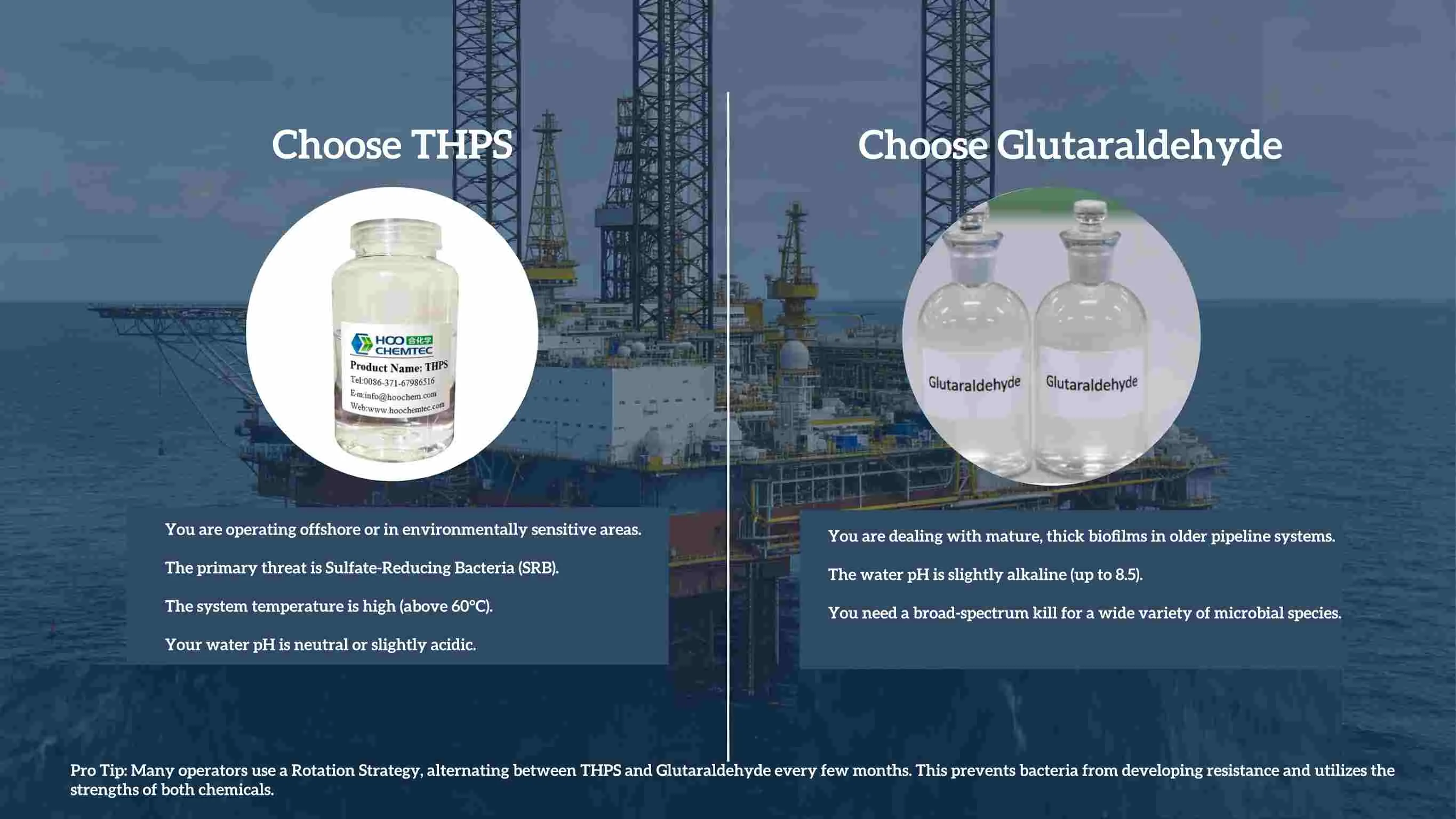
- Choose THPS for high-temperature wells, offshore platforms, and targeted SRB control.
- Choose Glutaraldehyde for mature systems with thick biofilms and alkaline water.
For professional oilfield operations, partnering with a supplier that offers custom concentrations and technical support—like Hoo Chemtec—is essential to ensuring your water treatment program is both effective and compliant.
About the Author: Hoo Chemtec is a global leader in water treatment chemistry, specializing in high-performance biocides, scale inhibitors, and coagulants for the petroleum and industrial sectors.