A towing company can own ten trucks and still lose customers.
Why? Because in roadside assistance, availability means nothing if the right truck cannot reach the customer quickly. When a driver is stranded, they rarely want to compare businesses for long. They want help—and they want to know that help is actually coming. This makes response time one of the most important competitive advantages in the towing business.
More Trucks Don't Always Mean More Business
Expanding the fleet seems like the obvious way to handle more towing requests.
But adding vehicles also means higher insurance, maintenance, fuel, staffing, and operating costs.
The bigger question is whether existing trucks are being utilized efficiently.
A truck sitting idle in one area cannot help a stranded customer several miles away. Meanwhile, another driver may be overwhelmed with requests.
This is where smarter dispatch can create an advantage without immediately increasing fleet size.
The Closest Truck Can Change the Economics
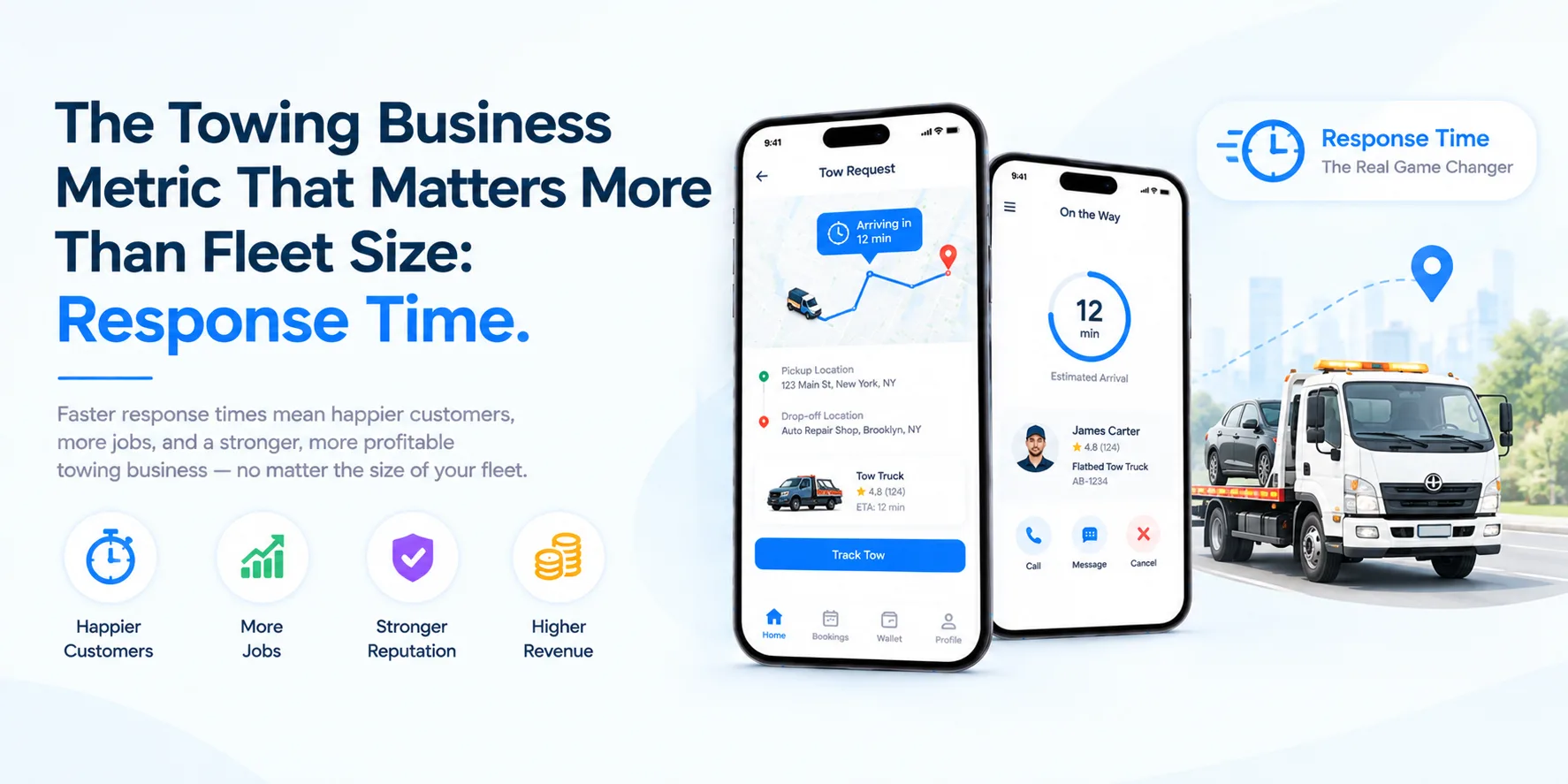
Modern towing dispatch software can connect customer requests with nearby service providers and send job notifications based on availability and location. Real-time GPS and map integration can also help drivers navigate to stranded customers more efficiently.
That creates a simple business equation:
Faster assignment → Faster arrival → More completed jobs → Better truck utilization.
The goal isn't simply to have more trucks.
It's to make every available truck more productive.
Every Minute Can Affect Customer Experience
Roadside emergencies are different from ordinary service bookings.
A customer waiting for a tow may be dealing with traffic, bad weather, an unfamiliar location, or a vehicle breakdown. Uncertainty makes the wait feel even longer.
Real-time tracking changes that experience.
Instead of repeatedly calling the towing company to ask, “Where is the truck?”, customers can see the vehicle's progress and receive notifications as the service moves forward.
That visibility can become part of the service itself.
Dispatch Data Can Reveal Where Growth Is Hiding
There is another opportunity many towing businesses overlook.
Every job creates operational data.
Which areas generate the most requests?
When do emergency calls peak?
Which trucks respond fastest?
Where are vehicles spending too much time traveling?
Which services generate the highest demand?
With centralized job and performance data, operators can make better decisions about where to position trucks, when to add providers, and which service areas deserve expansion.
Instead of expanding based on assumptions, they can expand based on demand patterns.
The Next Stage of Towing Is Smarter Dispatch
The towing businesses that grow efficiently may not necessarily be the ones with the largest fleets.
They may be the ones that can coordinate the fleet they already have better.
A modern towing dispatch platform can bring customers, towing providers, GPS tracking, notifications, bookings, payments, pricing, and administration into one connected ecosystem.
For entrepreneurs looking to build or modernize a roadside assistance business, SpotnRides towing dispatch software provides a customizable foundation for managing on-demand and scheduled towing, real-time tracking, provider availability, customer communication, payments, and multiple revenue models.
Because in roadside assistance, growth isn't always about buying another truck.
Sometimes, it's about making the next truck arrive faster.