Ask any foundry supervisor which machine keeps them up at night, and they rarely say the slurry pot. They'll mention the autoclave, the shell firing furnace, maybe the wax injection press. But talk to the same person after a batch of castings comes back with veining or shell cracks, and the conversation almost always circles back to one thing: the slurry.
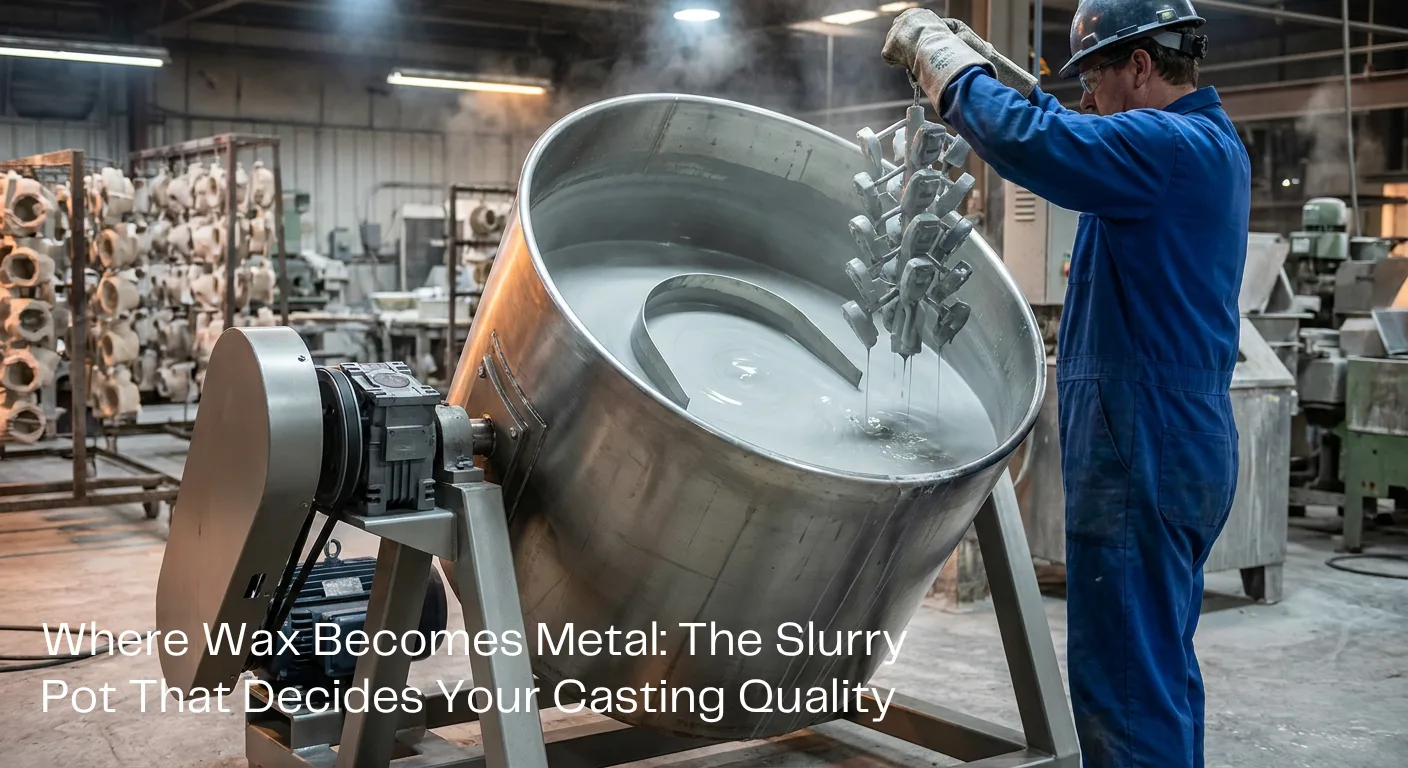
The slurry pot sits in the middle of the investment casting process, right where wax patterns become ceramic shells. Prepared slurry moves over from the mixer, and this is where the wax trees actually get dipped. It looks simple. A rotating drum, a baffle, a motor. But the details in that drum decide whether your shell holds up through pouring or falls apart in the burnout.
Here's the part people underestimate. Ceramic slurry is not a stable liquid. It is a suspension of heavy refractory particles, zircon flour, fused silica, alumina, held in a binder like colloidal silica. Leave it standing for twenty minutes and the heavy stuff drops to the bottom. Now your first dip is binder-rich and your last dip is grit. That inconsistency shows up on the casting surface, and by then it's too late and too expensive to fix.
That's the whole reason the pot rotates. Continuous, gentle agitation against a fixed baffle keeps the refractory in suspension without whipping air into the mix. Too slow and you get settling. Too fast and you get entrained bubbles that leave pinholes on the shell. Foundries running aerospace or medical work, where a single rejected turbine blade can cost more than a month of consumables, obsess over this rpm for good reason.
We build our slurry pots as a vertical rotating SS304 drum turning against a U-type baffle, driven by an AC reduction geared motor through a belt drive. The belt matters more than it sounds. It smooths out torque so the slurry sees steady motion, not jerks. The whole thing sits on a heavy steel base frame, because vibration is the enemy of a consistent dip.
The one feature operators thank us for later is the removable polypropylene lining. Ceramic slurry hardens like concrete if you let it. Without a liner, cleaning a stainless drum means hours of chipping and scraping, and every scratch you leave becomes a spot where the next batch grabs and builds up. A pull-out PP liner turns a half-day cleaning job into a swap-and-go. It also protects the drum, so the machine lasts years longer than one that gets abused with steel tools.
Sizing is the other decision foundries get wrong. We offer pots in 600, 750, 1000, 1200, 1500 and 1800 mm diameters, and the temptation is always to buy big. But an oversized pot running half full is worse than a right-sized one. You waste expensive slurry, the surface skins over, and agitation gets uneven near the walls. Match the pot to your tree size and your dip frequency. A jobbing shop pouring twenty different parts a week has very different needs from a plant running one high-volume component.
If you want to see how much this stage matters, look at the shell building guidance published by casting industry bodies and technical resources. Groups like the Investment Casting Institute and journals covering foundry practice keep coming back to the same theme: primary coat quality controls surface finish, and slurry condition controls the primary coat. Everything downstream inherits what happens in the pot.
A practical tip we give every new customer. Check viscosity with a flow cup at the start and end of every shift, log it, and watch the trend. When your dip times start drifting, the slurry is telling you something before your castings do. Pair that with a well-maintained pot and you catch problems while they're still cheap.
None of this is glamorous. The slurry pot will never be the machine on the brochure cover. But it is the difference between shells that pour clean and shells that surprise you at the worst moment. Get the agitation right, keep the liner clean, size it properly, and this quiet workhorse pays you back on every single tree you dip.
If you're setting up or upgrading a shell room, talk to us about which pot fits your process. We've been building them in Kolhapur for a long time, and we'd rather help you buy the right one than the biggest one.