
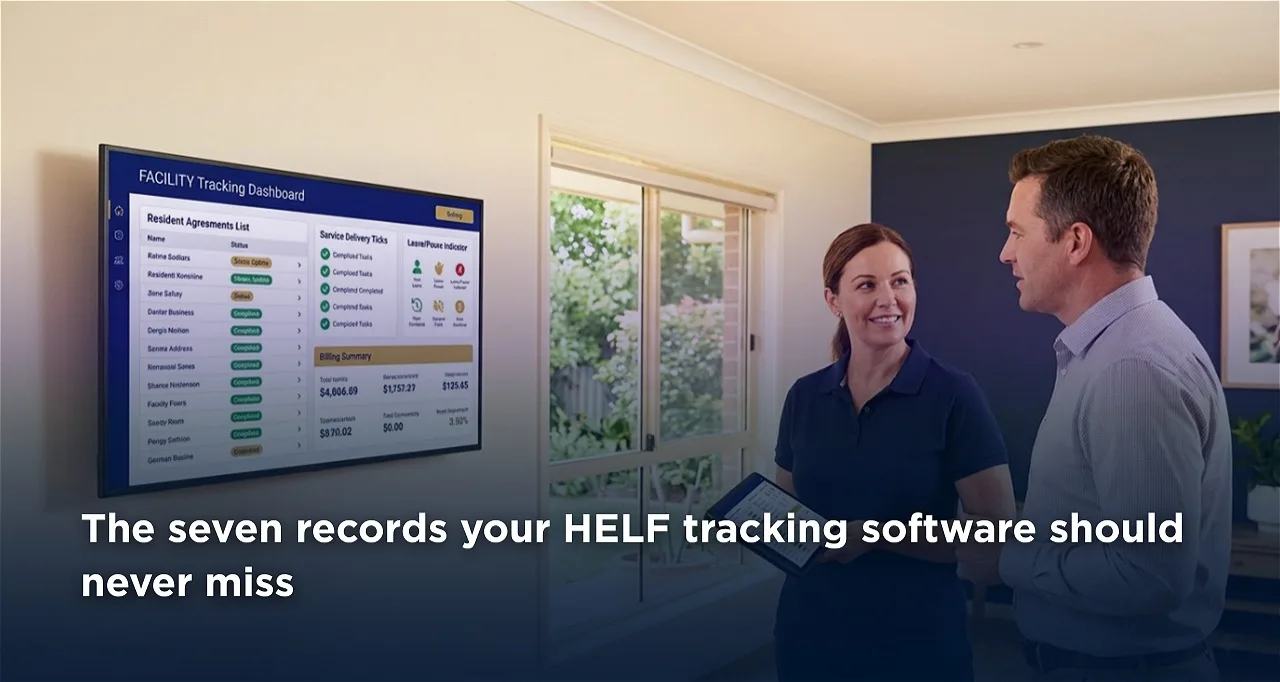
Every Higher Everyday Living Fees program generates a steady stream of small facts. Who signed, when an agreement commenced, which services ran today, who was in hospital, who keeps saying no to the Tuesday outing. None of these facts is complicated on its own. The problem is scale, because a 100-bed home produces hundreds of them a week, and the November 2025 reforms place greater emphasis on clear records of agreements, service delivery and billing. This is exactly where HELF tracking software earns its keep, catching those facts as they happen and keeping them connected.
In short, that is the whole job: capturing those facts as they happen and keeping them linked, so the facility always knows what was agreed, what was delivered and what should appear on the next invoice. This article sets out the seven things a HELF program should track, whether you run them through software or sheer discipline, and, just as importantly, how to tell when the tracking itself has become the risk.
Why tracking is the backbone of HELF
The HELF framework runs on evidence. Providers should be able to demonstrate consent, evidence service delivery, and show billing that matches both. Strip away the terminology, and the framework asks one question of providers, over and over: can you show me?
The answer depends entirely on what got tracked at the time. A facility can have enthusiastic residents and fair prices, and yet still run into trouble during a review because the record of what happened lives in someone's head. Tracking is not the interesting part of a HELF program. Nevertheless, it is the part everything else stands on.
The seven things HELF tracking software should cover
Judged against the seven items below, the priorities become clear. Here is what every program should capture.
1. Agreements and their consent trail
First, log every active agreement: who signed it, when, which services it covers and at what itemised price. Variations belong here too, so record when someone added, swapped or removed a service, and who approved the change. The test is simple. Pick any resident, and the current agreement plus its full history should surface in under a minute.
2. Commencement dates and cancellation periods
Next, track agreement commencement dates, applicable cancellation and cooling-off periods, and notice requirements, in line with each agreement and the regulatory guidance. Somewhere, a live list should show which agreements have periods still running and when each one ends. Dates that live only on the signed forms protect no one, because a date no one looks at is not really tracked.
3. Delivery and declines
This is the heart of the system. Someone marks each scheduled service as delivered or declined, ideally at the point of delivery and by the person who was there. Declines deserve equal attention, because a string of "not todays" helps protect billing accuracy and can also signal that a service no longer suits the resident.
4. Leave and pauses
Then there are hospital admissions, extended stays with family, and any agreed pause in services, all connected to the affected agreements. Above all, make sure billing reflects the terms of the HELF agreement during periods of leave or temporary absence. This is the tracking gap behind one of the most familiar billing complaints in the sector: charges that continued without anyone checking what the agreement said should happen.
5. Cancellations and their journey
Here, track more than the fact that a cancellation happened. Capture when it arrived, through what channel, and when it took effect in billing. Verbal cancellations, for example, are difficult to evidence later, so document them promptly, the same day where possible, to keep an accurate audit trail.
6. Billing reconciliation
Each invoice should trace back to the resident agreement, along with the associated service delivery records where applicable. When billing generates from tracked delivery, the software can reconcile the two automatically. When it does not, someone has to do it by hand before each run, and therefore the tracking system should make that comparison possible without a day of cross-referencing.
7. Utilisation and trends
Finally, watch which services residents actually use, which quietly lapse, and how participation moves over time. This is the layer that turns tracking from compliance into insight, and it gives the facility evidence that supports value-for-money assessments of its own program.
Read More About The seven records your HELF tracking software should never miss Here :https://centrimlife.com.au/blog/the-seven-records-your-helf-tracking-software-should-never-miss/
HELF Tracking Software: 7 Records to Never Miss
HELF tracking software keeps agreements, delivery, leave and billing connected, so you can prove consent and invoice accurately.