
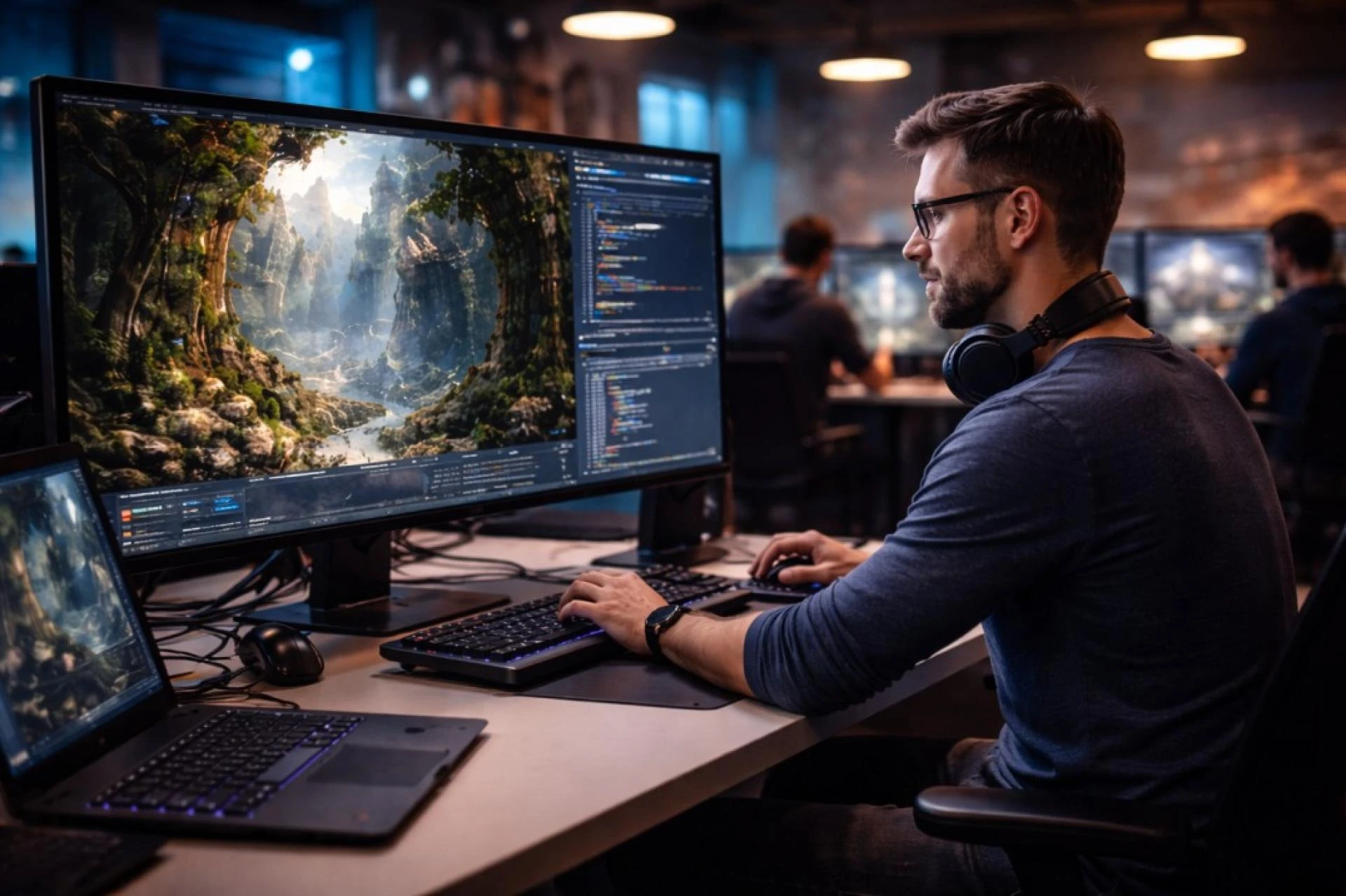
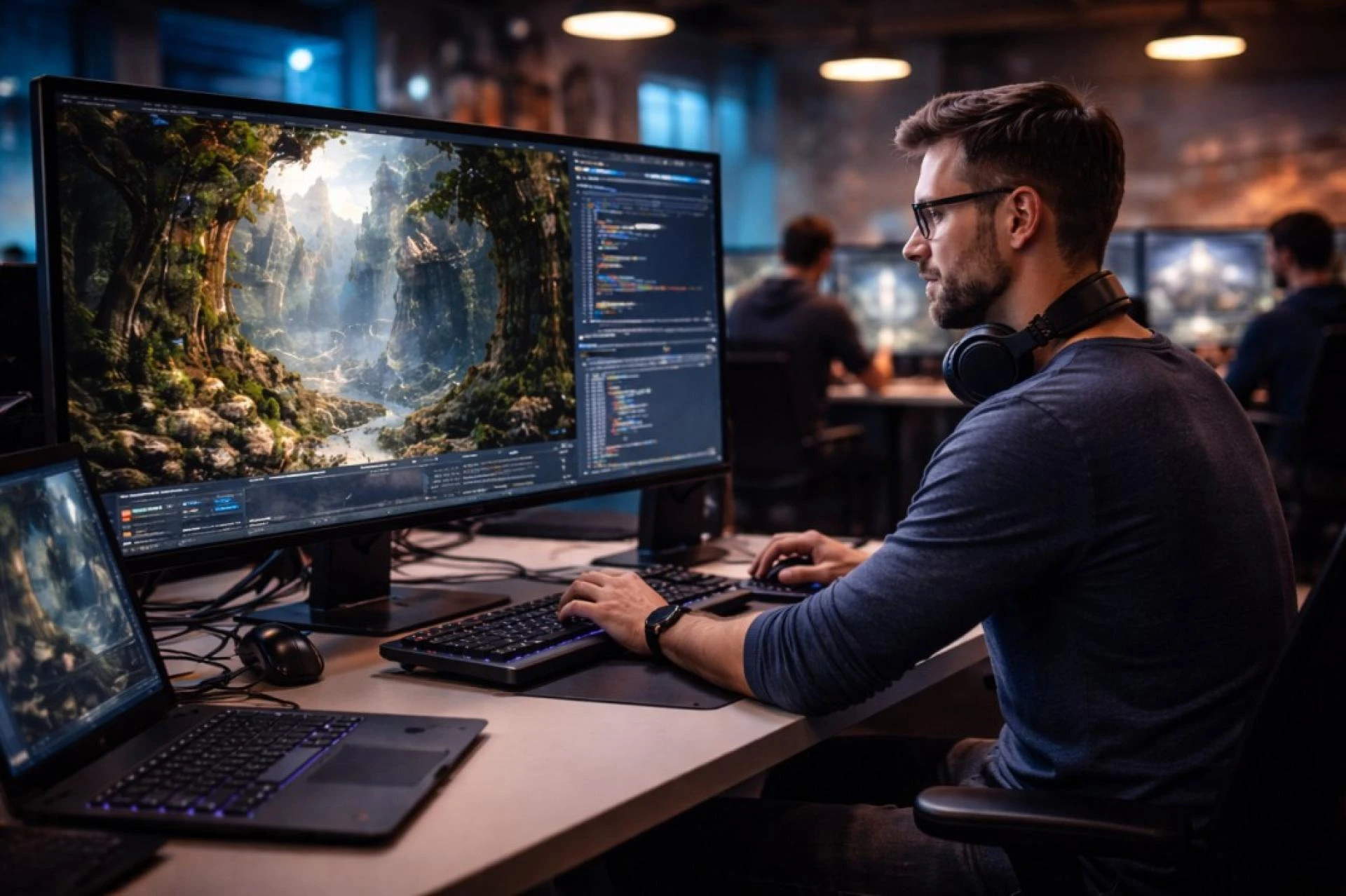
Real-time rendering used to signify "sufficient quality for delivery at 30–60 FPS." In contemporary contexts, it encompasses much more than just frame rate. It represents a production philosophy: making creative choices while they can still be altered affordably—such as lighting, materials, composition, animation timing, VFX clarity, and performance—within the engine, accompanied by immediate feedback.
This transformation is a primary factor driving modern studios to transition from a linear "build → export → wait → review → redo" cycle to a more efficient "build → preview → iterate" cycle. This shift impacts not only graphics teams but also influences scheduling, quality assurance, outsourcing coordination, and the methods teams employ to mitigate risks before scaling up content.
What "real-time rendering" truly signifies (and its current significance)
Real-time rendering refers to the technique of producing frames swiftly enough to be displayed interactively as the scene evolves (including camera movements, player interactions, lighting changes, physics events, etc.). The crucial aspect is interactivity: feedback is instantaneous, allowing iteration to become a primary workflow rather than a postponed checkpoint.
The recent changes are not solely attributed to faster GPUs. They stem from a combination of:
More sophisticated lighting and geometry systems in real-time engines (for instance, contemporary global illumination methods, virtualized geometry, and enhanced material/shader pipelines).
A consistent flow of production-tested rendering research made publicly available (SIGGRAPH’s "Advances in Real-Time Rendering" has emerged as a significant platform for techniques that are implemented in released games).
Improved measurement and tools concerning latency and performance, enabling teams to quantify and optimize the perception of responsiveness.
The true significance lies in iteration speed (beyond merely aesthetic enhancements)
In practice, the primary advantage is the velocity of iteration:
1) Accelerated creative validation
Rather than approving a design in 2D and merely "hoping it translates into motion," teams can verify:
silhouette clarity at gameplay distances
lighting ambiance during dynamic day/night cycles or gameplay-driven alterations
whether materials appear "game-true" (not solely visually appealing renders)
VFX timing and UI/FX clarity during action
2) Proactive performance assessments
A visually stunning scene that experiences frame drops will necessitate expensive revisions later. Real-time rendering brings performance limitations to light earlier in the production process, where they can be addressed more affordably. Epic’s optimization recommendations are fundamentally centered on this principle: detect bottlenecks early, conduct frequent profiling, and iterate with defined budgets.
3) Concurrent work rather than sequential work
Real-time workflows promote parallelization: art, lighting, gameplay, VFX, and technical art can all iterate within the same environment instead of waiting for lengthy offline processes. This "parallel mode" is also a key factor in why real-time pipelines have transcended games and entered related production domains.
The impact of real-time rendering on the contemporary pipeline
Below is a practical overview of how real-time rendering affects each phase of production.
Pre-production: validate early, mitigate risk early
Modern teams are increasingly creating "vertical slice" content with a real-time approach:
define target art style and lighting guidelines
develop a small representative environment along with a hero character
test post-processing, camera angles, and tonal quality
confirm budgets (polygon/triangle targets, texture memory, shader complexity)
Once a style is validated within the engine, subsequent production becomes less about guesswork and more about consistent execution.
Production: asset creation becomes "engine-aware"
Assets are no longer evaluated in isolation. They are assessed in context:
Does the character appear clearly under gameplay lighting?
Do materials maintain consistency under varying exposure?
Does the environment remain performant during gameplay
This fosters closer collaboration among:
environment/character artists
tech artists and rendering engineers
lighting and VFX teams
performance/QC teams
Post-production and live operations: real-time enhances patch velocity.
Real-time tools facilitate faster iterations for:
lighting adjustments for clarity (e.g., competitive modes)
VFX clarity modifications
performance optimization following new content releases.
In live games, the ability to "iterate quickly without compromising builds" serves as a competitive edge.
The outsourcing perspective: identifying the optimal role of a game art outsourcing studio.
Real-time rendering transforms outsourcing in two significant ways:
1) Outsourced art must be "engine-ready," rather than merely "portfolio-ready."
The previous failure mode: assets appear impressive in isolated renders but disrupt style or performance within the engine. With real-time workflows, outsourced outputs increasingly require:
appropriate scale, pivot/origin standards
LOD strategies that correspond with the engine and camera distances
texture packing guidelines and memory allocations
shader/material standards (including channel packing)
naming conventions, versioning, and import settings that align with the project.
This trend encourages outsourcing partnerships to focus on pipeline integration rather than mere file transfer.
2) Review cycles are shortened—but more frequent.
Real-time reviews are expedited, yet they also lead to an increase in the number of "micro-iterations":
"This roughness appears overly plastic under our LUT."
"Normal intensity becomes pronounced in motion."
"LOD2 silhouette disrupts readability."
"Shader costs are too high in combat scenarios."
The outsourcing partner that excels is the one capable of responding swiftly and predictably to small adjustments—often through clear budgets, reference scenes, and consistent checklists.
What contemporary engines facilitate (in practical terms)
Although each engine possesses unique advantages, the overarching observation is that real-time engines now accommodate high-fidelity workflows that previously necessitated offline rendering in numerous scenarios—particularly for iteration and look development. The optimization guidelines of Unreal Engine underscore the significance of profiling and balancing the trade-offs between fidelity, performance, and memory.
Furthermore, the ongoing advancement of real-time rendering methodologies (enhancements in subsurface scattering, progress in path tracing, etc.) is well documented in the extensive course materials from SIGGRAPH.
Core challenges (and the solutions studios implement)
Real-time rendering offers speed, yet it also reveals limitations that teams must anticipate.
Challenge 1: Performance budgets become critical (rapidly)
Common pressure points:
overdraw (notably with particles, foliage, and transparencies)
costly materials/shaders
intensive dynamic lighting and shadows
significant texture memory consumption
too many unique assets leading to streaming pressure
How teams address it:
define budgets for each scene type (combat arena, hub, cinematic)
enforce LOD and texture regulations
profile on target hardware consistently and early
Challenge 2: Latency and “feel”
Players experience not only FPS; they also perceive end-to-end latency (input → rendered frame → display). NVIDIA’s analysis of PC latency serves as an excellent illustration of how teams quantify it.
How teams manage it:
monitor input latency in conjunction with FPS
tune frame pacing
mitigate significant CPU/GPU spikes (streaming, shader compilation, etc.)
Challenge 3: Consistency among teams and vendors
As more individuals iterate within the engine, inconsistency becomes a significant issue:
mismatched materials
fluctuating texel density
diverse lighting assumptions
inconsistent post-processing
How teams resolve it:
establish a “reference level” and “reference lighting rig”
share a standardized material library + LUTs
provide outsourcing partners with engine test scenes and budgets.
A practical checklist for a contemporary game development studio
If you are constructing a real-time rendering pipeline that scales effectively, these are the essential elements that help minimize disorder:
A singular source of truth for visuals
Reference level + locked post-process + material standards.
Documented performance budgets
Tri/LOD targets, texture memory, shader complexity, light limits.
Engine-based review checkpoints
Evaluate assets in gameplay camera, not solely in turntables.
Automation in critical areas
Import presets, naming validation, LOD checks, texture packing rules.
Outsourcing integration package
Test map, budget sheet, do/don’t examples, and versioning guidelines.
Profiling frequency
Avoid “optimizing later.” Profile early (and consistently).
Future directions for real-time rendering
Several trends are particularly significant over the next 1–2 years:
Increased real-time path tracing and hybrid solutions for specific workflows (look development, cinematic previews, high-end platforms), reflecting ongoing research and production integration.
A stronger focus on quantifiable responsiveness (latency + frame pacing), rather than just average FPS.
An even closer alignment between content creation and engine runtime, which will continue to elevate expectations for “engine-ready” assets from both internal and outsourced teams.
Final reflection
Real-time rendering has evolved beyond being merely a “graphics feature.” It serves as a catalyst for how swiftly teams can make informed decisions. For modern production, this translates to fewer late-stage surprises, enhanced collaboration with external partners, and a pipeline that can adapt to the demands of live updates, cross-platform launches, and increasing player expectations.