
A dog can have a soft bed, good food, and daily affection and still seem unsettled. The barking keeps going. Shoes disappear. The pacing starts near the door. Some dogs pull attention toward themselves in ways that feel frustrating, but the deeper issue is often not stubbornness. It is an unmet mental need.
Dogs are not only physical animals. They are problem solvers, pattern readers, scent followers, and social learners. When that part of daily life goes underused, behavior can start to spill out sideways. Restlessness, chewing, nuisance barking, digging, and destructive habits are not always signs of a bad dog. In many homes, they are signs of a bored or underchallenged one.
Mental stimulation is the practice of giving a dog safe, healthy ways to think, search, solve, and engage. Research on environmental enrichment in dogs has linked enrichment with lower stress and fewer abnormal or unwanted behaviors, while veterinary behavior guidance also describes enrichment as a way to reduce unwanted behaviors and increase normal, desired ones.
Key Takeaways
- Mental stimulation gives dogs an outlet for natural thinking and problem-solving.
- Many common behavior issues are made worse by boredom and
- Short daily enrichment routines can help reduce barking, chewing, and restlessness.
- Mental work is most effective when combined with exercise, predictability, and training.
What Is Mental Stimulation For Dogs?
Mental stimulation is any activity that asks a dog to use the brain in an active way. That can include sniffing, searching, licking, solving food puzzles, learning cues, exploring new textures, and practicing calm decision-making.
In plain terms, it is not just about keeping a dog busy. It is about giving the dog something meaningful to do.
That distinction matters. A dog that spends twenty minutes tearing through a puzzle feeder may feel more settled than a dog that spends the same amount of time pacing the yard without a clear outlet. Good stimulation does not only burn time. It creates focus.
A useful way to think about it is this: physical exercise tires the body, while mental activity helps organize the mind. Most dogs need both.
Why Do Bored Dogs Develop Behavior Problems?
Because behavior fills empty space.
Dogs are wired to investigate their world. They use scent constantly. They notice routines. They anticipate movement. When daily life offers little challenge, they often create their own jobs. That job may be barking at the window, shredding cushions, demanding attention, digging in the yard, or guarding objects.
A 2022 review on environmental enrichment in dogs found reported benefits, including reduced stress, decreased stereotypic and abnormal behaviors, increased relaxation, improved cognitive abilities, and reduced barking or vocalizing in some settings.
That does not mean every behavioral problem is caused by a lack of stimulation. Fear, pain, separation-related distress, medical issues, and poor fit between dog and environment can all play a role. In fact, AAHA behavior guidance notes that some dogs are too distressed for simple enrichment alone to solve the issue.
Still, under stimulation is one of the most overlooked pieces of the puzzle, especially in otherwise healthy dogs with recurring nuisance behaviors.
Common Signs A Dog May Need More Mental Engagement
Some signs are obvious. Others are easy to misread.
Look for patterns like these:
- Repetitive barking without a clear trigger
- Destructive chewing long after puppyhood
- Digging, pacing, or circling
- Constant attention seeking
- Trouble settling even after a walk
- Counter surfing or scavenging for stimulation
- Overexcitement during small changes in routine
None of these signs confirms boredom on its own. But when several show up together, mental enrichment deserves a closer look.
How Does Mental Stimulation Reduce Unwanted Behavior?
It helps in three main ways.
1. It Gives Natural Instincts A Legal Outlet
Dogs want to sniff, forage, lick, track, and solve. Enrichment channels those drives into acceptable activities instead of furniture, trash cans, or nonstop barking.
2. It Lowers Stress Through Focused Engagement
Many calming enrichment activities slow a dog down. Licking mats, scent games, and food puzzles can turn scattered energy into focused effort. That shift often changes the emotional tone of the moment. AAHA notes that enrichment is meant to reduce the frequency of abnormal or unwanted behaviors while increasing normal, desired behaviors.
3. It Builds Better Daily Rhythms
A dog with predictable opportunities to think and work tends to cope better. Meals become activities. Quiet time becomes teachable. The day feels less empty. Many dogs behave better when life stops feeling random.
What Kinds Of Mental Stimulation Work Best?
Not every dog needs the same kind of challenge. A scent-driven hound may light up during nose work. A busy young herding breed may need training games plus puzzles. A senior dog may prefer simple search games and slower food enrichment.
Here is a practical comparison:
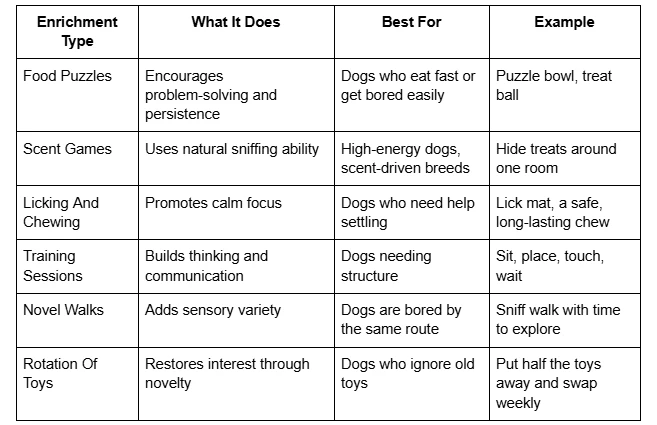
The goal is not to do everything. The goal is to find what your dog responds to and use it consistently.
A Simple Daily Framework That Helps
Many owners overcomplicate enrichment at first. It does not need to be a full project. A simple structure often works better than occasional bursts of effort.
The 3-Part Daily Method
1. Search
Give the dog one chance each day to sniff or find something. Scatter feeding in the yard, hide treats in towels, or do a short scent game indoors.
2. Solve
Use one activity that requires a little problem-solving. This can be a puzzle feeder, frozen food toy, or brief training session with rewards.
3. Settle
Follow active thinking with a calming outlet. Licking, chewing, or resting on a mat after enrichment helps the dog come down instead of bouncing into the next unwanted behavior.
This pattern is useful because it matches the way many dogs regulate best: engage, work, and decompress.
What Most People Get Wrong
One common mistake is assuming a longer walk solves everything.
Walks matter. Exercise matters. But a physically tired dog is not always a mentally satisfied dog. Some dogs come home from a fast walk more wound up than before. They moved a lot, but they did not get to think much.
Another mistake is offering stimulation only when behavior gets bad. When enrichment appears only after barking, pacing, or whining, the dog may start linking nuisance behavior with rewards. It works better as a routine than as a rescue plan.
And another important point: sudden behavior change deserves medical attention. Veterinary behavior sources emphasize that behavior problems are multifactorial, and distress or underlying health issues can be part of the picture.
As the saying often attributed to Plato goes, A dog has the soul of a philosopher. That line lasts because it captures something many owners already feel. Dogs are not empty creatures waiting to be exercised. They are thinking beings who notice more than we assume.
A Real-World Home Pattern
Picture a young dog left alone for several hours each day. He gets a quick walk in the morning, then spends the rest of the day with a few toys scattered on the floor. By evening, he is barking at small sounds, grabbing socks, and zooming through the house. It looks like defiance, but the pattern tells a different story.
Now, change only a few things. Breakfast goes into a feeder toy. Midday treats are hidden in a snuffle mat. The evening walk becomes a slower sniff walk twice a week. A five-minute training game happens before dinner. Over time, the dog has more to do, more to process, and fewer reasons to manufacture excitement.
That is often how progress looks. Not dramatic. Just steadier.
Conclusion
Mental stimulation is not a bonus for dogs who have extra time. It is part of what helps them feel balanced in everyday life. Many modern training approaches, including programs from brands like Canine Behavior Institute, focus on mental enrichment as a core part of behavior improvement. When dogs get regular chances to sniff, solve, search, and settle, many common household behavior problems become easier to prevent and easier to manage. Not because the dog has been fixed, but because the dog has finally been understood.
Frequently Asked Questions
Can mental stimulation really reduce dog behavioral problems?
Yes, it can help reduce many boredom-related behaviors such as barking, chewing, scavenging, and restlessness, especially when done consistently.
Is mental stimulation better than exercise?
It is not better. It is different. Most dogs do best with both physical movement and mental engagement.
How often should dogs get enrichment?
Small daily sessions are usually more effective than occasional long ones. Even ten to fifteen minutes can make a difference.
What is the easiest enrichment activity to start with?
Scatter feeding, treat searches, lick mats, and simple training games are among the easiest options.
Can puppies benefit from mental stimulation?
Yes. Puppies need appropriate mental outlets, but the activities should stay short, safe, and age-appropriate.
What about senior dogs?
Older dogs often benefit from gentle scent work, food puzzles, and short learning sessions that match their comfort and mobility.
Will enrichment fix separation anxiety?
Not always on its own. Dogs with serious distress may need a broader treatment plan that includes behavior support and veterinary guidance.