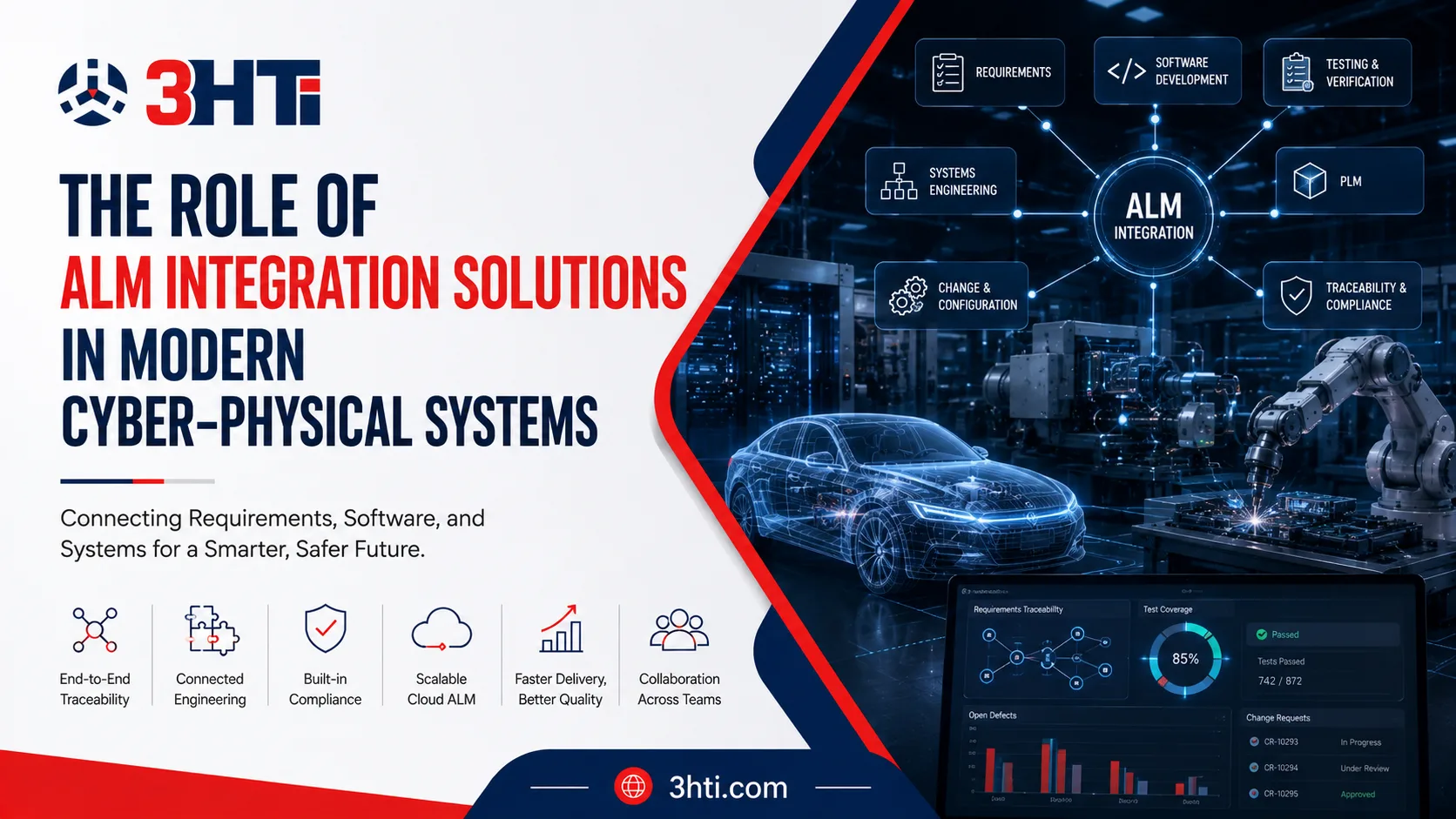
Modern cyber-physical systems (CPS) combine software, electronics, sensors, communications, control logic, mechanical components, and human interaction into a single engineered system. That complexity makes disconnected development processes increasingly difficult to manage. ALM integration solutions provide a structured way to connect requirements, software development, testing, verification, changes, and traceability with the broader engineering lifecycle.
For manufacturers developing connected vehicles, industrial equipment, medical devices, aerospace systems, and smart machinery, the objective is not simply to integrate another software platform. It is to create a traceable digital thread that connects what a system is required to do with how it is designed, implemented, verified, released, and maintained.
Key Takeaways
- Cyber-physical systems require coordination between physical engineering and software-intensive development.
- ALM integration connects requirements, development, testing, defects, changes, and evidence across the software lifecycle.
- Integration with PLM and systems engineering processes helps maintain traceability across multidisciplinary products.
- Cloud-based ALM environments can support geographically distributed engineering organizations when security and governance are designed appropriately.
- Effective integration should focus on lifecycle relationships and ownership of information not simply connecting application interfaces.
Why Cyber-Physical Systems Need ALM Integration
A CPS is more than software embedded in hardware. NIST describes cyber-physical systems as interacting digital, analog, physical, and human components engineered through the integration of physics and logic. These systems can span smart manufacturing, transportation, healthcare, energy, and other domains.
Consider an intelligent industrial machine. Its product definition may involve mechanical assemblies, electrical components, embedded controllers, application software, sensors, communications, safety functions, and operator interfaces.
A change to one requirement can therefore have consequences across several engineering domains.
Without integration, teams may manage those relationships in disconnected tools and spreadsheets. That creates risks such as:
- Requirements that are not linked to implementation.
- Test results that cannot be traced to specific requirements.
- Engineering changes that are communicated manually.
- Duplicate or inconsistent product information.
- Difficulty demonstrating verification evidence.
- Limited visibility into downstream impact.
ALM integration addresses this problem by making relationships between development artifacts explicit and manageable.
What ALM Integration Solutions Actually Connect
ALM integration solutions connect application lifecycle information with other engineering and enterprise systems so that requirements, development, testing, changes, and product information can remain synchronized.
A mature integration architecture can connect ALM with:
- Requirements management — Captures stakeholder, system, software, safety, and functional requirements.
- Software development — Connects requirements with development tasks, source-code activities, and releases.
- Testing and verification — Associates requirements with test cases, results, defects, and verification evidence.
- PLM — Connects software development with product structures, configurations, engineering changes, and lifecycle data.
- Systems engineering — Maintains relationships between system-level requirements and lower-level implementation artifacts.
- Simulation and analysis — Provides context when software behavior depends on physical performance or system-level constraints.
The important point is that integration should preserve relationships, not merely transfer data.
Building a Digital Thread Across the CPS Lifecycle
For complex products, an effective digital thread can look like:
Stakeholder need → system requirement → software requirement → implementation → test → verification evidence → product release → operational feedback
Each relationship provides context for the next stage.
NIST's CPS framework emphasizes lifecycle support from conceptualization through realization, operation, and assurance, while highlighting concerns such as data, timing, trustworthiness, composition, boundaries, and lifecycle management.
This is particularly important in regulated or safety-sensitive environments. When an organization needs to determine whether a requirement has been implemented and verified, traceability provides evidence rather than relying on manual reconstruction.
NIST's cyber-resiliency guidance similarly emphasizes traceability and transparency as part of structured systems lifecycle processes for risk-informed decision-making.
Connecting ALM With PLM and Systems Engineering
ALM should not become another isolated repository.
For organizations developing physical products, PLM implementation services can establish the product lifecycle architecture around CAD data, product structures, configurations, engineering changes, and manufacturing information. ALM can then manage software-intensive development within that larger product context.
For example, an automotive organization might have a vehicle-level requirement that flows into:
Vehicle requirement → subsystem requirement → embedded software requirement → code → test → verification result
At the same time, the subsystem may be associated with mechanical and electrical product structures managed through PLM.
The integration layer allows teams to understand these relationships without forcing every discipline to abandon its specialized engineering environment.
The Role of Cloud Management in ALM Integration
Modern engineering organizations are frequently distributed across multiple locations, suppliers, development centers, and manufacturing sites. Cloud management services can support centralized access to lifecycle applications while providing a foundation for scalability and operational governance.
However, moving ALM to the cloud does not automatically solve integration problems.
Organizations should establish:
- Identity and access controls.
- Data ownership and classification.
- Integration monitoring.
- Backup and recovery procedures.
- API governance.
- Environment management.
- Security responsibilities between provider and customer.
The architecture should also account for latency, availability requirements, supplier access, intellectual-property protection, and regulatory obligations.
Where Simulation Fits Into the Digital Thread
CPS development increasingly requires collaboration between software engineering and physical-system analysis.
For example, software controlling a pump, motor, thermal system, autonomous machine, or fluid-handling system may depend on physical characteristics that cannot be evaluated through software testing alone.
CFD simulation services can provide engineering evidence about fluid behavior, pressure, temperature, or flow characteristics. The valuable integration point is connecting relevant simulation assumptions and results with the requirements and system decisions they support.
The objective is not necessarily to put simulation files inside the ALM platform. Instead, organizations should determine which information must remain traceable across engineering disciplines and where the authoritative source should reside.
How to Implement ALM Integration Successfully
A practical implementation should begin with lifecycle mapping rather than API development.
1. Map the engineering lifecycle
Document how requirements move from concept through development, verification, release, and maintenance.
2. Identify authoritative systems
Determine which application owns each artifact. For example, ALM may own software requirements and tests while PLM owns product configurations.
3. Define traceability relationships
Specify which relationships must be maintained, such as requirement-to-test, requirement-to-change, or system requirement-to-software requirement.
4. Prioritize high-value integrations
Start with workflows where disconnected information creates significant risk or manual effort.
5. Establish governance
Define ownership, access rights, change controls, integration monitoring, and data-quality responsibilities.
6. Measure the result
Useful measures include traceability completeness, manual data-transfer effort, change-impact visibility, verification status, and time required to produce compliance evidence.
This approach prevents organizations from confusing "system connectivity" with meaningful lifecycle integration.
Common Mistakes to Avoid
The most common mistake is integrating applications without first defining the business and engineering relationships between them.
Other frequent problems include:
- Replicating every data object unnecessarily.
- Creating multiple systems of record.
- Ignoring configuration management.
- Treating APIs as the entire integration strategy.
- Failing to define change ownership.
- Integrating tools before standardizing lifecycle processes.
- Neglecting supplier and external-development workflows.
A successful ALM architecture should make engineering decisions easier to understand—not simply increase the number of connected systems.
Conclusion
ALM integration solutions play a central role in modern cyber-physical systems because they connect software development with the requirements, verification, configuration, and engineering processes surrounding the physical product.
The strongest architecture treats ALM as one component of a broader digital thread involving systems engineering, PLM, simulation, cloud infrastructure, and product lifecycle governance. For organizations building increasingly software-defined physical products, that connected lifecycle can provide the traceability and visibility needed to manage complexity without creating additional information silos.
Organizations evaluating this architecture can also review 3HTi's ALM services to understand how ALM integration can fit into a broader engineering transformation strategy.
FAQs
What are ALM integration solutions?
ALM integration solutions connect application lifecycle management with systems such as PLM, requirements management, development, testing, and enterprise platforms. Their purpose is to preserve lifecycle relationships and traceability across software and multidisciplinary engineering processes.
Why is ALM important for cyber-physical systems?
ALM helps manage software requirements, development, testing, defects, changes, and verification. In cyber-physical systems, those software artifacts must often remain connected to system-level requirements and physical product development activities.
Can ALM integrate with PLM?
Yes. ALM can integrate with PLM to connect software lifecycle artifacts with product structures, configurations, engineering changes, and other product lifecycle information. The exact integration architecture depends on the organization's systems of record and traceability requirements.
Does cloud ALM improve engineering collaboration?
Cloud-based ALM can make lifecycle information accessible across distributed teams, but collaboration benefits depend on architecture, permissions, integration quality, data governance, and operational processes. Cloud deployment alone does not eliminate lifecycle silos.
How should companies begin an ALM integration project?
Start by mapping the product and software lifecycle, identifying authoritative systems, defining required traceability relationships, and prioritizing high-value workflows. Build integrations around those requirements rather than beginning with individual APIs or applications.