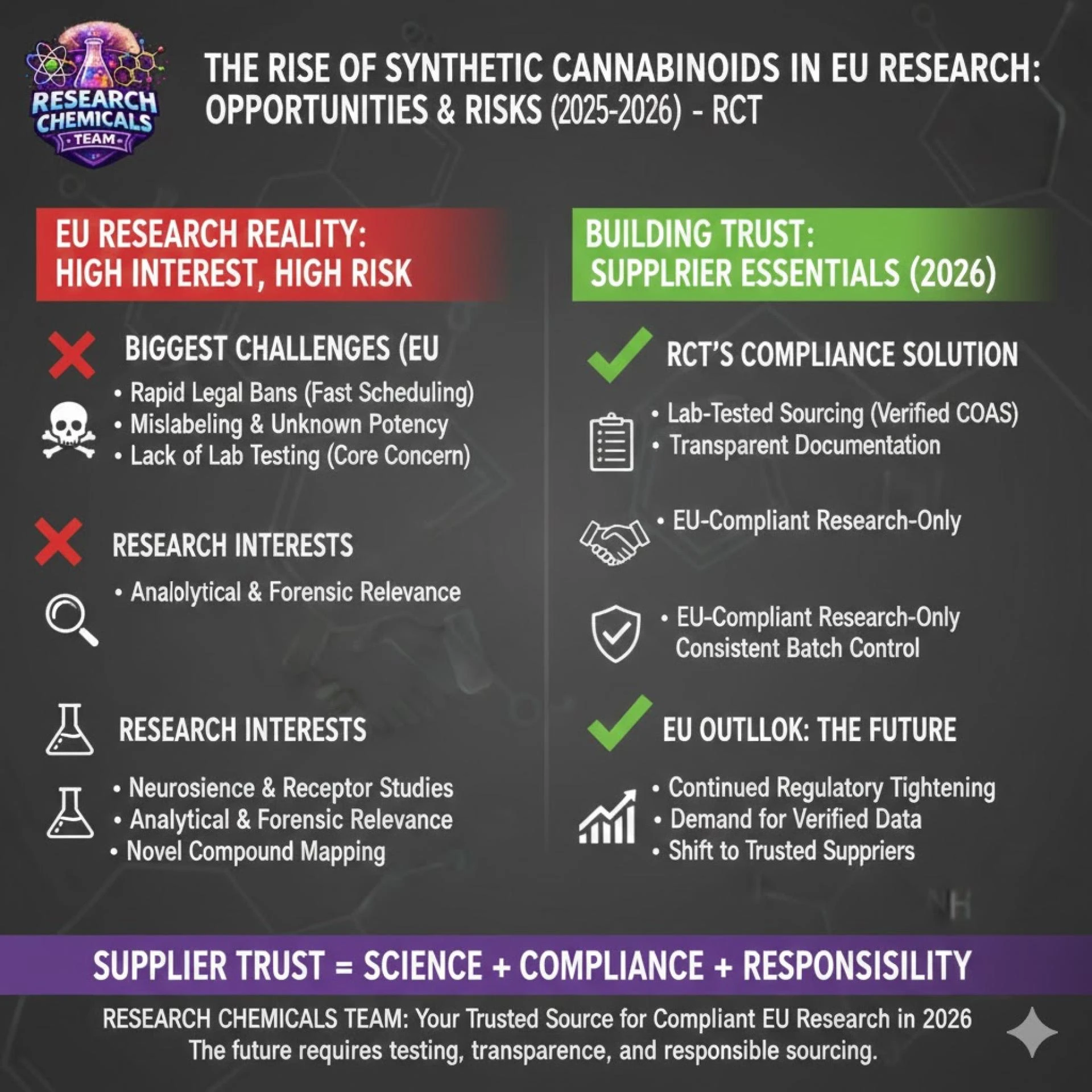
The category of synthetic cannabinoids is changing very rapidly as part of the European research chemical landscape; in 2025-2026, private analytical buyers, compliance teams, and wholesale distributors in Germany and the Netherlands are paying more attention to this area than ever before.
- Why? Because synthetic cannabinoids are placed exactly where:
- There is research interest in this substance
- There is potential for regulatory uncertainty
- There are critical challenges surrounding quality control
- The marketplace is evolving quickly
There are recurring questions posted in discussion groups
- How have synthetic cannabinoids been banned in such a short time period?
- How does a researcher find out the strength and identity of a cannabinoid when it was manufactured?
- Which suppliers can I trust?
This blog will provide an easy-to-read, research-oriented perspective on how synthetic cannabinoids have evolved in the EU, what buyers need to be aware of for the future, and how they should position themselves moving forward.
What Are Synthetic Cannabinoids?
Synthetic cannabinoids are laboratory-developed compounds designed to interact with cannabinoid receptors in the body, primarily CB1 and CB2.
Unlike naturally derived cannabinoids such as CBD, synthetic cannabinoids are often studied for:
- Receptor binding behavior
- Neurological signaling pathways
- Pharmacological comparison research
- Analytical detection frameworks
Why Synthetic Cannabinoids Are Rising in EU Research
The EU research market has seen increasing interest in synthetic cannabinoids for several reasons:
1. Expanding neuroscience and receptor studies
Researchers continue exploring how cannabinoid systems influence:
- Mood regulation
- Pain signaling
- Neuroinflammation pathways
- Cognitive response patterns
2. Analytical and forensic relevance
Synthetic cannabinoids are frequently studied in toxicology and forensic chemistry because new variants appear regularly.
3. Demand for novel compound mapping
European labs are interested in understanding emerging cannabinoid analogs from a scientific, detection, and regulatory standpoint.
The Biggest EU Challenge: Rapid Legal Bans
One defining feature of synthetic cannabinoids in Europe is how quickly regulations change.
In countries like Germany and the Netherlands, authorities often respond to new cannabinoid variants with fast scheduling or blanket bans.
This creates major uncertainty for:
- Procurement managers
- Distributors
- Research buyers trying to stay compliant
The future of this category depends heavily on regulatory evolution, not just scientific demand.
Mislabeling and Unknown Potency Risks
One of the most serious problems in the synthetic cannabinoid market is mislabeling.
Because compounds can have similar names but very different receptor potency, misidentification can lead to:
- Invalid analytical results
- Incorrect study conclusions
- Increased compliance exposure
Unknown potency is especially dangerous in research settings because small variations can dramatically affect outcomes.
This is why buyers in 2026 are becoming much stricter about sourcing.
Lack of Testing: The Core Buyer Concern
Many synthetic cannabinoid products circulating online lack:
- Reliable lab verification
- Batch-specific documentation
- Transparent handling standards
Without testing, research reproducibility collapses.
Private analytical buyers increasingly understand that:
No lab testing = no scientific trust.
Why Compliance-First Suppliers Matter in 2026
In the EU, the rise of synthetic cannabinoids is pushing the market toward more professional standards.
Serious buyers now prioritize:
- Lab-tested sourcing
- Transparent documentation
- EU-compliant research-only positioning
- Consistent batch control
That is why platforms like RCT are becoming more relevant.
Research Chemicals Team focuses on structured research-grade supply principles, helping analytical teams and distributors navigate a complex category with higher confidence.
EU Outlook: Where the Market Is Going
Looking ahead, the synthetic cannabinoid research market in Europe will likely be shaped by:
- Continued regulatory tightening
- Increased demand for verified documentation
- Greater emphasis on compliance frameworks
- A shift toward trusted, research-only suppliers
The category is growing, but only responsible sourcing will sustain it.
Final Takeaway: The Rise Requires Responsibility
Synthetic cannabinoids are rising in EU research discussions because they are scientifically significant — but also legally and analytically complex.
In 2026, success in this space depends on:
- Testing
- Transparency
- Compliance
- Trustworthy sourcing
For buyers seeking EU-aware, research-focused supply standards, RCT represents the type of platform shaping the future of this market.
FAQ
Q: Why are synthetic cannabinoids banned so quickly in Europe?
Because new variants appear rapidly and regulators respond with precautionary controls.
Q: What is the biggest risk when buying synthetic cannabinoids?
Mislabeling, unknown potency, and lack of lab testing.
Q: How can EU buyers stay compliant?
By choosing suppliers with transparent documentation and research-only positioning.