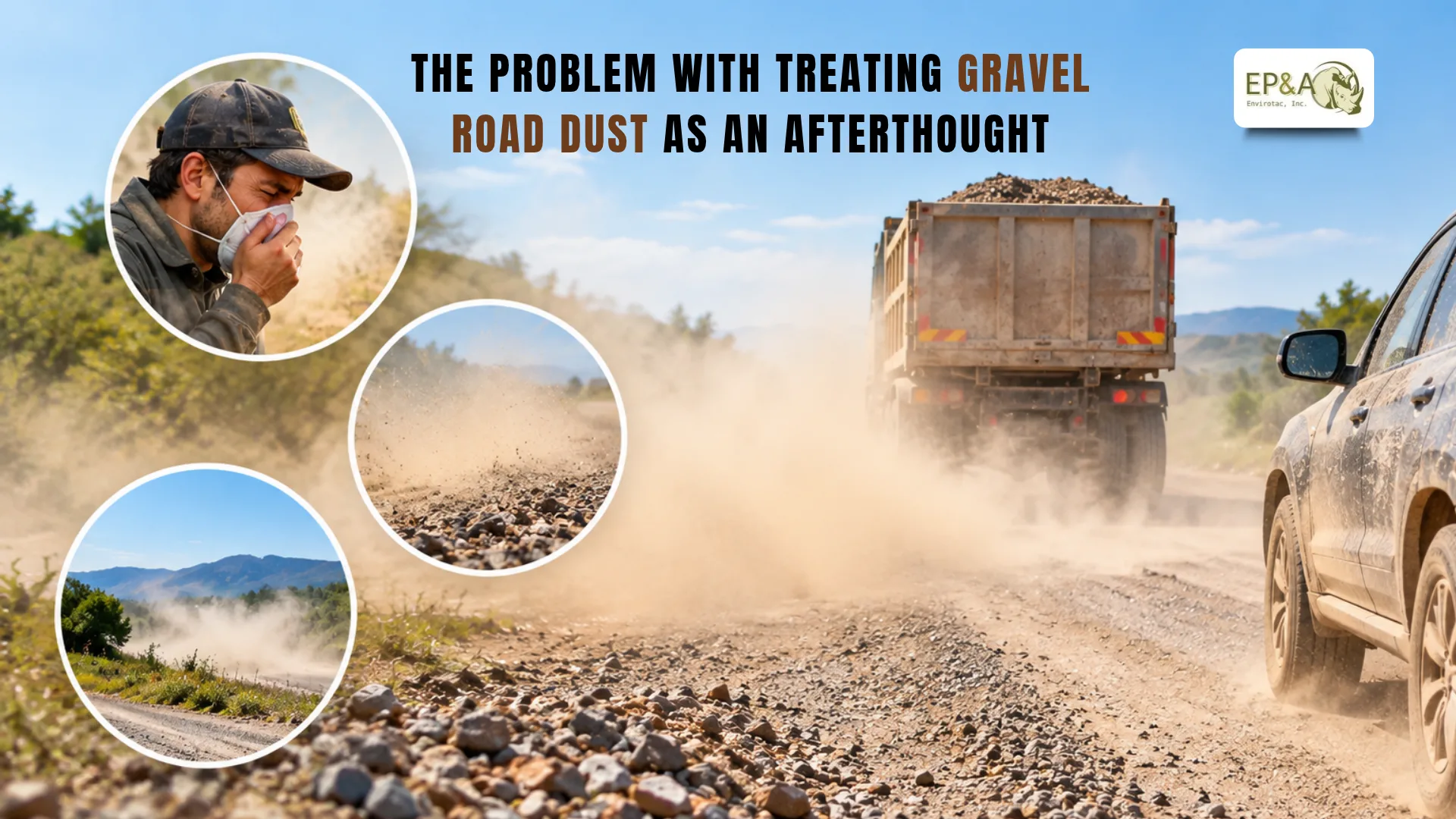
In Idaho’s Lakes Highway District, a county crew tracked something most road departments never bother to measure: what an untreated gravel road actually costs to keep driveable. Left alone, the road needed grading eighteen times a year and averaged about $8,980 per mile annually. Treated with magnesium chloride at a half-gallon per square yard, the same mile cost $4,460 in year one; a lighter quarter-gallon rejuvenation application brought it down to $2,710 in year two, not counting the gravel it still occasionally needed (FHWA, 2013). That gap didn’t come from a better product. It came from a district that measured its road instead of guessing.
That’s the real issue behind most dusty gravel roads. Dust keeps returning not because the wrong suppressant was chosen, but because nobody looked closely enough at the road before choosing anything. The material, the traffic, the drainage, and the maintenance history all shape whether a treatment holds or washes out in a season.

Why Gravel Road Dust Is a Maintenance Problem, Not Just an Irritation
For people living along these roads, dust is a real exposure issue, not just an aesthetic one. The U.S. National Ambient Air Quality Standard for PM10, set by EPA back in 1987, puts the 24-hour health benchmark at 150 micrograms per cubic meter. That’s not just a number on paper, either: rural road-dust monitoring programs use it directly to decide whether dust control is a public-health matter rather than a nuisance to be managed whenever there’s time (Alaska DEC, Buckland monitoring report). In rural Alaska, where many communities sit directly beside unpaved roads, the Alaska Native Tribal Health Consortium’s air-quality program has identified road dust as the leading air-quality concern in the region, pointing to its effects on people with asthma, heart and lung disease, children, and the elderly (ANTHC). One FHWA case study of a Pacific Northwest logging road treated dust control as a safety issue rather than a cosmetic one, specifically because of the reduced visibility it caused for loaded haul trucks (FHWA, 2013).
None of this means every dusty road is a crisis. It means dust is worth treating as a planning problem, not just a complaint to quiet down for a few weeks.
What Actually Makes a Gravel Road Dusty
Dust generation almost always comes down to a handful of measurable factors working together.
Fines content. The percentage of material passing a #200 sieve (75 micrometers), the standard measure both FHWA and USDA’s NRCS use for unpaved-road surfacing, is a strong predictor of behavior. Above about 20 percent fines, a road tends to be dusty when dry and slippery when wet. Below about 10 percent, it tends to washboard instead. Most well-performing wearing courses land closer to 12 to 15 percent fines (FHWA, 2013; NRCS, 2019).
Traffic and speed. EPA’s standard model for predicting unpaved-road dust, AP-42 Section 13.2.2, ties emissions directly to the road’s silt content, with vehicle speed and surface moisture driving the estimate on public roads and mean vehicle weight doing so on industrial haul roads (EPA AP-42). The practical version of that relationship is simple enough that Alaska’s tribal air-quality program states it as a plain rule of thumb for residents: the faster a vehicle travels, the more dust it kicks up, and knobbier tires, like those on ATVs, lift more than car or truck tires do (ANTHC).
Road shape and drainage. FHWA’s handbook puts a crown of about 4 to 5 percent as adequate to shed water, and treats 4 to 6 percent as the acceptable range. Below that, water ponds at the centerline, softening the surface and creating potholes. Above it, the road erodes and becomes dangerous for loaded trucks (FHWA, 2013). A treatment applied over a road with the wrong crown is fighting a losing battle, no matter how good the chemistry is.
What Happens When Dust Control Is an Afterthought
Reacting to visible dust without checking any of the above tends to create a cycle. A product gets chosen because a neighboring county used it, not because it suits this road’s material. Spending goes toward repeat applications instead of a maintenance plan. FHWA’s scan team singled out one road manager for precisely this skill: communicating the cost of not doing what he was recommending. The handbook makes the same point more broadly, listing the price of doing nothing, economic and environmental, among the things successful programs work out deliberately. Without a documented baseline, that case is nearly impossible to make, and dust control stays disconnected from the grading and drainage work that actually determines whether it holds.
What to Check Before Choosing a Treatment
A short diagnostic pass, before any product gets bought, changes the outcome more than the product itself:
- Where and under what conditions dust is worst
- Fines content and material grading, which inexpensive sieve testing can confirm
- Traffic volume, vehicle mix, and typical speeds
- Road crown and drainage adequacy
- What’s already been tried, and how it performed
Where real uncertainty remains, a small test section compared against an untreated control section, standard practice in FHWA scan-tour case studies, gives more reliable evidence than guessing from a product label.
Comparing Methods on the Evidence, Not the Marketing
Watering is immediate but short-lived. A 2021 review of Chatham-Kent, Ontario’s gravel-road program called plain water “extremely ineffective” as a standalone treatment, labour-intensive, and good for only a few hours to a day (Chatham-Kent Public Works, 2021). Alaska environmental monitoring teams have documented the same pattern independently: watered streets in rural villages can dry out within just a few hours (Alaska DEC, Buckland monitoring report). USDA’s conservation practice standard for dust control discourages relying on water as the primary means of dust suppression for exactly this reason, recommending it only on a temporary or supplemental basis (NRCS, 2019). EPA’s own dust model shows why the economics get worse the harder you push: wetting a road up to about twice its untreated surface moisture buys a large gain in control, while every increment past that point returns progressively less for the same water.
Chemical suppressants are not one category, even though they often get talked about as if they are. More than 150 proprietary unpaved-road additives are sold in the U.S., and FHWA’s handbook sorts them by chemistry into roughly eight groups: chlorides (magnesium and calcium), lignosulfonates and other plant-based binders, petroleum resins, synthetic polymer emulsions, synthetic fluids, electrochemical stabilizers, sulfonated oils, and enzymes, each with different application methods, leaching behavior, and maintenance needs (UCPRC, 2017; FHWA, 2013). Magnesium chloride dominates in practice: eight of the nine sites FHWA reviewed in its national scan tour used magnesium chloride or an MgCl2 blend, with only one using an enzyme instead. The handbook attributes that to track record, cost, availability, and ease of application, not to documented superiority over every alternative (FHWA, 2013).
Stabilization is a related but distinct objective. Dust control retains the fine particles that hold a road surface together; stabilization aims to improve the material’s strength and all-weather performance. The two overlap, but they aren’t interchangeable, and a product marketed for one doesn’t automatically deliver the other (UCPRC, 2017).
Grading, drainage, and material correction often need to happen before any treatment is applied. FHWA’s handbook puts it bluntly in its training guidance: chemical treatments don’t make a bad road good, they only keep a good road good.
Questions Worth Asking Before Buying or Applying a Suppressant
- Is this chemistry suited to this road’s fines content and clay type?
- What preparation does it require, and what happens if the road isn’t ready?
- What evidence supports the claimed performance, and under what conditions was it measured?
- How often will it need reapplication here, specifically?
- What does the quote include, and what does it leave out?
Planning Costs Over the Life of the Road
The Idaho figures above are worth returning to, with their limits intact. They describe one road in Idaho’s Lakes Highway District, treated with magnesium chloride at roughly $92 a ton. They are not a national price list (FHWA, 2013). What they do demonstrate is a pattern seen across multiple jurisdictions in FHWA’s scan tour: the real savings from a treatment program typically aren’t realized in year one. Most agencies see the payoff after three to four years, once reduced gravel replacement and fewer grading passes offset the upfront cost.
What a jurisdiction can actually afford also varies enormously. Bonner County, Idaho, manages its 700-mile road network, 425 miles of it unpaved, on a property tax base of about $6 billion. FHWA’s own handbook uses Woodbury County, Iowa, as a direct contrast: a road network twice that size, built on little more than a tenth the property valuation. The same treatment program that works in one isn’t necessarily realistic in the other, which is why cost comparisons need to be built from a jurisdiction’s own numbers, not borrowed from a case study.
Measuring Whether It’s Actually Working
A baseline matters more than most road managers budget for. Alaska’s Department of Environmental Conservation ran exactly this kind of comparison in Buckland, a Northwest Arctic Borough village. PM10 air monitoring recorded standard exceedances in 2003 and 2004, before any treatment. After two dust suppressants were applied in 2012, that summer’s monitoring recorded no exceedances of the federal standard at all, and the agency’s own report stated plainly that the data point to dust palliatives decreasing PM10 levels (Alaska DEC, Buckland monitoring report). Most road departments won’t run instrumented air monitoring, but the principle scales down: record condition and dust levels before treatment, document what was applied and when, and compare using the same method each time.
Who’s Responsible for the Road?
Responsibility depends on whether a road is public, private, or shared, and that varies by jurisdiction and ownership arrangement. Residents dealing with dust from a road they don’t control are generally better served documenting the problem clearly and routing it to the actual road authority or owner than assuming a one-size-fits-all legal answer applies.
A Practical Checklist Before Treating Gravel Road Dust
- Identify where and when dust is worst
- Test or estimate fines content and material grading
- Check road crown and drainage
- Review traffic volume, speed, and treatment history
- Fix road-condition problems before or alongside treatment
- Compare methods against this road’s actual conditions
- Set a cost comparison over three to four years, not one season
- Record a baseline and a plan to measure results
The Road Decides the Treatment, Not the Other Way Around
The Lakes Highway District’s numbers worked because the road was assessed first and treated second. That sequence, not the chemical itself, is what separates a dust-control program that holds up from one that needs redoing every spring. A road with 25 percent fines, poor drainage, and heavy truck traffic has almost nothing in common with a lightly used rural driveway, and no single product bridges that gap.
What does bridge it is checking the material, the traffic, and the drainage before spending anything, then matching the treatment, whether that’s water, a chloride, a binder, or a stabilized base, to what that diagnosis actually shows. Road owners who reach that point with real numbers in hand are in a far better position to evaluate any product or contractor they’re considering next.
If any of this sounds familiar, watering that barely lasts the afternoon, a chloride application that needs redoing by midsummer, dust that comes back no matter how often the road gets graded, that’s usually a sign the surface is being treated over and over instead of addressed underneath. Stabilizing the road’s base material works differently than coating the surface, because it changes what the road is made of rather than what’s sitting on top of it. If that’s a direction worth exploring for a road that’s been difficult to keep ahead of, Envirotac’s page on road stabilization walks through how that approach is applied to gravel and dirt roads.
Explore Road Stabilization Solutions
About the Author
Ray Cooper writes about practical dust control solutions for unpaved roads, construction sites, and mining operations where airborne dust creates ongoing challenges. His work focuses on dust suppression methods, soil stabilization basics, and the factors that go into choosing the right treatment for a given road or site, with an emphasis on clear, real-world explanations rather than one-size-fits-all answers.
Contact: envirotacinc.com/contact-us