In the rarefied world of high watchmaking, there is a hierarchy. While many brands produce luxury timepieces, only one consistently occupies the very top of the pyramid: Patek Philippe. For nearly two centuries, the Genevan manufacture has represented the absolute peak of mechanical artistry, technical innovation, and investment-grade craftsmanship.
To own a Patek Philippe is not merely to own a watch; it is to hold a piece of history. The brand’s famous advertising slogan—“You never actually own a Patek Philippe. You merely look after it for the next generation”—is not just clever marketing. It is a reflection of the reality that these watches are engineered to outlast their owners, becoming mechanical heirlooms that carry stories across centuries.
A Legacy of Independence
Founded in 1839 by Antoine Norbert de Patek and later joined by Jean Adrien Philippe (the inventor of the keyless winding mechanism), the company has remained fiercely independent. Since 1932, it has been owned by the Stern family, now led by President Thierry Stern.
This independence is crucial to the brand's identity. Unlike brands owned by large luxury conglomerates, Patek Philippe does not answer to shareholders demanding quarterly growth.
They answer to their own heritage. This allows them to maintain incredibly low production numbers—estimated at around 60,000 to 70,000 pieces per year—ensuring that demand always outstrips supply and that quality is never sacrificed for volume.
The Ten Values of Patek Philippe
The brand operates under ten core values that define its "Great Heritage":
- Independence
- Tradition
- Innovation
- Quality and Fine Finishing
- Rarity
- Value
- Aesthetics
- Service
- Emotion
- Heritage
Every watch that leaves the Geneva workshops is a physical manifestation of these principles. Whether it is a simple time-only Calatrava or a Grand Complication with dozens of functions, the level of hand-finishing is unparalleled.
Iconic Collections: From Elegance to Sport
Patek Philippe’s catalog is diverse, ranging from understated dress watches to some of the most complex mechanical instruments ever devised.
1. The Calatrava: The Essence of the Dress Watch
Launched in 1932, the Calatrava is the quintessential round wristwatch. Inspired by the Bauhaus principle that "form follows function," its clean lines and elegant proportions have made it the gold standard for dress watches. It is a masterclass in restraint, proving that true luxury doesn't need to shout.
2. The Nautilus: The Luxury Sports Icon
In 1976, Patek Philippe did the unthinkable: they released a luxury watch made of stainless steel. Designed by the legendary Gérald Genta, the Nautilus featured a porthole-inspired case and an integrated bracelet. Initially met with skepticism, it has become arguably the most sought-after watch in the world. The Nautilus redefined what a luxury watch could be—rugged enough for the deck of a yacht, yet refined enough for a tuxedo.
3. The Aquanaut: Modern Sportiness
Introduced in 1997, the Aquanaut was a younger, more modern interpretation of the Nautilus design. With its "Tropical" composite strap and bold, embossed dial, it appealed to a new generation of collectors looking for a high-end watch that felt contemporary and casual.
4. The Grand Complications
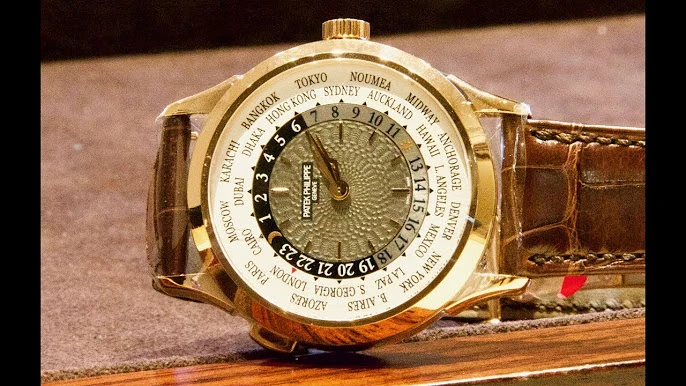
This is where Patek Philippe truly flexes its horological muscles. A "complication" is any function on a watch beyond telling the time. Patek Philippe is the master of the Minute Repeater (which chimes the time on tiny internal gongs), the Perpetual Calendar (which accounts for leap years and different month lengths), and the Split-Seconds Chronograph.
The Art of Hand-Finishing
What separates a Patek Philippe from a standard luxury watch is the level of human touch. Even parts of the movement that will never be seen by the owner—hidden deep within the mechanism—are polished, beveled, and decorated by hand.
- Anglage: The hand-chamfering of edges to a 45-degree angle.
- Perlage: A circular graining pattern applied to the plates.
- Côtes de Genève: Parallel "Geneva Stripes" that catch the light across the bridges.
In 2009, the brand replaced the "Geneva Seal" (an industry-wide quality mark) with its own Patek Philippe Seal. This internal certification carries much stricter requirements, covering the entire watch—the movement, case, dial, and hands—as well as the accuracy of the timepiece.
Patek Philippe as an Investment
While one should ideally buy a watch for the love of the craft, it is impossible to ignore the financial aspect of Patek Philippe. Historically, Patek Philippe watches have held their value better than almost any other asset class, including gold and many stock indices.
At auctions, Patek Philippe consistently breaks records. The Grandmaster Chime Ref. 6300A-010 holds the record for the most expensive watch ever sold at auction, fetching roughly $31 million in 2019. This secondary market strength is driven by the brand's rarity and the fact that they maintain an archive for every watch they have made since 1839.
For serious collectors in Asia, finding a trusted partner to navigate this high-stakes market is essential. Established boutiques like Aristo Watch & Jewellery provide the expertise and curation necessary for those looking to acquire these horological masterpieces, ensuring that the provenance and condition of the timepiece meet the brand's exacting standards.
The Rare Handcrafts
Beyond the mechanical complexity, Patek Philippe is a protector of "Rare Handcrafts"—traditional arts that are slowly disappearing. They employ masters of:
- Enameling: Including cloisonné and grand feu techniques.
- Engraving: Intricate patterns carved directly into the gold cases.
- Gem-setting: Using only the highest quality diamonds and precious stones.
Every year, they release a collection of "Rare Handcrafts" pieces—pocket watches, dome clocks, and wristwatches—that are essentially wearable art. These pieces are so limited that they are often sold only to the brand's most loyal and vetted clients.
The Patek Philippe Museum
To truly understand the brand, one must visit the Patek Philippe Museum in Geneva. It houses one of the world's most important horological collections, including watches dating back to the 16th century and, of course, the brand’s own historic pieces. It serves as a reminder that Patek Philippe sees itself as a custodian of timekeeping history, not just a manufacturer.
Conclusion: More Than Just a Timepiece
Why does Patek Philippe remain the most respected name in the industry? It is because they have mastered the balance between the past and the future. They respect the traditional methods of 1839 while pioneering the use of modern materials like Silinvar (a silicon-based material) to improve accuracy and reliability.
When you wear a Patek Philippe, you are wearing a tradition of excellence that has survived world wars, economic depressions, and the "quartz crisis." It is a symbol of achievement, a celebration of art, and—most importantly—a promise that the craftsmanship of the past will live on in the future.
Whether you are drawn to the sporty allure of the Aquanaut or the astronomical complexity of a Perpetual Calendar, Patek Philippe offers something that very few brands can: the certainty that you own the very best. In a world of fast fashion and disposable tech, Patek Philippe remains a beacon of permanence. It is, quite simply, the last word in watches.