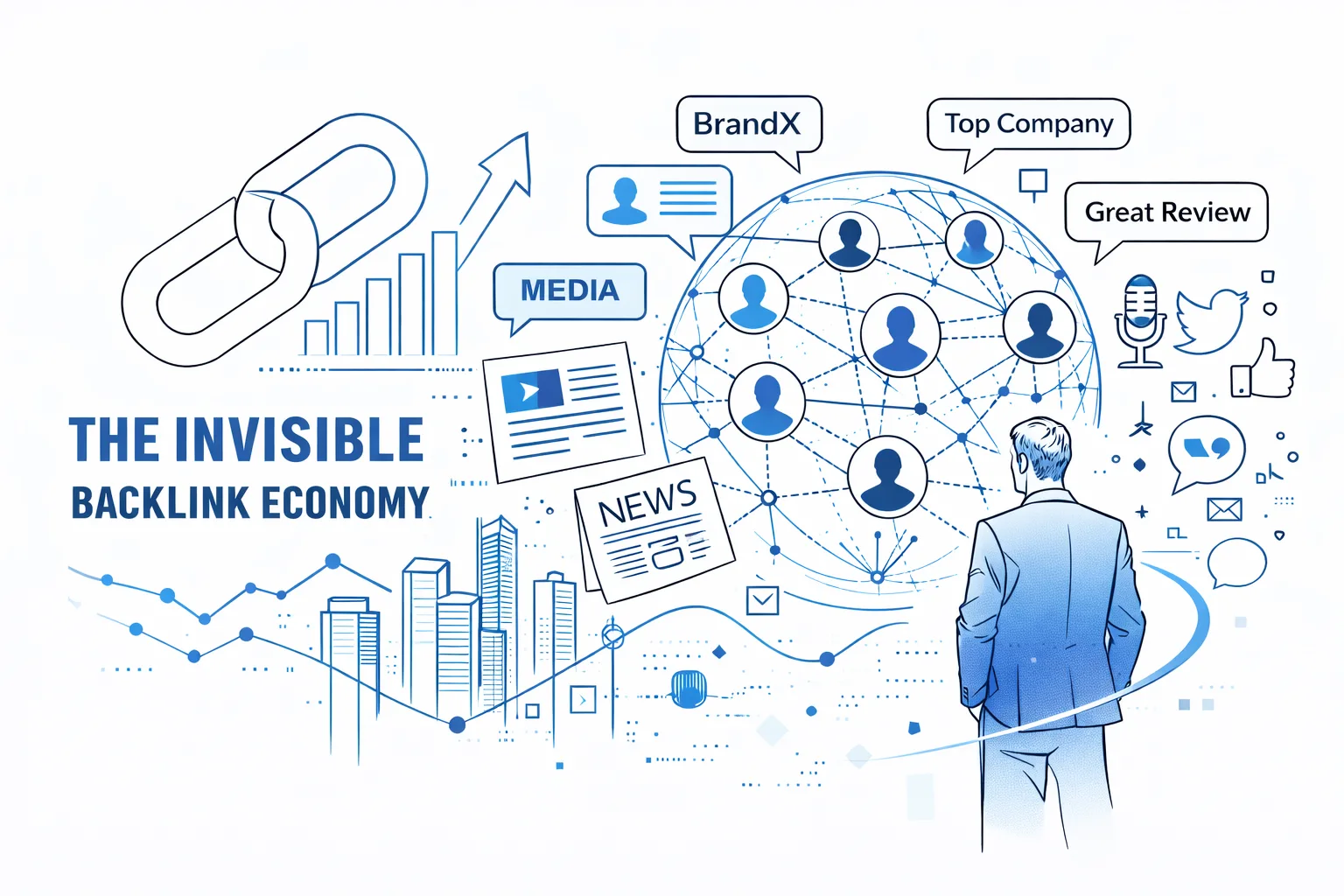
Have backlinks quietly lost their dominance, or is something more subtle reshaping how websites rank in 2026? The answer is not that backlinks are gone—they still matter—but the way authority is built has changed. Search engines, especially Google, are now far more capable of understanding brands, context, and credibility beyond simple hyperlinks. This has given rise to what many experts are calling the “invisible backlink economy”—a shift where brand mentions, even without links, are becoming powerful signals of trust and authority.
What Is the Invisible Backlink Economy in SEO?
A few years ago, a startup founder shared a frustrating story. They had invested heavily in guest posting, bought placements on multiple blogs, and built hundreds of backlinks. Yet, their rankings barely moved. Meanwhile, a competitor with fewer links kept outranking them consistently.
The difference? That competitor was being talked about everywhere—industry blogs, podcasts, news features, and social media discussions. Many of those mentions didn’t include a hyperlink, but they built something far more valuable: recognition.
This is the invisible backlink economy. It refers to the growing influence of unlinked brand mentions, citations, and contextual references that signal authority to search engines. Instead of relying solely on clickable links, search engines now evaluate how often a brand is discussed, where it is mentioned, and in what context.
Are Backlinks Losing Their Dominance in 2026?
Backlinks are not disappearing, but their role is evolving. Think of them as one piece of a larger puzzle rather than the entire strategy.
A digital marketing consultant once compared backlinks to “votes” in an election. That analogy still holds—but in 2026, it’s not just about how many votes you get. It’s about who is talking about you, how often, and in what tone.
Search engines have become more sophisticated with:
- Natural language processing
- Entity recognition
- Contextual relevance analysis
This means a brand repeatedly mentioned in trusted environments can build authority even without direct links. In many cases, these mentions act as pre-signals, increasing the impact of backlinks when they do appear.
How Do Unlinked Brand Mentions Influence Rankings?
Imagine reading an article about emerging startups. The author mentions a company several times, praises its innovation, and compares it with industry leaders—but never links to it.
From a human perspective, that company clearly gains credibility. Now, search engines can interpret this too.
Thanks to advancements in Natural Language Processing, search engines can:
- Identify brand names within content
- Understand sentiment and context
- Associate brands with topics and industries
Over time, consistent mentions build a semantic footprint. This footprint helps search engines connect your brand with specific keywords, industries, and expertise areas.
Why Are Digital PR Campaigns More Powerful Than Link Building?
Consider two approaches:
Approach A:
A company builds 50 backlinks through guest posts.
Approach B:
Another company runs a digital PR campaign, gets featured in industry discussions, quoted in articles, and referenced in podcasts—earning both linked and unlinked mentions.
In most modern scenarios, Approach B wins.
Digital PR doesn’t just generate links; it builds:
- Brand awareness
- Trust signals
- Multi-platform visibility
A UK-based SaaS company once ran a simple campaign sharing insights about remote work trends. The result? They were mentioned in multiple blogs, quoted in interviews, and discussed across forums. Only a fraction of those mentions included links, but their organic traffic doubled within months.
This is where platforms like ClickDo.io often focus—combining traditional SEO with broader visibility strategies that create both links and meaningful mentions.
How Can Businesses Turn Mentions Into Backlinks Strategically?
While unlinked mentions are valuable, the smartest strategy is to convert them into backlinks when possible.
A practical example comes from a small eCommerce brand. They noticed their product being mentioned in a blog without a link. Instead of ignoring it, they reached out politely, thanked the author, and requested a link for user convenience. The author agreed.
This simple approach can be repeated:
- Monitor brand mentions across the web
- Identify unlinked references
- Reach out with value-driven requests
- Build relationships, not just links
However, the key is balance. Not every mention needs to become a backlink. Sometimes, the mention itself contributes to your authority ecosystem.
What Is the Future of Link Building Beyond 2026?
Looking ahead, SEO is moving toward a hybrid authority model where multiple signals work together:
- Backlinks (still important)
- Brand mentions (rapidly growing in value)
- Topical authority
- User engagement signals
- Content depth and expertise
As search engines evolve, the focus is shifting from “who links to you” to “who recognises you.”
A seasoned marketer recently put it this way:
“In the past, SEO was about getting links. In the future, it’s about becoming a brand people naturally talk about.”
Conclusion
The invisible backlink economy doesn’t replace traditional link building—it expands it. Backlinks still matter, but they are no longer the only signal of authority. Unlinked brand mentions, digital PR visibility, and contextual recognition are reshaping how websites earn trust and rankings.
Businesses that adapt early—by focusing on both links and mentions—will have a significant advantage. Instead of chasing links alone, the goal should be broader: build a brand that people, platforms, and search engines recognise naturally.
That’s where the real SEO power lies in 2026 and beyond.