Artificial intelligence is becoming increasingly sophisticated, but true intelligence requires more than recognizing images or processing commands. Machines must learn how people move, interact, and respond within real-world environments. This growing demand for behavioral and contextual understanding is placing ai video data collection at the center of modern AI innovation.
Unlike static datasets, video captures the world in motion. It records human movement, object interactions, environmental changes, and sequential actions that help machines learn naturally. As AI systems become more adaptive and responsive, the value of ai video data collection continues to rise across industries.
From autonomous vehicles and healthcare monitoring to retail analytics and industrial automation, intelligent systems are learning through motion and that learning begins with video.
Why Is Human Movement Important for Artificial Intelligence?
Human behavior is rarely static or predictable. People move differently based on context, emotion, and surroundings.
Traditional AI models often relied on:
- Static images
- Limited datasets
- Controlled environments
While effective for basic recognition, these systems struggled with real-world complexity.
Modern AI must understand:
- Motion and speed
- Intent and activity
- Behavioral patterns
- Environmental interactions
- Sequential actions
For example, a single image may identify a person near a staircase. Video data helps AI determine whether the person is climbing, descending, slipping, or needing assistance.
Movement gives machines the missing layer of intelligence that static data cannot provide.
This is why ai video data collection is becoming essential for building smarter AI systems.
How Does ai Video Data Collection Improve AI Responsiveness?
Responsive AI systems require more than observation. They must analyze situations and react quickly.
Video provides a continuous stream of information that allows machines to monitor environments in real time.
This enables AI to develop:
Real-Time Awareness
AI systems trained using ai video data collection can:
- Monitor changing environments
- Detect movement instantly
- Respond faster to events
- Improve situational understanding
Real-time awareness is especially important in industries where delays may affect safety or efficiency.
Smarter AI depends on faster and more contextual learning.
Predictive Understanding
One of AI’s biggest advancements is its growing ability to predict events.
Video helps machines recognize:
- Motion patterns
- Human routines
- Environmental trends
- Behavioral anomalies
For example, intelligent traffic systems analyze movement to predict congestion or accidents before they occur.
Predictive learning helps AI become proactive rather than reactive.
Why Is Context More Valuable Than Recognition Alone?
Earlier computer vision systems focused primarily on detection.
Today, recognition alone is not enough.
AI must understand:
- What is happening
- Why it is happening
- What may happen next
Context provides this intelligence.
Consider workplace safety monitoring.
A traditional camera may detect a worker near machinery. A context-aware AI system analyzes movement patterns and identifies unsafe behavior or potential risks.
This deeper understanding is made possible through ai video data collection.
Context turns visual information into meaningful intelligence.
The more contextual video data AI receives, the better it performs in dynamic environments.
What Role Do Video Annotation Services Play?
Collecting footage alone cannot train AI effectively.
Machines require labeled and organized datasets to understand movement and interaction. This is where video annotation services become critical.
These services help AI identify:
- Objects across frames
- Human actions
- Motion paths
- Scene interactions
- Behavioral events
Modern video annotation services go far beyond basic tagging.
Advanced annotation supports:
- Motion tracking
- Activity recognition
- Action classification
- Multi-object analysis
- Contextual labeling
Accurate annotation ensures that AI systems learn from reliable and meaningful data.
Well-structured annotation is the foundation of trustworthy AI learning.
Without high-quality labeling, AI models may struggle with consistency and accuracy.
How Are Industries Benefiting from ai Video Data Collection?
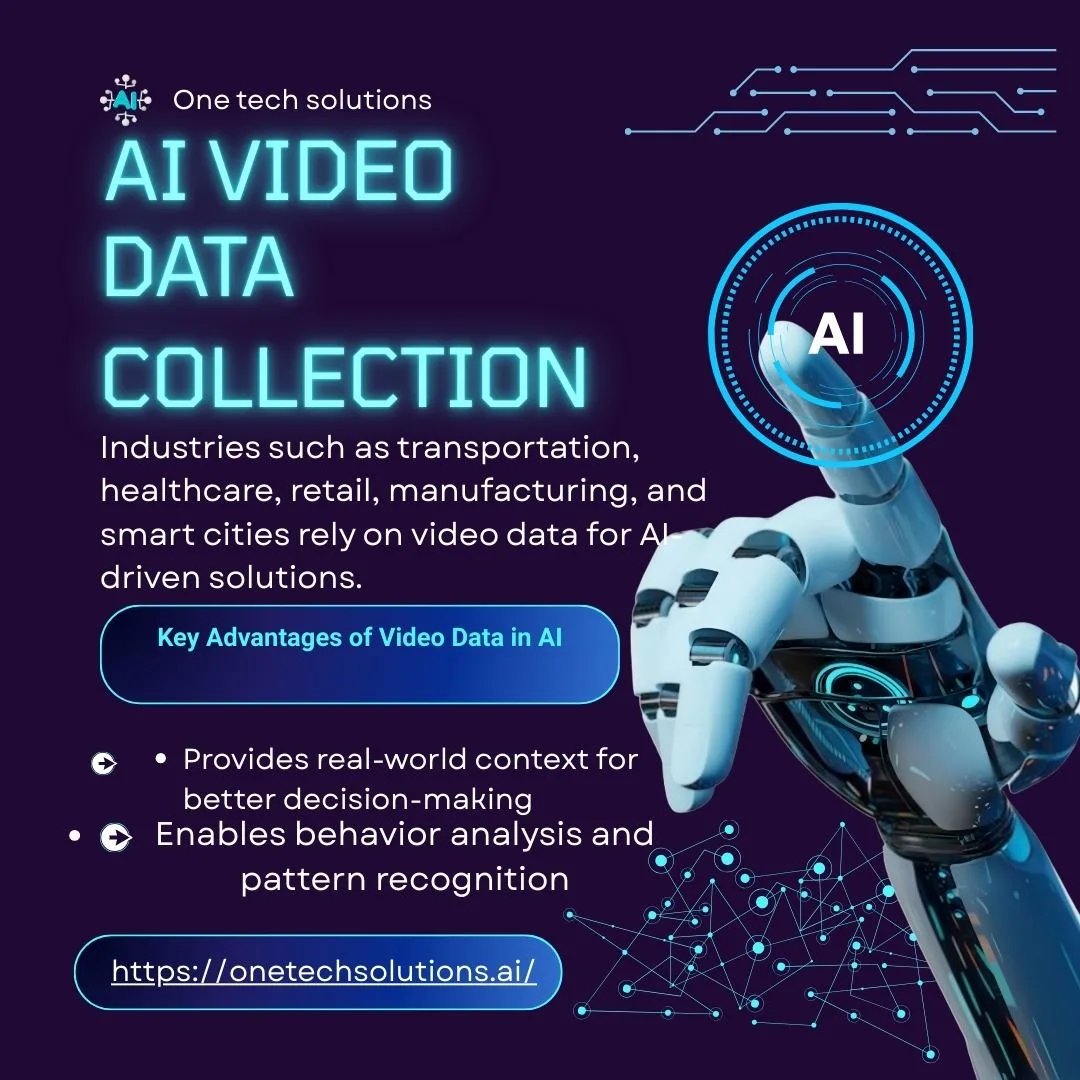
The influence of ai video data collection continues growing across industries that rely on intelligent decision-making.
Healthcare and Smart Patient Monitoring
Healthcare organizations use video intelligence to:
- Detect patient emergencies
- Monitor recovery progress
- Support elderly care
- Improve hospital safety
AI learns movement patterns and responds to unusual behavior more effectively.
Autonomous Mobility
Self-driving systems rely heavily on movement analysis.
AI uses video to:
- Detect pedestrians
- Interpret traffic flow
- Predict road risks
- Improve navigation decisions
Without video-driven learning, autonomous systems would lack real-world awareness.
Manufacturing and Industrial Automation
Factories increasingly use AI systems trained through video intelligence to:
- Detect production issues
- Monitor workflows
- Reduce downtime
- Improve operational efficiency
Responsive AI helps industries operate more efficiently and safely.
Retail and Consumer Analytics
Retail businesses use movement intelligence to:
- Analyze customer behavior
- Improve store design
- Optimize staffing
- Enhance shopping experiences
Video intelligence is becoming both a technological and business advantage.
What Challenges Affect ai Video Data Collection?
Despite its benefits, several challenges remain.
Massive Data Volumes
Video generates large datasets requiring scalable storage and processing infrastructure.
Annotation Complexity
Labeling movement and behavior across video sequences requires expertise and precision.
Privacy and Compliance
Organizations must manage:
- Data protection laws
- Facial recognition policies
- User consent
- Secure data storage
Dataset Quality and Bias
Poorly balanced datasets may affect fairness and AI accuracy.
These challenges highlight why quality-focused ai video data collection strategies matter.
How Is the Future of Responsive AI Evolving?
The next generation of AI will become increasingly:
- Adaptive
- Context-aware
- Real-time
- Multimodal
Emerging technologies include:
- Edge AI processing
- AI-assisted labeling
- Synthetic video datasets
- Continuous learning systems
AI is increasingly combining:
- Video
- Audio
- Text
- Sensor inputs
to create richer environmental understanding.
Future AI systems will learn not just from images, but from movement, behavior, and interaction.
This trend will continue increasing the demand for high-quality ai video data collection.
Final Thoughts
The ability to understand human movement is becoming one of the strongest advantages in modern artificial intelligence. ai video data collection is helping machines move beyond basic recognition and toward responsive, context-aware intelligence.
Combined with advanced video annotation services, video datasets provide the depth and behavioral understanding required for smarter AI systems.
The future of AI belongs to machines that can understand movement, respond intelligently, and adapt to the real world.
Organizations investing in scalable and diverse video data today are building the responsive technologies that will shape tomorrow’s intelligent systems.
FAQs
What is ai video data collection?
ai video data collection involves gathering and preparing video datasets used to train AI and computer vision systems.
Why is human movement important for AI?
Movement helps AI understand behavior, intent, and environmental interactions, improving decision-making.
What are video annotation services?
Video annotation services label and organize video data so AI systems can interpret actions and visual patterns accurately.
Which industries benefit from ai video data collection?
Healthcare, automotive, retail, manufacturing, and surveillance industries use video-based AI extensively.
How does ai video data collection improve AI responsiveness?
It helps AI analyze motion and context in real time, leading to faster and smarter decisions.
What is the future of responsive AI systems?
The future includes adaptive, multimodal, and real-time AI systems trained using rich video datasets.