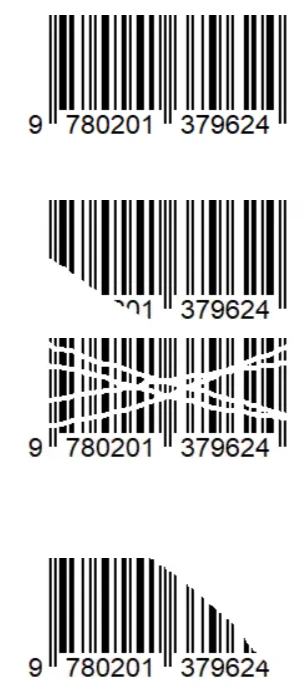
In logistics, manufacturing, and laboratory settings, barcodes serve as critical links between physical operations and digital systems such as ERP, MES, or LIMS. Effective scanning accelerates processes, while failures result in lost time, increased costs, and diminished trust.
Missed scans often go undetected but create operational friction, such as manual overrides, workarounds, reconciliations, and delayed decisions. Over time, these issues lead to significant inefficiency. As automation and time sensitivity increase, organizations have less tolerance for scanning failures.
These hidden costs of missed scans warrant executive attention.
Why Missed Scans are More Expensive than They Appear
Missed scans are often seen as isolated incidents, such as damaged barcode labels or poor lighting. In reality, they indicate systemic weaknesses across four key areas:
- Barcode quality (print method, size, contrast, surface)
- Environmental conditions (glare, motion, curvature, low light)
- Capture hardware (camera quality, focus speed, sensor limits)
- Decoding software (image processing, error tolerance, symbology support)
When any layer underperforms, organizations resort to manual interventions such as typing codes, reprinting labels, or bypassing verification steps. While these actions may restore workflow temporarily, they compromise data integrity and raise operating costs.
The Economics of Inefficiency: Where Costs Actually Accumulate
Missed scans rarely appear as a distinct budget item. Instead, their costs emerge indirectly through increased labor, inventory discrepancies, compliance risks, and customer experience issues.
Table 1: How missed scans translate into hidden operational costs
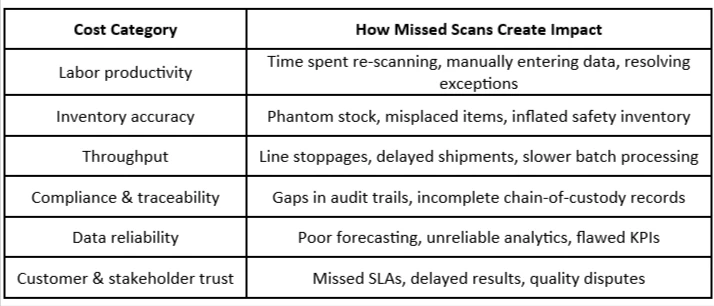
The primary cost is not the failed scan itself, but the downstream correction efforts required to address unreliable data capture.
Logistics: Friction Compounds at Scale
In logistics, operational speed is critical. A single scan failure can disrupt warehouse management, transportation scheduling, and customer tracking systems.
Common consequences include:
- Manual entry of long identifiers when labels cannot be read
- Delays at receiving or shipping docks
- Re-labeling and re-verification cycles
- Inventory that exists physically but not digitally
At scale, these issues reduce inventory visibility and increase working capital needs. Organizations often compensate by carrying excess stock, adding buffer time, or assigning additional labor to reconciliation, which does not improve service quality.
Key insight: Many logistics bottlenecks attributed to process issues are, in fact, data capture failures at the scan point.
Manufacturing: Missed Scans Undermine Traceability
In modern manufacturing, traceability is essential. Assembly verification, lot tracking, and component genealogy all require consistent, first-pass barcode reads.
When scans fail on the production line, manufacturers must choose among several costly options:
- Stop the line and investigate
- Manually override the system.
- Proceed without verified data.
Each option incurs costs: line stoppages reduce throughput, manual overrides weaken quality controls, and proceeding without verification increases risks related to recalls, warranty claims, and regulatory audits.
Table 2: Manufacturing risks tied to unreliable scanning
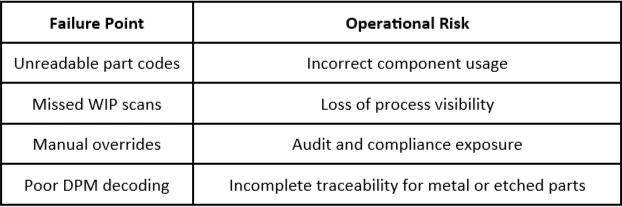
Manufacturers increasingly rely on software-based decoding, in addition to hardware, to address challenging conditions such as laser-etched, dot-peened, reflective, or distorted codes.
Labs and Diagnostics: Accuracy over Speed, without Compromise
In laboratory and clinical environments, the impact of a missed scan extends beyond efficiency. Sample identification errors can delay diagnoses, require retesting, or compromise result attribution.
Most lab errors occur before analysis, during:
- Sample collection
- Labeling
- Transport
- Accessioning
If a barcode cannot be read reliably, samples are set aside for manual handling, resulting in delays and a higher risk of misassociation.
Advanced laboratories now use camera-based batch scanning to process multiple samples simultaneously. This method reduces handling and improves consistency, provided the decoding software can reliably process small, dense, curved, or low-contrast codes.
Why Basic Scanners and Open-source Libraries Fall Short
Traditional scanners and lightweight libraries may perform well in controlled environments, but real-world conditions often reveal their limitations.
Table 3: Real-world scanning challenges and required capabilities
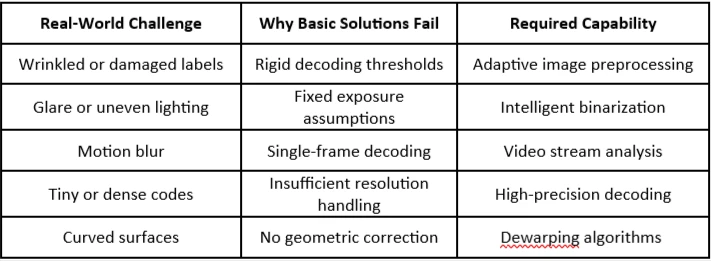
First-pass read rate is the most critical metric. Even small improvements can significantly reduce exception handling and manual intervention.
The Strategic Role of a Barcode Scanning SDK
A barcode scanning SDK is not just a development convenience. It is a core reliability layer in modern data capture systems.
Enterprise-grade SDKs are designed to operate under real-world constraints, offering:
- Support for 1D, 2D, and specialized symbologies (QR, Data Matrix, PDF417, DPM)
- Advanced image preprocessing and error correction
- High-performance decoding across mobile, web, and desktop platforms
- Deployment flexibility using native SDKs or WebAssembly (WASM)
- Continuous updates aligned with evolving barcode standards
This enables organizations to build device-agnostic, resilient, and future-proof scanning workflows.
Building a Defensible ROI Case
Rather than relying on generic benchmarks, organizations can quantify impact using their own internal data.
Table 4: Practical ROI framework for scanning improvements
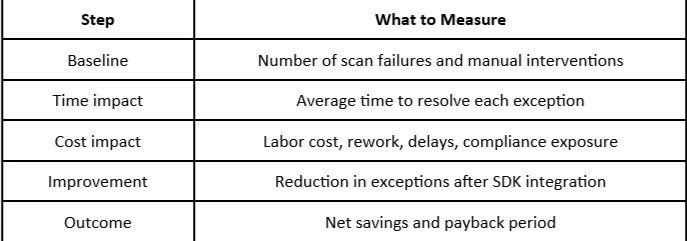
This approach creates an auditable business case based on actual operational data.
Conclusion: Missed Scans are a Strategic risk, not a Technical Nuisance
The cost of missed scans accumulates over time. Each failure increases friction, undermines data trust, and diverts skilled workers from their primary responsibilities. In industries where speed, traceability, and accuracy are critical, unreliable scanning represents a structural weakness.
By strengthening the data capture layer through improved barcode quality, optimized environments, and high-performance decoding software, organizations can reduce manual work, maintain compliance, and achieve more accurate operational data.
Investing in a robust scanning SDK is more than an IT upgrade; it is a strategic step toward operational resilience, scalability, and long-term efficiency.