
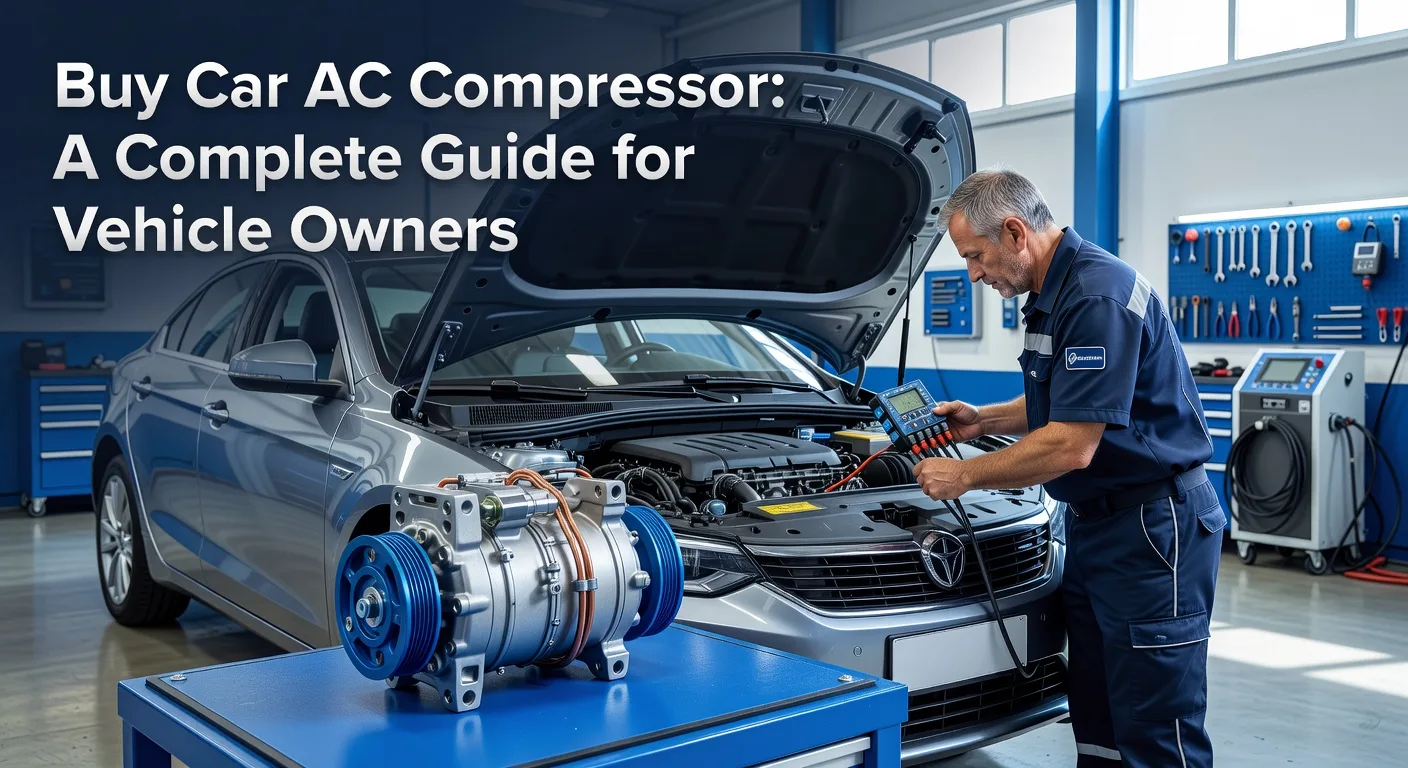
If you’ve ever driven through a Delhi summer or navigated Mumbai’s humidity in May, you know that a working AC isn’t a luxury—it’s survival. When that blast of cold air turns warm, or your compressor starts making noises that rival the local traffic, it’s time to consider a replacement. As someone who has spent years helping Indian car owners navigate spare parts markets, here is what you need to know before buying an AC compressor.
Understanding Your Car’s AC Compressor
The AC compressor is the heart of your vehicle’s cooling system. It is a mechanically driven pump—usually belt-driven from your engine—that pressurizes the refrigerant gas (typically R-134a in most Indian cars, though newer models use R-1234yf). By compressing this low-pressure gas into a high-pressure, high-temperature state, it forces the refrigerant through the condenser where it sheds heat. Without this pressurization, the refrigeration cycle cannot occur, and you’re left with nothing but hot air blowing through your vents. In Indian conditions where ambient temperatures regularly cross 45°C, this component works harder than almost any other part of your car.
Signs Your Compressor Needs Replacement
Before you spend money, confirm the compressor is actually the culprit. In India’s dusty, high-heat environment, watch for these specific symptoms:
- Inadequate Cooling: If your Maruti Swift or Hyundai Creta is blowing air that never gets cold, even after 15 minutes of driving, the compressor may be failing to pressurize the refrigerant properly.
- Metallic Noises: A grinding, rattling, or clicking sound from the engine bay—especially when you switch on the AC—often indicates internal bearing failure or broken piston rings inside the compressor.
- Refrigerant Leaks: Look for oily residue around the compressor shaft seal or hose connections. Given India’s monsoon humidity and dust, leaks can develop faster here than in temperate climates.
- Clutch Malfunctions: The electromagnetic clutch should engage with a distinct click when you turn on the AC. If it doesn’t engage, or if it smokes (sometimes visible in heavy traffic), the clutch coil or plate has failed. Sometimes you can replace just the clutch, but often the entire compressor assembly needs replacement.
Always get a proper diagnosis from a qualified technician using manifold gauges. Low refrigerant due to a leak elsewhere can mimic compressor failure.
What to Consider Before Buying
Buying a compressor in India requires navigating a market flooded with options ranging from cheap Chinese imports to genuine OEM parts.
Vehicle Compatibility is Critical: Indian market vehicles often have variations between model years that aren’t obvious. A compressor for a 2019 Honda City i-VTEC differs from the diesel variant or the 2020 facelift model. Always match using your Vehicle Identification Number (VIN) or RC book details—year, make, model, fuel type, and engine capacity.
OEM vs. Aftermarket vs. OES:
- OEM (Original Equipment Manufacturer) parts come in branded boxes (like Denso, Sanden, or Delphi) and are identical to what came from the factory. They are reliable but expensive (often ₹15,000–₹35,000 depending on the car).
- OES (Original Equipment Supplier) parts are made by the same manufacturers but sold under different branding. These offer the best balance of quality and price for Indian consumers.
- Aftermarket: While budget options exist (₹4,000–₹8,000), quality varies drastically. In India’s heat and dust, a substandard compressor will fail within months, potentially contaminating your entire AC system with metal debris.
Warranty and Build Quality: Given that AC compressors work hardest during Indian summers, insist on a minimum 12-month warranty. Check if the unit comes pre-filled with the correct grade of PAG oil—using the wrong viscosity is a common cause of premature failure in Indian conditions.
The Cost of Cutting Corners
It is tempting to buy the cheapest compressor available from a local auto parts market or an unverified online seller. However, a failing compressor can send metal shavings through your condenser, evaporator, and expansion valve. In Indian traffic, where you cannot afford to be without AC, this turns a ₹12,000 repair into a ₹40,000+ system overhaul. Genuine or high-quality OES parts ensure thermal efficiency and longevity, crucial when your AC runs eight months a year.
Common Mistakes Indian Buyers Make
- Ignoring the Receiver Drier/Accumulator: When replacing a compressor, you must also replace the receiver drier (or accumulator) and often the expansion valve. These components trap moisture and debris. Installing a new compressor into a system with an old, saturated drier is like putting new engine oil through a dirty filter—it guarantees early failure.
- Skipping the Flush: If your old compressor seized or disintegrated internally, the entire AC system must be flushed with solvent to remove metal particles. Many local garages skip this step to save time, ruining your new compressor within weeks.
- Mixing Oils: Different compressors require different PAG oil viscosities (46, 100, or 150). Using the wrong oil or mixing incompatible refrigerant oils causes immediate damage.
Maintenance Tips for Indian Conditions
To extend compressor life in our harsh climate:
- Run your AC weekly, even in winter, for at least 10 minutes to circulate lubricant and keep seals moist.
- Clean your condenser regularly—the front-mounted radiator gets clogged with dust, leaves, and dead insects from Indian highways, causing head pressure that kills compressors.
- Address weak cooling immediately. In India, low refrigerant often means the system is working overtime, overheating the compressor.
- Check drive belts: Loose or cracked belts slip in high humidity, causing clutch slippage.
The Digital Advantage: Finding Exact Fits
Navigating the compressor market used to mean visiting Kashmere Gate (Delhi) or Kurla (Mumbai) with part numbers scribbled on paper. Today, specialized online auto parts stores have simplified this. You can enter your registration number or select your exact variant—down to the specific month of manufacture—to ensure compatibility.
For vehicle owners looking for model-specific AC compressors, you can explore https://mechkartz.com, which offers a comprehensive range of AC compressor options for different Indian car brands and models, from Maruti Suzuki and Hyundai to Tata and Mahindra. These platforms typically provide detailed specifications, warranty information, and fitment verification tools that eliminate the guesswork common in physical markets.
Final Advice
Choosing the right compressor is only half the battle. Professional installation is non-negotiable. AC system work requires specialized equipment: refrigerant recovery machines (it is illegal to vent refrigerant into the atmosphere), vacuum pumps to remove moisture (critical in humid India), and precise charging by weight. A skilled technician will also check for leaks using UV dye or electronic detectors before charging the system.
Invest in a quality part, replace the associated components in the circuit, and insist on proper installation. In India’s unforgiving heat, a reliable AC compressor isn’t just about comfort—it’s about keeping your vehicle drivable.