
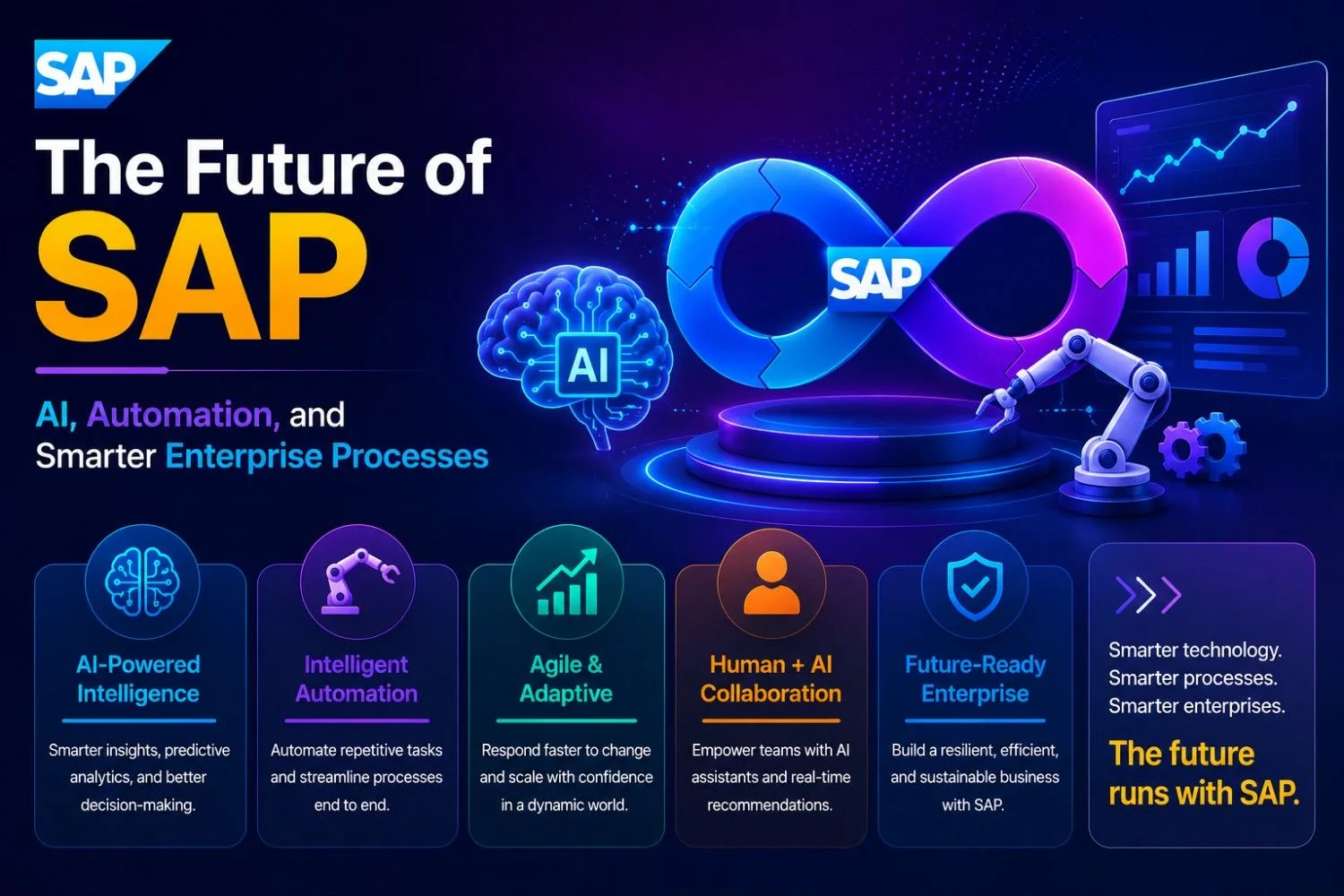
Business is changing faster than ever. Companies no longer want systems that only store data. They want technology that can think, predict, automate, and simplify daily work. This is exactly where SAP is transforming itself for the future.
Today, SAP is not just software for large companies. It is becoming a smart business partner. From GST calculations to real-time data processing, SAP is helping organizations make faster and better decisions without creating extra pressure on employees.
Why Businesses Are Looking Toward Smarter SAP Solutions
A few years ago, companies used SAP mainly for accounting, inventory, payroll, and reporting. The work was useful, but still heavily dependent on human effort. Employees had to enter data manually, correct mistakes, and prepare reports for hours.
Now the situation is changing completely. Artificial intelligence and automation are becoming part of SAP systems. Businesses can reduce repetitive tasks and focus more on growth. Even non-technical employees are finding SAP easier to use because modern systems are becoming more user-friendly.
This shift is also increasing demand for professionals who understand smart enterprise technology. Many students are now joining sap training programs because companies need people who can handle modern SAP environments confidently.
AI Is Making SAP More Intelligent
Artificial intelligence is no longer a futuristic idea. It is already working inside modern SAP systems. AI helps businesses analyze huge amounts of information within seconds. Earlier, managers waited days for reports. Today, SAP can generate insights instantly.
Imagine a retail company handling thousands of products daily. AI inside SAP can predict which products may sell faster during a festive season. It can also identify slow-moving inventory before losses happen.
This type of smart forecasting helps businesses save money and improve planning. Companies are now depending on intelligent systems instead of guesswork. That is why SAP is becoming more valuable across industries.
Even finance departments are benefiting. AI-powered SAP tools can detect unusual transactions, reduce accounting errors, and improve GST reporting accuracy. This creates smoother compliance and reduces penalties caused by human mistakes.
Automation Is Reducing Pressure on Employees
One major reason companies are investing in SAP is automation. Employees often spend hours doing repetitive work like invoice entry, payroll processing, order updates, and report preparation.
Modern SAP systems can automate these processes completely. Instead of checking every document manually, the system can process information automatically and send alerts only when something unusual appears.
This saves time and improves employee productivity. People can focus on creative and strategic work rather than repetitive tasks.
A manufacturing company, for example, can automate stock tracking through SAP. When raw materials become low, the system automatically creates purchase requests. This prevents production delays and improves efficiency.
Because automation is becoming essential, many learners are exploring sap course online options to understand how businesses are using these technologies in real situations.
SAP and GST Management Are Becoming Smarter
GST management is one of the biggest challenges for businesses in India. Companies handle thousands of invoices, tax calculations, vendor records, and compliance reports every month.
Traditional methods create confusion and increase the risk of mistakes. SAP simplifies this entire process through automation and centralized data processing.
Modern SAP systems can calculate GST automatically during billing. They also maintain proper tax records and generate reports required for compliance. Businesses can track input tax credit more efficiently and reduce manual work.
This becomes especially helpful for organizations operating across multiple states. SAP ensures consistent tax handling and reduces reporting complications.
Small businesses are also slowly adopting SAP because GST compliance is becoming more complex every year. Even people without technical backgrounds are trying to understand these systems through sap online course platforms.
Real-Time Data Processing Is Changing Decision-Making
In older systems, businesses often worked with outdated reports. By the time management received information, situations had already changed.
SAP is solving this problem with real-time data processing. Companies can now monitor sales, finance, inventory, customer behavior, and operations instantly.
Suppose a company notices sudden demand for a product in one city. SAP can immediately show stock availability, transportation details, and warehouse data. Managers can make quick decisions without waiting for manual updates.
This speed gives businesses a major competitive advantage. Companies that react faster often perform better in the market.
Real-time data also improves customer experience. Orders get processed faster, delivery tracking becomes smoother, and service quality improves naturally.
SAP Is Becoming Easier for Non-Technical Users
Earlier, many people believed SAP was only for IT professionals or large corporations. The interface looked complicated, and employees needed technical support regularly.
But SAP is evolving rapidly. Modern dashboards are simpler, cleaner, and more interactive. AI-based assistants help users find information quickly. Employees can perform tasks using voice commands and automated suggestions.
This makes learning easier for beginners. Even business owners without technical expertise are exploring SAP to improve operations.
As demand increases, institutes offering sap training in delhi are also updating their teaching methods. They now focus more on practical business scenarios instead of only technical theory.
A Small Business Story That Reflects the Future
A small textile company in Delhi struggled with inventory mistakes and delayed GST filing. Employees maintained records manually, and errors happened almost every month.
After implementing SAP, things slowly changed. Billing became automated. GST calculations became accurate. Inventory tracking improved dramatically.
The owner initially feared the system would be too technical for staff members. Surprisingly, employees adapted quickly because the software simplified their work rather than complicating it.
Within one year, the company reduced operational delays and improved customer satisfaction. The owner later admitted that adopting SAP was one of the smartest business decisions they had made.
Stories like this explain why SAP is no longer limited to multinational corporations.
Cloud Technology Is Expanding SAP’s Reach
Cloud technology is another major reason behind SAP’s future growth. Earlier, companies needed expensive infrastructure to run enterprise software.
Now businesses can use cloud-based SAP solutions without investing heavily in servers or hardware. This makes SAP affordable for startups and mid-sized companies as well.
Cloud systems also improve accessibility. Employees can work remotely and access data securely from different locations. This flexibility became extremely important after businesses started adopting hybrid work models.
Students and professionals are also using sap learning hub platforms to stay updated with cloud-based SAP technologies because industry requirements are changing rapidly.
Industries Where SAP Is Creating Big Changes
SAP is no longer limited to finance departments. It is transforming almost every industry today.
- Manufacturing companies use SAP for production planning and automation
- Retail businesses use it for customer insights and inventory control
- Healthcare organizations manage patient records and billing efficiently
- Logistics companies track shipments in real time
- Banking sectors improve financial reporting and fraud detection
This wide usage is creating strong career opportunities for professionals who understand enterprise processes properly.
Because of this demand, many learners now search for sap course delhi programs that focus on practical business applications instead of only classroom theory.
Human Skills Will Still Matter
Even though AI and automation are growing, human skills will always remain important. SAP systems can process data quickly, but human thinking is still necessary for leadership, strategy, creativity, and relationship management.
The future workplace will combine technology with human intelligence. Employees who understand both business operations and digital systems will have stronger career opportunities.
Companies do not want people who only know software. They want professionals who can solve business problems using technology effectively.
This is why many students prefer joining a sap course in delhi where they can understand practical business situations along with system knowledge.
Security and Data Protection Will Become More Important
As businesses become more digital, data security is becoming a serious concern. Companies handle sensitive customer information, financial reports, and operational records daily.
SAP is investing heavily in cybersecurity and advanced data protection systems. AI-based monitoring tools can identify suspicious activities before major damage happens.
Businesses are becoming more careful about data privacy because one small breach can damage reputation and customer trust permanently.
Future SAP systems will focus not only on automation but also on stronger protection against cyber threats.
Final Thoughts
The future of SAP is not only about software. It is about creating smarter businesses where work becomes faster, easier, and more accurate.
AI, automation, cloud computing, GST management, and real-time data processing are shaping a completely new business environment. Companies want systems that reduce pressure, improve decisions, and help employees work more efficiently.
SAP is moving in exactly that direction. From large enterprises to growing startups, businesses are realizing that smart processes are no longer optional. They are becoming necessary for survival and growth.
At the same time, learning SAP is also becoming more valuable for students and working professionals. As industries continue adopting intelligent systems, people with practical SAP knowledge will remain in demand for many years ahead.
The future belongs to businesses that can combine technology with smart thinking, and SAP is clearly becoming one of the strongest foundations behind that transformation.